The stunning portrayals of the Canadian landscape in the documentaries produced by the National Film Board of Canada, not only influenced cinematic language but shaped our perception of the environment. In the early days of the organization, nature films produced by the NFB supported the Canadian government's nation-building project and show the state as an active participant in the cultural construction of the land. By the mid-1960s however, films like Cree Hunters of Mistassini and Death of a Legend were asking provocative questions about the state's vision of nature. Filmmakers like Boyce Richardson and Bill Mason began to centre the experiences of First Nations people, contest the notion that nature should be transformed for economic gain, and challenge the idea that the North is a wild and empty landscape bereft of civilization. Author Michael Clemens describes how films produced by the NFB broadened the ecological imagination of Canadians over time and ultimately inspired an environmental movement.
eBook - ePub
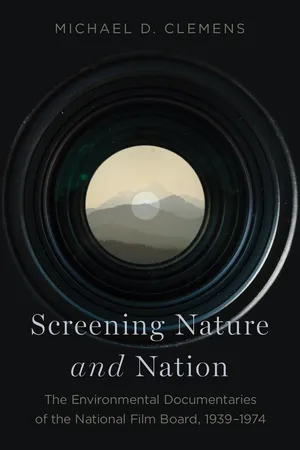
Screening Nature and Nation
The Environmental Documentaries of the National Film Board, 1939-1974
- 233 pages
- English
- ePUB (mobile friendly)
- Available on iOS & Android
eBook - ePub
Screening Nature and Nation
The Environmental Documentaries of the National Film Board, 1939-1974
About this book
Information
Subtopic
Film History & Criticism1 Filming like a State
Canadians must . . . cooperate with the government, for it is that which ensures there will be sufficient resources in the future.
—Water for Prairies
On 14 September 1943, a small committee from the National Film Board of Canada (NFB) gathered in downtown Ottawa to discuss an unusual request made by the Department of Agriculture (DOA). Earlier that year, the DOA had approached the NFB to make a series of documentaries about “the relationship of the soil to plant, animal, and human life.”1 The NFB was taken aback at first. It did not have a lot of experience making educational movies on the virtues of soil. Most of its productions up to that point were dramatic newsreels about the Second World War. Still, it was difficult to ignore such an invitation. The DOA was an important sponsor of the fledgling agency, and it had deep pockets.
The committee debated the merits of the DOA’s request in the waning light of that September afternoon. Eventually, the members resolved to establish an entire production unit devoted to investigating the “urgent phases of Canadian agriculture.”2 In a letter to Minister of Agriculture James Gardiner, the committee explained that this new division would produce “information films” on a variety of farming subjects, including “rural health and sanitation, care of livestock, weed eradication, animal and plant diseases, farm electrification, horticulture, and farm beautification.” Although the committee was confident that the DOA would accept the proposal, it was apprehensive that it might not pass muster with the NFB’s governing body, the Ministry of National War (MNW). To avoid a setback (and a squandered funding opportunity), the members shrewdly justified that the agricultural films would be “of great importance to the war effort and to post-war planning.”3 A week later, the MNW permitted the NFB to proceed with the film project. The Agricultural Production Unit (APU) immediately went to work producing a series of vignettes about Canadian agriculture.
The APU yelled its final “cut!” in 1949, but its influence on the NFB reverberated long after that. The unit’s popularity with viewers across Canada encouraged the NFB to produce and distribute more documentaries on the environment. In the ensuing years, the NFB made dozens of films about agriculture, wildlife conservation, natural resources, and geography. More importantly, the documentaries of the APU expressed the close bond between NFB filmmaking and government discourse about nature. The APU’s resolution to “promote a direct facing of the present and future problems of Canadian agriculture” was informed by the state’s desire to make films in the national interest.4 The country was at war, and invigorating a healthy agricultural sector was a priority for the Liberal government. The relationship between government discourses and NFB production priorities would continue through the 1940s and 1950s. Documentaries about the environment were typically made at the behest of state sponsors that wanted to promote their various policies and initiatives regarding the uses and limits of the natural world. This relationship confined NFB filmmakers to a certain vision of the world, although it did have its benefits. Government patronage kept the lights on and the cameras rolling.
In general, NFB films made between 1940 and 1955 reinforced the state’s utilitarian philosophy that nature should be used to strengthen and expand the economy. Films that instructed audiences on how to manage their farms and documentaries that promoted the benefits of a strong (and government-led) resource policy argued that the environment was a gift to be exploited vigorously but wisely.
The specific messages and aesthetic strategies of these works depended on the political and social contexts in which they were produced. During wartime, the NFB distributed a series of natural resource films that supported the government’s total mobilization agenda. The documentaries used dramatic voice-over narration and newsreel footage to communicate to viewers the importance of conserving timber, minerals, wheat, and other strategic materials. In the postwar period, NFB documentaries about the environment tended to support the aspirations of the nascent welfare state. Agricultural films, for instance, endorsed government initiatives to improve the social, economic, and environmental conditions of Canadians across the country. The documentaries invited farmers to incorporate modern agricultural techniques, electric technologies, and conservation strategies advocated by government experts. Doing so would improve the lives of farmers and make their land use more efficient. Such improvements would strengthen the economic well-being of the nation. As the Advisory Committee on Post-War Reconstruction explained in its final report, agricultural development was essential for “a balanced and prosperous economy.”5
NFB documentarians tackled a range of subjects in their films about the environment during this period. Despite their topical differences, the films collectively advanced a state way of seeing nature, in particular the ideology of high modernism. Filmmakers such as APU producer Evelyn Cherry praised the large-scale transformation of nature and the tidy arrangements of simplified resource landscapes. It was no fluke that depictions of a farmer tilling the land with his state-of-the-art tractor, a government officer calculating the circumference of a conifer, and wind passing through crops sprayed with pesticides were some of the most prominent features in NFB cinema during this period. The filmmakers accurately reflected the visions of their Canadian sponsors, who saw social and environmental spaces as things to be streamlined, managed, and exploited.
Wartime and Films about Natural Resources
The association between NFB production priorities and the government was forged from the beginning. Acting on the recommendations of Scottish documentarian John Grierson, the federal government established the NFB to function as an information service to “help Canadians everywhere understand the problems and way of life of Canadians in other parts of the country.”6 Under Grierson, the NFB operated as the voice of the government, teaching, encouraging, and persuading Canadians to comply with its wishes. Documentary filmmaking was a “hammer” that “mold[ed] and pattern[ed] men’s actions,” explained the film commissioner in an interview during his tenure.7
Government influence on NFB filmmaking was the most salient during the Second World War. In 1940, the infant organization was recruited by the MNW to support the war effort. The NFB’s commitment to Prime Minister Mackenzie King’s total mobilization strategy was further entrenched in October 1941 when an order-in-council designated the minister of national war services as the overseer of the NFB. Over the next five years, the NFB dutifully churned out propaganda films and newsreels series, such as Canada Carries On and World in Action, each work commanding members of the public to do their part in helping the Allies win the war. Nonmilitary documentaries about food, health, and labour were also drafted into service for their country. Domestic life—how a person cooked, farmed, or saved money—was linked to the overall war effort. To support the individuals fighting overseas, it was vital that all Canadians be mindful about how they lived.8
Stylistically, NFB wartime films, in the words of one critic, were “direct to the point of vulgarity.”9 Grierson did not argue the point. In fact, he liked to brag to his colleagues back in England that NFB documentaries were not encumbered by the indignant moralism or rank patriotism that characterized UK movies.10 NFB films were straightforward, stripped of any cinematic splendour.11 And that was the point. The films might have been “vulgar,” but their simplicity made them perfect vehicles for conveying government ideas and values. NFB films spoke clearly and definitively for the state, telling Canadians what they “needed to know” and how to “do their best by Canada and themselves.”12
John Grierson’s belief that the NFB should broadcast government values shaped how it represented the environment. In wartime documentaries, nature was depicted primarily as an asset to be expropriated and used against the enemy.13 Coal Face Canada (1944) is a perfect example of how the NFB linked the exploitation of the country’s natural resources to the success of the war effort.14 In the film, director Robert Edmonds shows the importance of coal (and the combustible energy it provides) through the eyes of Bruce Adams, an army veteran who has returned home after being honourably discharged from military service. Like his father before him, Adams finds work in a coal mine. “Once a miner, always a miner,” he says glumly as he chips away in a dark tunnel.15 At first, Adams is unhappy with the work. The subterranean environment is stifling, and mining seems to be trivial compared with soldiering on the European battlefield. Over the course of the documentary, however, Adams learns to appreciate the strategic importance of his vocation. Although coal mining is not glamorous, it is nonetheless essential to the military success of the Allies. Adams and others harvest resources used to develop important weapons, such as highly explosive bombs and medical supplies. In this sense, coal miners were presented as indispensable “combatants.”
Coal Face Canada’s description of the environment as a resource vital to the needs of the nation (domestically and abroad) is typical of NFB films during this period.16 The Strategy of Metals (1941) and Battle for Oil (1942) similarly demonstrate how the exploitation of raw materials helps Canada fight overseas. In Food—Weapons of Conquest (1941), narrator Lorne Greene bellows that the western prairies are a vast resource that meets the “real food needs of fellow men.”17 Grain nourishes both the Canadian military and its allies, many of whom are experiencing food shortages. Hands for the Harvest (1943), a documentary produced for the APU, similarly contends that agrarian resources are crucial to winning the war. The film describes how farmers “of all ages persevere” during wartime. Despite wartime austerity measures, they plow their fields and harvest their crops without complaint because they know that the fruits of their labour will provide Canadian forces with the “energy” to keep fighting.18
Although the NFB supported the exploitation of the environment as part of the government’s total war strategy, it also recognized that valuable commodities were finite. Indeed, conservation was a central theme in wartime documentaries about resource extraction. Echoing the government’s new liberal mandate to actively manage social and environmental spaces, the NFB argued that state-led conservation tactics were essential to maintain a healthy surplus of the country’s timber, ore, wildlife, and grain. Conservation films produced during the Second World War typically followed a specific narrative formula. At the start of the documentary, the narrator addresses a problem (a resource shortage). Then the film briefly describes the origin of the issue (either human mismanagement or natural catastrophe). Finally, it concludes with a solution (government intervention, conservation measures, and the application of scientific principles).
Timber Front (1940), one of the first conservation documentaries produced by the NFB, exemplifies this approach. Sponsored by the Lands, Parks and Forests Branch, the film explains that timber resources were “vital” in the “struggle against the enemy” and that managing this commodity was “critical to the war effort.”19 The film beseeches lumber companies to protect the country’s forests by adhering to state conservation measures.
Timber Front begins with a folksy chronicle of logging in Canada. “So into the woods plunged the logger, the real North American pioneer, with a capacity for hard work . . . unsurpassed in history,” the narrator remarks as men in woolen plaid shirts march across the screen. Logging was not a job for the faint of heart, but it was honest work. With their axes, these brave men “helped build a nation.” But the days of the solitary bark skin are long gone, reports the narrator. New technologies and large-scale operations transformed the logging industry in substantial ways. Timber extraction in the middle of the twentieth century was easier and far more efficient than it had been in the nineteenth century. Loggers could clear massive strips of land in an astonishingly short period of time. In the past, the comparatively slower pace of timber extraction meant that the forest could still protect itself from harm. Young saplings were allowed to grow, and certain species were left alone. In this new era of logging, however, forests were cleared en masse. As a result, adjacent forests were more vulnerable to disease, fire, and abuse. By the 1940s, timber resources were rapidly disappearing. Although Canadians were the “owners of 800 million acres of forest land (one-third of the country’s geography),” that number was rapidly declining, the film states ominously.20
Technology made it easier to cut down trees, but the real culprit behind the depletion of forestry resources was the individual operating the machinery. Timber Front declares that human negligence was ultimately to blame for Canada’s exhausted timber stands. In a greedy attempt to maximize their yields, industrial logging operations “stripped” Canada’s “virgin forests bare.” The gendered language was intentional no doubt. Not only did it mirror the wartime propaganda of the government, but also it highlighted the so-called purity and vulnerability of feminine nature. This was rape on a national scale. On cue, the camera cuts to a hellish landscape of gnarled stumps and mud. The ravished countryside is reminiscent of the bombed-out front line in Central Europe. Timber men have left “a trail of scars—deserted mills, and houses, wasted logs, and stumps.” In the wake of this “slash and . . . waste,” devastating forest fires can erupt, destroying the remaining trees. “Over 46 million dollars are lost” in Porcupine, Ontario, alone, the narrator laments.21
The tone of Timber Front is melodramatic (and thus tonally consistent with most wartime pictures), but it accurately documents the problem of deforestation in early twentieth-century Canada. Advanced machinery, increased manpower, and a cut and get-out mentality in the forestry industry ravaged the country’s woodlands. The situation was serious enough in the 1920s that provincial governments across the country introduced new restrictions on logging activities. Despite nationwide attempts to regulate the resource extraction, loggers continued to mow down Canadian forests at an alarming rate. Anxiety about the health of the country’s timber resources peaked in the 1930s. The federal government tried to step in, but timber companies continued to chop down everything in sight.22 Legislators were helpless in stopping big companies from taking what they wanted. A series of devastating forest fires in the late 1930s did not help the already grim situation. According to a report by the Lands, Parks and Forests Branch published in 1939, tree loss was “considerabl...
Table of contents
- Cover
- Title Page
- Copyright Page
- Contents
- Acknowledgements
- Introduction
- 1 Filming like a State
- 2 Visions of the North
- 3 Cry of the Wild
- 4 Challenge for Change
- Conclusion
- Notes
- Selected Bibliography
- Index
Trusted by 375,005 students
Access to over 1.5 million titles for a fair monthly price.
Study more efficiently using our study tools.
Frequently asked questions
Yes, you can cancel anytime from the Subscription tab in your account settings on the Perlego website. Your subscription will stay active until the end of your current billing period. Learn how to cancel your subscription
No, books cannot be downloaded as external files, such as PDFs, for use outside of Perlego. However, you can download books within the Perlego app for offline reading on mobile or tablet. Learn how to download books offline
Perlego offers two plans: Essential and Complete
- Essential is ideal for learners and professionals who enjoy exploring a wide range of subjects. Access the Essential Library with 800,000+ trusted titles and best-sellers across business, personal growth, and the humanities. Includes unlimited reading time and Standard Read Aloud voice.
- Complete: Perfect for advanced learners and researchers needing full, unrestricted access. Unlock 1.5M+ books across hundreds of subjects, including academic and specialized titles. The Complete Plan also includes advanced features like Premium Read Aloud and Research Assistant.
We are an online textbook subscription service, where you can get access to an entire online library for less than the price of a single book per month. With over 1.5 million books across 990+ topics, we’ve got you covered! Learn about our mission
Look out for the read-aloud symbol on your next book to see if you can listen to it. The read-aloud tool reads text aloud for you, highlighting the text as it is being read. You can pause it, speed it up and slow it down. Learn more about Read Aloud
Yes! You can use the Perlego app on both iOS and Android devices to read anytime, anywhere — even offline. Perfect for commutes or when you’re on the go.
Please note we cannot support devices running on iOS 13 and Android 7 or earlier. Learn more about using the app
Please note we cannot support devices running on iOS 13 and Android 7 or earlier. Learn more about using the app
Yes, you can access Screening Nature and Nation by Michael D.Clemens in PDF and/or ePUB format, as well as other popular books in Media & Performing Arts & Film History & Criticism. We have over 1.5 million books available in our catalogue for you to explore.