- 368 pages
- English
- ePUB (mobile friendly)
- Available on iOS & Android
eBook - ePub
About this book
This fascinating study of mathematical thinking among sub-Saharan African peoples covers counting in words and in gestures; measuring time, distance, weight, and other quantities; manipulating money and keeping accounts; number systems; patterns in music, poetry, art, and architecture; and number magic and taboos. African games such as mankala and elaborate versions of tic-tac-toe show how complex this thinking can be. An invaluable resource for students, teachers, and others interested in African cultures and multiculturalism, this third edition is updated with an introduction covering two decades of new research in the ethnomathematics of Africa.
Information
SECTION 1
THE BACKGROUND
Was there mathematics in Africa? On the basis of the references to Africa in books about the history of mathematics and the history of number, one would conclude that Africans barely knew how to count. In the opening section we shall summarize the content of this book as contrasted with the treatment of African numeration by American and European authors. A brief history of Africa, home of man’s most remote ancestors, includes an account of ancient Egyptian mathematics as well as a look at several centuries-old African societies.
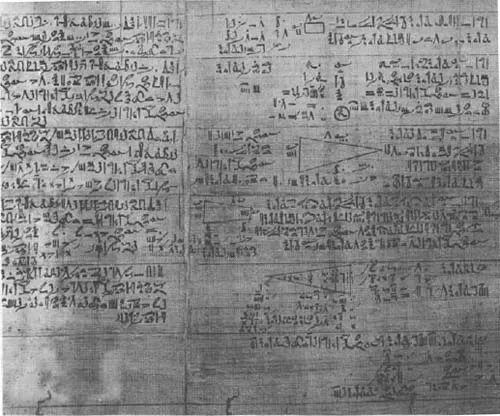
Figure 1-1 Extract from the Rhind papyrus, written by the Egyptian scribe Ahmes about 1650 B.C. This document and the Moscow papyrus are our chief sources of knowledge of ancient Egyptian mathematics. This text contains 85 problems of a practical nature. British Museum.
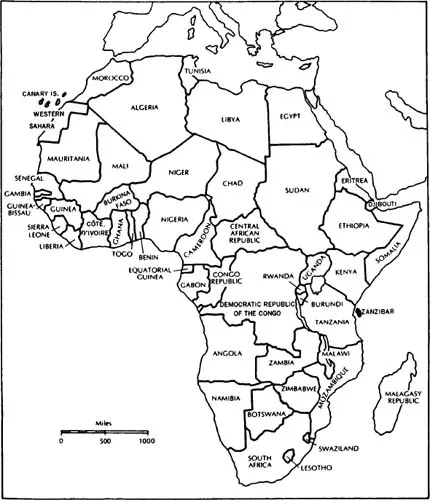
Figure 1-2 Africa Today
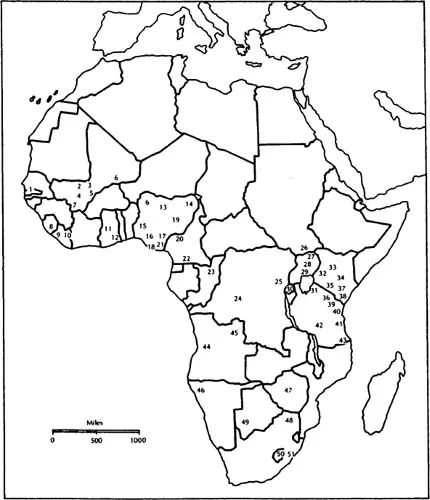
Figure 1-3 Peoples Discussed in the Text.
Peoples referred to in the text.
11. Akan (includes Asante)
36. Arusha Maasai
11. Asante (see Akan)
1. Balante
4. Cambara
16. Bini(Edo)
49 Bushmen (San)
24. Bushongo (Shongo, Kuba)
39. Chagga
5. Dogon
16. Edo(Bini)
21. Efik
20. Ekoi
12. Ewe
6. Fulani
28. Ganda
13. Hausa
42. Hehe
46. Herero
29. Hima (Nkole)
26. Huku
17. Igbo
18. Ijo
45. jokwe
33. Kalenjin (includes Kipsigis and Nandi)
37. Kamba
14. Kanuri
27. Karimojong
34. Kikuyu
33. Kipsigis (see Kalenjin)
10. Kpelle
24. Kuba (Shongo, Bushongo)
23. Kwele
32. Luo
35. Maasai
43. Makonde
7. Malinke (Mandingo)
44. Mbundu
25. Mbuti (Pygmy)
8. Mende
33. Nandi (see Kalenjin)
29. Nkole(Hima)
25. Pygmy (Mbuti)
30. Rwandese (includes Tutsi, Hutu, and Twa)
49. San (Bushmen)
40. Shambaa
47. Shona
24. Shongo (Bushongo, Kuba)
3. Songhai
2. Soninke
50. Sotho
41. Swahili
38. Taita
19. Tiv
30. Tutsi (included in Rwandese)
9. Vai
48. Venda
22. Yaounde (Beti)
15. Yoruba
31. Ziba
51. Zulu
CHAPTER 2
HISTORICAL BACKGROUND
Africa in the Prehistoric World
Man apparently first emerged on the African continent. The scientific world was astounded when Drs. Mary and Louis Leakey announced the discovery in 1959 of the remains of Homo habilis, a tool-making hominid estimated by the potassium-argon dating technique to be 1,750,000years old. The scene of the discovery, Olduvai Gorge in northern Tanzania, has since yielded much information about the development of man.
Later, two human skulls and stone tools were excavated in Kenya, east of Lake Rudolf; their age is estimated to be 2.6 million years. In February, 1971 came the announcement that a human type of jawbone from the same area was five and a half million years old! No part of the world has proved as fertile a field for the discovery of skeletal remains and stone tools. The most impressive to date is the finding at Fort Ternan, Kenya, of a man-like creature and animals estimated to be fourteen million years of age.
A spectacular discovery, reported early in 1970, was that of an ancient mine in an iron-ore mountain in Swaziland, in southeast Africa. Stone age mining tools were foun...
Table of contents
- Cover
- Title Page
- Dedication01
- Copyright
- Dedication02
- Contents
- Foreword to the 1999 Edition
- Foreword to the 1973 Edition
- Preface to the 1973 Edition
- Section 1 The Background
- Section 2 Numbers—Words, Gestures, Significance
- Section 3 Numbers in Daily Life
- Section 4 Mathematical Recreations
- Section 5 Pattern and Shape
- Section 6 Regional Study: Southwest Nigeria
- Section 7 Regional Study: East Africa
- Section 8 Past and Future
- Appendix
- Index
- Maps Africa Today
- Africa: Geographic Features and Ancient Cities
- Distribution of Numeration Systems in Africa
- Sixteenth-Century States of the Nigerian Region
- Eastern Africa: Countries and Peoples
Trusted by 375,005 students
Access to over 1.5 million titles for a fair monthly price.
Study more efficiently using our study tools.
Frequently asked questions
Yes, you can cancel anytime from the Subscription tab in your account settings on the Perlego website. Your subscription will stay active until the end of your current billing period. Learn how to cancel your subscription
No, books cannot be downloaded as external files, such as PDFs, for use outside of Perlego. However, you can download books within the Perlego app for offline reading on mobile or tablet. Learn how to download books offline
Perlego offers two plans: Essential and Complete
- Essential is ideal for learners and professionals who enjoy exploring a wide range of subjects. Access the Essential Library with 800,000+ trusted titles and best-sellers across business, personal growth, and the humanities. Includes unlimited reading time and Standard Read Aloud voice.
- Complete: Perfect for advanced learners and researchers needing full, unrestricted access. Unlock 1.5M+ books across hundreds of subjects, including academic and specialized titles. The Complete Plan also includes advanced features like Premium Read Aloud and Research Assistant.
We are an online textbook subscription service, where you can get access to an entire online library for less than the price of a single book per month. With over 1.5 million books across 990+ topics, we’ve got you covered! Learn about our mission
Look out for the read-aloud symbol on your next book to see if you can listen to it. The read-aloud tool reads text aloud for you, highlighting the text as it is being read. You can pause it, speed it up and slow it down. Learn more about Read Aloud
Yes! You can use the Perlego app on both iOS and Android devices to read anytime, anywhere — even offline. Perfect for commutes or when you’re on the go.
Please note we cannot support devices running on iOS 13 and Android 7 or earlier. Learn more about using the app
Please note we cannot support devices running on iOS 13 and Android 7 or earlier. Learn more about using the app
Yes, you can access Africa Counts by Claudia Zaslavsky in PDF and/or ePUB format, as well as other popular books in Social Sciences & Cultural & Social Anthropology. We have over 1.5 million books available in our catalogue for you to explore.