Fundamentals of Aircrew Performance
This book takes the latest developments in psychology (learning, stress management, coaching, personality, etc.), neuroscience (cognition, memory, data-processing, etc.), and linguistics (cognitive behavioral therapy (CBT), neuro-linguistic programing (NLP), etc.) and shows how they can be applied in a practical way to improve the performance of aircrew. It complements the skills training and aviation medicine training currently undertaken by aircrew to allow them to perform at their best in the high-stress, data-rich environments of modern aircraft.
'Airmanship' is a much-overused word in the aviation world: Part 1 of this book will allow the reader to have a much clearer idea of what it is, together with concrete and practical ways to improve 'cognitive airmanship'. Each chapter includes sections to aid in the assessment and instruction of these skills.
Part 2 of the book covers Aircrew Performance Coaching, detailing how executive coaching techniques can be combined with sports psychology to provide a unique and proven system applicable to aircrew.
- 170 pages
- English
- ePUB (mobile friendly)
- Available on iOS & Android
eBook - ePub
Fundamentals of Aircrew Performance
About this book
Trusted by 375,005 students
Access to over 1.5 million titles for a fair monthly price.
Study more efficiently using our study tools.
Information
Subtopic
AviationPart 1
Cognitive Airmanship
Chapter 1
Introduction to Airmanship
At a fundamental level Airmanship is related to and underpins aircrew performance. High levels of Airmanship are required for high levels of performance. Consequently, a comprehensive understanding of all aspects of Airmanship is required if aircrew performance is to be improved. Airmanship is that element of flying, from the planning stage to debrief, that deals with effective application of knowledge and skill, both mental and physical, in the operation of the aircraft. Although some elements of Airmanship are assimilated through experience most can be taught and assessed. Those that are gained through experience require structured ‘post flight’ analysis through debriefing to be effective. Fundamental to good Airmanship is the ability to think clearly, which requires mental capacity. An adult’s mental capacity cannot be increased therefore it is vital to ensure that an individual maximises this capacity through effective utilisation of each separate skill within airmanship. Failure to do so may lead to inadequate spare capacity remaining to learn new skills or perform additional tasks. Due to its multi-faceted characteristics Airmanship can best be defined as ‘The Art of Operating the Aircraft’ which means that some areas of Airmanship are more relevant to some aircraft and/or roles than to others.
‘The Art of Operating the Aircraft’ as an overarching definition is adequate but does not give any detail as to the specific areas that go to make up Airmanship. Studies have shown that Airmanship is predominately a cognitive skill associated with behaviour best modelled on a ‘Decision-Action’ loop. The most famous ‘Decision-Action’ loop is the OODA loop – Observe, Orientate, Decide, then Act - which was created by Col John Boyd, USAF to help teach and understand Air Combat Training (ACT) in the 1960s. The underlying performance premise being that whichever pilot ‘actioned’ their OODA loop fastest would dominate the fight and eventually win. This was expanded by the Royal Air Force to the RAPDAR loop – Recognise, Analyse, Prioritise, Decide, Act then Review – to better describe the behaviour associated with Airmanship. To Clarify:
a. RECOGNISE significant factors or events
b. ANALYSE likely effects of the recognised events or factors and project possible action.
c. PRIORITISE multiple events, factors or analyses
d. DECIDE on most appropriate action
e. ACT on the decision
f. REVIEW/REPEAT process
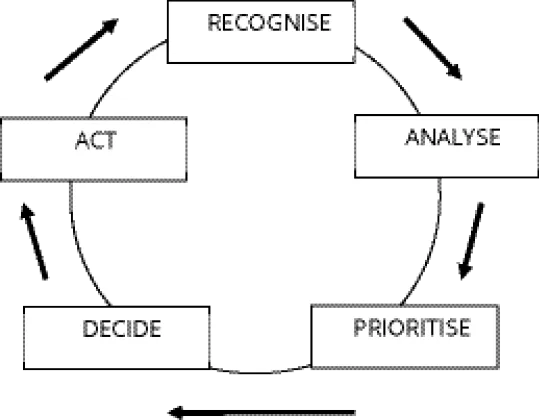
Fig 1.1 RAPDAR Loop
The Review phase is critical as it allows for data and analysis validation and caters for a changing and dynamic situation. If the Review is not carried out there is no chance to correct errors made in analysis or accommodate and process new data. The Review also allows one to check if the action has had the required effect and take account of any time limits. A good example of the impact of neglecting the Review is the infamous incident of the Airbus 330 which had to divert and land ‘engines out’ in the Azores. The flight deck crew analysed an indicated fuel imbalance as a difference in fuel burn between engines and, as dictated by the aircraft emergency check-list, opened the fuel cross-feed to correct this. No review was carried out and the true cause of the fuel imbalance – a massive fuel leak – was not diagnosed until a low fuel problem became evident. By this time the impact of the incorrect diagnoses and subsequent actions meant that the aircraft engines would flame-out before a landing could be accomplished. Luckily, due to the exceptional skill of the pilots, a safe glide landing was carried out with minimal damage to the aircraft and no injuries to the passengers.
Once the ‘Decision-Action’ format was established specific areas could be identified that make up Airmanship. These are:
a. Situational Awareness
b. Mental Performance
c. Decision Making
d. Communication
e. Resource Management
f. Spare Mental Capacity
Although ‘Situational Awareness’, ‘Mental Performance’ and ‘Decision Making’ are given separate headings there is significant overlap between them. All areas can be taught and assessed and are dealt with in detail in later chapters.
Chapter 2
Basic Psychology Underpinning Aircrew Performance
Basic Psychology
Introduction
In broad terms Psychology deals with the ‘Why, What & How’ of human behaviour. As performance is another way of describing behaviour a basic understanding of some fundamental psychological principles is required when dealing with aircrew performance and airmanship. The scope is wide, but the level of understanding is basic and for this the simple...
Table of contents
- Foreword
- Preface
- Part 1
- Part 2
- Bibliography
Frequently asked questions
Yes, you can cancel anytime from the Subscription tab in your account settings on the Perlego website. Your subscription will stay active until the end of your current billing period. Learn how to cancel your subscription
No, books cannot be downloaded as external files, such as PDFs, for use outside of Perlego. However, you can download books within the Perlego app for offline reading on mobile or tablet. Learn how to download books offline
Perlego offers two plans: Essential and Complete
- Essential is ideal for learners and professionals who enjoy exploring a wide range of subjects. Access the Essential Library with 800,000+ trusted titles and best-sellers across business, personal growth, and the humanities. Includes unlimited reading time and Standard Read Aloud voice.
- Complete: Perfect for advanced learners and researchers needing full, unrestricted access. Unlock 1.5M+ books across hundreds of subjects, including academic and specialized titles. The Complete Plan also includes advanced features like Premium Read Aloud and Research Assistant.
We are an online textbook subscription service, where you can get access to an entire online library for less than the price of a single book per month. With over 1.5 million books across 990+ topics, we’ve got you covered! Learn about our mission
Look out for the read-aloud symbol on your next book to see if you can listen to it. The read-aloud tool reads text aloud for you, highlighting the text as it is being read. You can pause it, speed it up and slow it down. Learn more about Read Aloud
Yes! You can use the Perlego app on both iOS and Android devices to read anytime, anywhere — even offline. Perfect for commutes or when you’re on the go.
Please note we cannot support devices running on iOS 13 and Android 7 or earlier. Learn more about using the app
Please note we cannot support devices running on iOS 13 and Android 7 or earlier. Learn more about using the app
Yes, you can access Fundamentals of Aircrew Performance by Adrian Rycroft in PDF and/or ePUB format, as well as other popular books in Technology & Engineering & Aviation. We have over 1.5 million books available in our catalogue for you to explore.