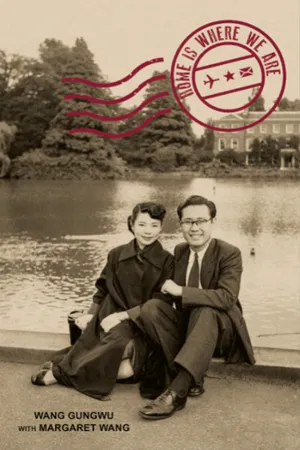
Does home have to be a country or a city?... Or is home this house or that? We have been fortunate.... We seemed always to have been home.
Wang Gungwu's account of his university education in Singapore and the UK, and the early years of his career as an academic in Malaysia captures the excitement, the ambition, and the choices of a generation that saw it their responsibility to build the new nations of Southeast Asia.
The exploration of the emotional and intellectual journey towards the formation of an identity, treasured by readers of Wang's Home Is Not Here, extends in this volume into an appreciation of love, family life, and the life of the mind. We also see these years from Margaret's perspective, her own fascinating family story, and her early impressions of this young bearded poet. Wise and moving, this is a fascinating reflection on identity and belonging, and on the ability of the individual to find a place amidst the historical currents that have shaped Asia.
- English
- ePUB (mobile friendly)
- Available on iOS & Android
eBook - ePub
Home Is Where We Are
About this book
PART ONE
Fitting In
Soft Landing
ON THE EVE of my 19th birthday, I acquired two new identities. I was a post-colonial undergraduate and a citizen of the Federation of Malaya. I was no longer a foreign Chinese in the eyes of the government and now had the opportunity to go on to learn in a university. In both identities, Malaya loomed large. And I spent the next twenty years of my life wondering how I could make Malaya my country.
I was lucky to have such a soft landing. My father made that possible because he was determined that his only child would not miss out on higher education simply because he had called me back from Nanjing. He could not afford to send me overseas again. When he learnt that MU was being planned, he saw that getting me admitted was the only way I could continue my studies. Fortunately, something he did in the years 1945–47 made that possible. This was when he postponed the family’s return to China after the war ended so that I could finish my secondary education. That way, I would not have to start afresh in a high school in China to qualify to sit for a university entrance examination. He had therefore waited until my Cambridge School Certificate results were announced before we left Malaya.
Little did he know what a good decision that was. When we unexpectedly came back, the delay till the middle of 1947 to go to China helped me in two ways. The certificate I had received made me eligible to apply for admission to the new university in Singapore, and the extra two years staying on in Malaya also qualified me to seek Federal citizenship under the new constitution. Given that the anti-British war known as the “Emergency” was underway, my status as a Chinese national who was not local born, someone stateless, could have jeopardized my chances of being admitted. By that time, my father had become open to the idea that Malaya was where we could settle down. My parents never admitted it but I believe they anticipated the political fallout among local Chinese who supported the Republic of China (ROC in Taiwan) against those excited by the New China in Beijing and did not want me to be drawn to one side or the other. I also began to sense that they now thought that living in Malaya was better than anywhere else in the region.
The University of Malaya’s primary mission was to train locals to assist British officials in the work of administering their colonies and protectorates. This British-type university set out to transmit ideas and institutions that could help develop the future nation, ideally one that would have goodwill towards British interests. Young Malayans would be selected to take over when the colonial officers eventually left. This was an imperial cause that planned ahead for the end of Empire and its replacement by a new Commonwealth. To accomplish this task, graduates of Britain’s best universities were encouraged to go forth to teach in Malaya. It was understood that everything would be done to make MU’s degrees recognized and its graduates useful.
***
The University was formally inaugurated on 8 October 1949. Malcolm MacDonald, the Commissioner General for Southeast Asia, conducted the opening ceremony. Present were Malay monarchs or their representatives as well as political leaders from all parts of the Federation of Malaya and the Colony of Singapore. That campus was renamed University of Singapore in 1962 and then National University of Singapore in 1980. In 1999, when it celebrated the 50th anniversary of its foundation, I described the university as having had a head start preparing for a post-colonial world. At the time, events in Malaya were pointing to some testing years ahead. We were alerted to ready ourselves for major transformations in the region. I suggested that, at the Foundation Ceremony, there was already an air of expectation that this was an institution that would play an important role in the building of a new nation.
The students were new to the idea that Southeast Asia was a region. They were the products of colonial education. The textbooks we used were more or less the same across all the schools in the British Empire and Commonwealth. All students matriculated with certificates provided by the Cambridge Examination Board. As preparation for a future Commonwealth centred in London, the system was skillfully designed, and did the job well. But, as a result of that standardization, most of us arrived at the new university knowing little about Malaya and the countries in the neighbourhood. I was even worse off than most because only half of my education was at a school that looked to England, with the other half being done at a home that focused on the ideal world of ancient China. In addition, my school education was truncated by the Japanese occupation.
Our British teachers hardly knew any more about Malaya. There were a few exceptions among those who had taught in Raffles College before the war and survived three and a half years in Japanese prisons. Not surprisingly, geographers like E.H.G. Dobby led the way. He produced the first geography textbook on the region, which highlighted the strategic importance of Southeast Asia to Britain. Also, there were some in the Economics Department who concentrated on aspects of the Malayan economy, seen as vital to Britain’s post-war recovery. T.H. Silcock, in particular, took us through the most recent studies concerning Malaya’s tin and rubber industry. In the field of history, Brian Harrison produced the first book on the history of Southeast Asia although it was quickly supplanted by a more comprehensive work by D.G.E. Hall, the former professor of history at Rangoon University.
Most staff and students admitted that they were not sure how the Malayan nation would develop. The idea of “nation” in the West was normally based on the idea of a people having the same language and religion and sharing the same history for a long while. This clearly did not describe the several varieties of polities that were federated in 1948. When I met my new friends coming from all parts of the country, I soon realized that I was one of the least equipped to be Malayan. I knew the parts of Perak I had gone to with my father when he visited in his capacity as inspector of Chinese schools. Some of my school friends had told me about Penang and Kuala Lumpur. More recently, I had read news of the Emergency in parts of the peninsula, the conflict between British troops and the Malayan National Liberation Army led by the Malayan Communist Party (MCP). About Singapore, I knew even less. I had passed through the port on the two trips I made to China but could only remember its railway station.
I was not alone in not knowing enough, but few realized that I had to start almost from scratch to find out what the new country was to be about. In comparison, the local-born from long-settled families were much better informed. Many had visited relatives in different parts of the country or had fathers in business or in government service who had transferred from place to place in their careers. There were also those whose families were forced to move around to escape Japanese mistreatment during the war as well. I also found out that, among the older students, a few had been abroad during the war and observed Malaya from outside. It was fascinating to hear a couple of Malay students tell us about how the Japanese had sent them to Japan for training, and also to meet others from “British India” who had sided with the Indian National Army and seen action in Burma.
My fellow students were a mixed bunch who had very different views of what a future Malaya would be like. I had paid little attention when I lived in Ipoh to local political developments because I was always getting ready to leave for China. Now that I was seeking to be part of a new country, I was keen to find out how I might belong here. I listened to those who described our situation as being part of a larger anti-imperialist movement seeking to transform our world into one of independent nation states. In order to gain a place in that world, we had to prepare for the day when the British withdrew totally. The Emergency was being fought largely in the jungles on the peninsula and was targeted at defeating, not communists (for hardly anyone knew what that really meant), and certainly not nationalists fighting only to free Malaya, but armed men who were called “terrorists” and “bandits”. My friends were broadly divided between those who were afraid that the British did not want to leave and would try to stay as long as they could, and those who were fearful of what would happen if the British were to leave without defeating the MCP.
I was conscious that something called decolonization was taking place elsewhere. Burma and Ceylon, like India, had achieved independence. The Philippines had been given theirs. A new people called Indonesians—whose armies like those of the Burmese had been trained by the Japanese—were winning the war to throw out the Dutch. As for the Vietnamese, their cruel fate was to be caught in the larger conflict between Soviet (and Chinese) communism and American capitalism. Located on the frontier between ideologies, theirs was no longer a legitimate war to gain their country’s freedom. Instead, it was becoming something much bigger between superpowers, ultimately leading to the hottest war in Asia since 1945.
What then about Malaya? Were the MCP forces really the nationalists who wanted independence for Malaya that they claimed to be? If so, was it necessary to use violent means to achieve that goal if there were non-violent paths towards a peaceful transfer of power? Were the British troops coming in to fight the Emergency or to delay giving the country independence as long as possible? Asking these questions was interesting even though many believed that as long as the MCP was around it would be a mistake to hurry the British along.
I was ignorant about the wide range of interests that were involved in the ongoing struggle. Before I left for China in 1947, I had noted the labour unrest in Ipoh when the British returned after the war. There had been street demonstrations and many arrests. I was curious but decided all that had nothing to do with me because I was going somewhere else. I recalled how the Malayan Union was received with outright opposition among the Malays and considerable scepticism among others who were suspicious of British motives. But as I was waiting to leave for Nanjing, I had not followed what was happening. Now that I was a citizen of the Federation, with the Emergency in full force and strict controls on what we could say and who we associated with, it was time to get my bearings right.
A Mixed Start
I ARRIVED AT the University of Malaya one day before my 19th birthday. Some of my school classmates at the time I left for China had been admitted to the two colleges that had now been merged to become the university. Thus, when I arrived in Singapore, they were my seniors. I was joining schoolmates of a later cohort and meeting other new friends. It seemed strange to have the university for Malaya established in the British colony of Singapore. I was assured that there were at least two good reasons for that: turning the established colleges into the university saved time and money; and in any case, everyone expected Singapore to become a constituent state of the Federation before too long.
The university was very small. The liberal arts faculties admitted 100 students that year, 40 for science (because of the limited laboratory space) and 60 for arts. It could be called a university because it had a medical school. Of the 60 freshmen in arts, I recall that over 40 came from the states of Malaya while the rest were from Singapore (out of a population, including Singapore, of six million). Those of us from the Federation stayed on campus or nearby, with the men in several dormitories and the women stayed in a hostel at Mount Rosie. Only a few Singapore scholarship holders were resident. As a result, the “hostelites” did not really know most of the Singapore students.
I was happy to learn that my fellow students came from different parts of the new country. Learning about where they came from was delightfully instructive. Outside the classroom, in the hostels and sports fields, at our society meetings, over meals and late-night sessions, I asked everyone where they came from. I had never been anywhere apart from a few towns in Perak. The considerable variations described to me were surprising and gave me different perspectives of what a future Malaya might look like. We were not convinced that independent Malaya would be anything like what the British had in mind. We already saw, however vaguely, that the future country was a question mark whose answer depended on those who actively worked to shape it. But when I first arrived on campus, all I wanted was a chance to learn whatever I could.
My hostel mates told me about their hometowns and states, often with intimate details that were more enlightening than what was found in textbooks. Among my seniors on campus, Beda Lim told me about the old families of Penang, and Jack da Silva and Yeo Beng Poh explained why Kuala Lumpur, the new nation’s capital, was the place to be. George and James Puthucheary underlined the importance of the state of Johor for both Singapore and the future Malaya. And I recall how Dollah Majid regretted the way everyone ignored his state of Pahang. He told me what his Mandailing ancestors from Sumatra had to do to open up the state. And there was Syed Mahadzar from the small state of Perlis, a state often unnoticed, describing how, together with its larger neighbour Kedah, it had plotted successfully to avoid conflict with the King of Siam.
Among my fellow freshmen, those of us who shared the dormitories got to know one another very well. My closest friend, Thiagarajan, was particularly interesting. His Chinese parents had given him away to their Chettiar friends in Kedah and he grew up as a Tamil. He attracted the whole class’s attention when he stood up when his name was called. The lecturer asked him not to be funny and he cheerfully explained that Thiagarajan was indeed his real name. Others who became good friends were Zakaria Haji Ali and Masood Ali, who readily described their kampong lives in the state of Johor. And then there was Hamzah Sendut, who was particularly proud of the exceptional matriarchal nature of his state of Negri Sembilan. He wanted me to understand that its Minangkabau traditions had shaped the Council of Rulers of the new federation. And most fascinating of all was a fun-loving Chinese whose name I have forgotten: he came from Kelantan and told jokes in his local Malay dialect that even his Malay friends could not understand. He would then proudly translate his jokes into English.
***
There was no talk of politics in any of our courses and no question of trusting our British teachers to talk about our future. It was enough that they did their formal teaching and left us to discuss politics among ourselves. It was just as well that I was not interested in anything overtly political. I was warned that some of my active friends had attracted the attention of the colonial police’s Special Branch. But I saw nothing wrong with what they were discussing and often expressed my agreement with what they thought about the British colonial record. It was a measure of my innocence that I was totally surprised when several of the most vocal among my friends were detained the year after I joined their debates.
In particular, I was shocked that Ong Cheng Hui, an Anderson School classmate and a dear friend now in the third year of his medical studies, was one of them. He was the top student in our class of 1946 and had never shown any interest in politics. The Japanese had killed his father during the occupation and I did remember how he had spoken bitterly about Japan’s imperial ambitions. The police detained him and his brother for a month and I was sure that their detention was undeserved. If anything, that made him more hostile towards British Malaya. I believe that the experience led him to choose not to serve as a doctor in Malaya but to go to China soon after graduation. Cheng Hui’s detention reminded us how fearful the colonial government was of any sign of dissent. Of those arrested, the authorities did not hesitate to banish anyone who was not born in Malaya, whether to Indonesia, China or India. That made those like me who were not born in Malaya all the more cautious about taking part in political activities and expressing anti-imperialist opinions.
Among those arrested with Cheng Hui were new friends I had met on campus, notably James Puthucheary and Dollah Majid who were detained for a year and a half. They were accused of having been members of the Anti-British League (ABL), an underground organization sympathetic to the MCP. We heard that when their rooms were raided, lists of likely recruits were found that included the names of several other students at the university. Stories spread around the campus that my name had been found in some of the ABL documents as a possible future recruit. It was certainly w...
Table of contents
- Cover
- Title Page
- Copyright
- Contents
- Before Home
- PART ONE Fitting In
- PART TWO My New Frame
- PART THREE Pairing Lives
- PART FOUR Double Vision
- PART FIVE Make a Family
- PART SIX Great Place to Work
- PART SEVEN Globalizing?
- PART EIGHT Roots
- PART NINE The Unexpected
- APPENDIX Writings Related to My Malaya Home
Trusted by 375,005 students
Access to over 1.5 million titles for a fair monthly price.
Study more efficiently using our study tools.
Information
Year
2021Topic
Biography & MemoirPrint ISBN
9789813251328
Subtopic
Education BiographieseBook ISBN
9789813251519
Frequently asked questions
Yes, you can cancel anytime from the Subscription tab in your account settings on the Perlego website. Your subscription will stay active until the end of your current billing period. Learn how to cancel your subscription
No, books cannot be downloaded as external files, such as PDFs, for use outside of Perlego. However, you can download books within the Perlego app for offline reading on mobile or tablet. Learn how to download books offline
We are an online textbook subscription service, where you can get access to an entire online library for less than the price of a single book per month. With over 1.5 million books across 990+ topics, we’ve got you covered! Learn about our mission
Look out for the read-aloud symbol on your next book to see if you can listen to it. The read-aloud tool reads text aloud for you, highlighting the text as it is being read. You can pause it, speed it up and slow it down. Learn more about Read Aloud
Yes! You can use the Perlego app on both iOS and Android devices to read anytime, anywhere — even offline. Perfect for commutes or when you’re on the go.
Please note we cannot support devices running on iOS 13 and Android 7 or earlier. Learn more about using the app
Yes, you can access Home Is Where We Are by Wang Gungwu,Margaret Wang in PDF and/or ePUB format, as well as other popular books in Biography & Memoir & Education Biographies. We have over 1.5 million books available in our catalogue for you to explore.