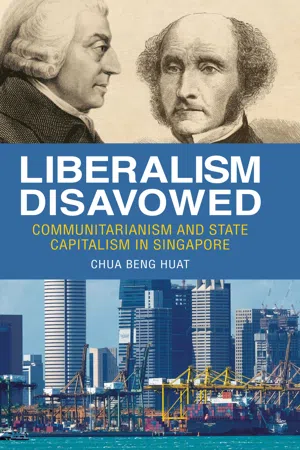
In Liberalism Disavowed, Chua Beng Huat examines the rejection of Western-style liberalism in Singapore and the way the People's Action Party has forged an independent non-Western ideology. This book explains the evolution of this communitarian ideology,
- English
- ePUB (mobile friendly)
- Available on iOS & Android
eBook - ePub
About this book
Information
Chapter 1
CONTEXTUALIZING SINGAPORE
Antipathy to Liberalism
Singapore did not believe in the Western liberal democratic model which developed in the last half-century as the pinnacle of human achievement and the solution for the whole of the world (Prime Minister Lee Hsien Loong, Straits Times 23 July 2009).
In the quote above, the third Prime Minister of Singapore, Lee Hsien Loong, states categorically that the People’s Action Party (PAP), which has governed continuously since 1959, or close to 60 years, is not interested in transforming the Singapore polity into a Western liberal democracy. This very explicit declaration is indicative of how the PAP government in Singapore sees itself as operating within and against the global ideological environment of liberal democracy. In the present post-socialist world where liberalism enjoys “a position of dominance not only within the academy but in general public discourse in all contemporary democracies around the world” (Chatterjee 2011: 2–3), the constellation of the three terms in the phrase, “liberal-capitalist-democracy,” has become conventionally understood as the desired common system (Fukuyama 1992). All other modes of governance are decried as deviations from this righteous path, including the single-party dominant PAP government. While its anti-liberalism stance is likely to be read by critics as a mere ideological rationalization of its uninterrupted rule as a single-party dominant parliament, the PAP’s disavowal of liberalism in fact has deeper roots in the social democratic orientation of the people who founded the party in 1954. Through a series of political twists and turns—the first fully elected self-government in 1959, the purge of its radical faction in the early 1960s, the brief membership in Malaysia starting in 1963 and Singapore’s subsequent independence in 1965—the PAP has been able to monopolize parliamentary power since 1968. Since then, the single-party dominant parliament has proved so expedient in enabling the government to efficaciously execute long-term political, social and economic planning that the PAP has been motivated to entrench its political system and practice, in defiance of domestic and international pressures to embrace liberal democracy. Against liberalism, it has proposed communitarianism as the preferred national ideology. However, because communitarianism has also been heralded as part of the national ideology by authoritarian political leaders in other East Asian nations with endemic corruption at all levels of government, the PAP’s ideological claim has been inevitably entangled in the skepticism and criticism of generalized “communitarianism in Asia.” To understand the current PAP government’s disavowal of liberalism, it is therefore necessary to know, first, how it conceptualizes liberalism as the ideology against which it defines itself and, second, how it distinguishes itself from the other governments that claim to be communitarian.
Trajectory of Liberal Individualism
Given the status of the US as a global power, the contemporary concept of liberal democracy arguably embraces a largely American version of liberalism. It should therefore not be surprising that it is this version which looms large in the PAP government’s antipathy to liberalism, especially its emphasis on individualism. Rooted in its unique history of being never burdened by a feudal aristocracy nor oppressed by colonization, the liberal ethos was inscribed into the US constitution in the 1776 American Declaration of Independence: “We hold these truths to be self-evident, that all men are created equal, that they are endowed by their Creator with certain unalienable Rights, that among these are Life, Liberty and the pursuit of Happiness” (Hartz 1955). Over the years of repetition, reiteration and reformulation, the phrase, “self-evident truths,” has crystallized into a set of vernacular values and beliefs of the American people. As summarized by the first black US President, Barack Obama, this liberty includes
…the right to speak our minds; the right to worship how and if we wish; the right to peaceably assemble to petition our government; the right to own, buy and sell property and not have it taken without fair compensation; the right to be free from unreasonable searches and seizures; the right not to be detained by the state without due process; the right to a fair and speedy trial; and the right to make our own determinations, with minimal restrictions, regarding family life and the way we raised our children. (2006: 86)
As “self-evident” truths, these freedoms of individuals extend by definition to all people at all times, that is, they are universal. As Lukes points out, American individualism refers “to the actual or imminent realization of the final stage of human progress in a spontaneously cohesive society of equal individual rights, limited government, laissez-faire, natural justice and equal opportunity, and individual freedom, moral development and dignity” (1973: 26). Achieving these individual freedoms thus constitutes the teleological end point of social political development of all societies.
Liberalism and Democracy
For the post-socialist world, the conjoining of liberalism and democracy may be a matter of course. In fact this coupling is historically a relatively recent phenomenon. As political theorist, Alan Wolfe, notes, “Any important political theorist of the nineteenth century would have been puzzled by the expression ‘liberal democracy’” (1977: 3). First, formally, in democratic systems “the political authority of citizens takes precedence over citizens’ personal freedoms” (Rodan and Hughes 2014: 8). Second, liberalism and democracy take diametrically opposite stances towards capitalism (Wolfe 1977: 4). The difference turns on their respective understandings of the concept of “equality.” Both capitalism and liberalism promote “equality in the abstract” to ideologically enable individuals to engage in economic exchange as “equals,” including the free exchange of labor power for wages between workers and employers. However, capitalists will fight equality “bitterly in the real world” of capitalism (Wolfe 1977: 5), as capitalism necessarily produces inequality, privilege and hierarchy as the unavoidable outcomes of competition. Liberalism serves to gloss over this inequality.1 In contrast, for democrats, equality implies social justice and civil rights, which must be protected “against the excesses of an unfettered, market-driven ethos” (Ong 2006: 2). Social justice “presupposes social solidarities and a willingness to submerge individual wants, needs, and desires in the cause of some more general struggle” (Harvey 2005: 41); demands of social justice and individual freedom are thus potentially incompatible. Therefore, to formally conjoin liberalism and democracy as conceptually seamless basically involves the displacement of the demand for social solidarity by privileging individual freedoms and desires. However, displacement is not erasure; conflicting ideological/political positions derived from democratic demands for social solidarity and social justice remain political possibilities.
Political Liberalism and the Welfare State
After the Second World War, the demand for social justice manifested itself in the development of the “welfare state,” as a compromise between capitalists and the working classes in democratic nations (Esping-Andersen 1990). David Harvey (2005) and, before him, Daniel Bell (1960) suggest that after the Second World War, the US polity had the following features: a “focus on full employment, economic growth, and the welfare of its citizens, and that state power should be freely deployed, alongside of or, if necessary, intervening in or even substituting for market processes to achieve these ends;” the state also “actively intervened in industrial policy and moved to set standards for the social wage by constructing a variety of welfare systems (health care, education, and the like);” finally, in societal management, the interventionist state fostered a “social and moral economy,” in which class compromise between capital and labor was seen as “the key guarantor of domestic peace and tranquillity” (Harvey 2005: 10). The broadly similar social welfare provisions had different political labels across the Atlantic. In Europe, it was called social democracy; in the US, political liberalism. This was because in post-war Europe, socialism and communism remained salient anti-capitalist ideologies, and socialist and communist political parties remained serious contenders for state power, until at least the late 1970s. Consequently, European democrats, including liberals, generally place emphasis on the social/collective responsibility; hence their label, “social” democracy. In contrast, communism and socialism in the US were thoroughly routed by McCarthyism in the 1950s. As a result, all left-of-liberal political language has since been suppressed in the public sphere. Social welfare advocates were thus called, by default, “liberal democrats” or “political liberals” to distinguish them from anti-welfare “conservatives” and “classic liberals” committed to individualism, private property and free market.
By the 1970s, the economic and political contradictions inherent in managing the tensions between the need to simultaneously maintain the conditions for capital accumulation and the mass loyalty of the citizens in the welfare state had become apparent. First, to maintain its source of revenues, taxation, tariffs and even borrowings for its fiscal needs, the state is compelled to ensure continual capital accumulation, that is, the profitability of private investments. To secure the conditions of capital accumulation, the state must provide and improve physical infrastructure, services and the quality and productivity of the workforce by investments in public education, health and housing, that is, increase “social capital” investments (O’Connor 2002: xix). The state cannot neglect its “accumulation function” without risking a capitalist revolt of withholding investments, without which all state revenues through taxation and tariffs would cease.
Second, capitalist production incurs externalized undesirable costs, including environmental degradation, urban transportation gridlock, unemployment, poverty, and “various groups whose life chances had been damaged systematically by market exchange processes” (Keane 1984: 13). To maintain the mass loyalty of citizens from whom it derives its mandate to govern, that is, to achieve its “legitimacy function,” the state needs to recognize the demands for compensation from organized civil society groups who have been affected by these negative externalities of capitalism. Consequently, beneficiaries of social expenditure in education, health care, housing, unemployment insurance and other financial assistance have been able to ideologically and substantively transform these provisions into an extensive set of “entitlements” and “rights” of citizenship (Keane 1984: 17) and state bureaucracy has to expand to cope with the workload. In the 1970s, capitalist resistance to increased taxation caused by welfare expansion resulted in a persistent fiscal deficit which affected the implementation of public policies, causing mass disaffection with the state. In short, the welfare state has been in a permanent state of fiscal crisis (O’Connor 2002) and has suffered an on-going deficit of legitimacy since the 1970s (Offe 1984; Habermas 1973). Meanwhile, the 1970s also saw the political right raise objections to social welfare entitlements as the weakening of work ethics and the ever-expanding state bureaucracy as “big” government. This led political conservatives to call for the return of classical liberal values.
Neoliberalism Interlude
By the early 1980s, US President Ronald Reagan (1981–89) reactivated a classic principle of Jeffersonian liberalism: “That government is best which governs least” (Lukes 1973: 82). To downsize the government, market regulations were reduced, state enterprises and state-owned assets were sold off, some state social responsibilities were outsourced (Niskanen 1988: 5), and social welfare provisions were cut back to “wean” citizens off state dependency. Meanwhile, the notions of free market, self-reliance, self-management and individual enterprise were ideologically emphasized. American political philosopher Irving Kristol saw this as America redirecting itself back to the original “liberal vision and liberal energy” (quoted in Williams 1997: 82), however, under a new name for a new time—neoliberalism.
The same strictures were undertaken in Britain by Prime Minister Margaret Thatcher, an ideological sibling and ally of President Reagan. Emphasizing individual self-reliance, she famously declared, “There is no such thing as society: there are only men and women, and there are families.”2 The family was added as an afterthought. For example, to reduce state responsibility in housing provision, she sold off state-subsidized council housing with a very significant one-off subsidy to sitting tenants, transforming many households into home owners but simultaneously driving those who were unable to purchase houses to residual units of the worst quality housing (Saunders 1990). Throughout the 1980s and 1990s, neoliberalism was embraced by the multilateral financial institutions under the control of the US, namely the International Monetary Fund (IMF) and the World Bank, and imposed on nations in need of their loans.
Two decades of continuous market deregulation resulted in a corporate world that focused almost exclusively on short-term profit for shareholders. Complicated financial “products” and transaction schemes—derivatives, hedge funds, securitizations, structured investments and collateralized debt obligations—which defy the understanding of most lay investors were invented to churn money and profit, which in turn justified hugely exaggerated salaries and bonuses for executives in financial industries. By 2008, the deregulated financial industries finally blew up. The undoing came with the unravelling of the US sub-prime mortgage system. Residential properties were sold, with minimum or no down payments or monthly mortgage payments for a sustained period, to households who had no means of meeting the regular financial obligations of their purchases. Such gain-without-pain schemes encouraged property speculation. These high-risk mortgages were in turn repackaged as “securitized” assets and sold to the next financial institutions in the global financial market. The sub-prime bubble finally burst in late 2007. Many financial institutions in the US and elsewhere globally that were exposed to the sub-prime mortgage industry either went bust or tottered on the brink of insolvency. The total global loss from the crisis was estimated by the IMF to be in excess of USD 4 trillion, with the US accounting for USD 2.7 trillion (Straits Times 22 Apr. 2009). The US sub-prime crisis turned into a global depression. Governments in the US and Europe had to bail out some of the biggest banks, insurance companies and industrial manufacturers. The state as the default rescuer of the last resort for private capital has always been just beneath the surface of the neoliberal rhetoric. With the government bailouts, deregulation and privatization were turned on their heads! Close to a decade later, the central banks of the world are still at a loss as how to “revitalize” the global capitalist economy. Significantly, Asian economies were largely spared from the crisis but not from the global recession.
Critiques of Liberal Individualism
Every ideology engenders its own critics and opposition, and liberalism is no exception. Criticism is frequently focused on its individualism. British conservative philosopher, John Gray, argues that the asocial individual of liberalism is a conceptual fiction, as such a person would be one “without history or ethnicity, denuded of the special attachments that in the real human world give us the particular identities we have” (1995: 5). The critique of asocial individualism is often accompanied by a counter-conceptualization of a socially embedded individual who realizes and reproduces his/her everyday life in and as a community. This is true also in America (Mudhall and Swift 1992). As recently as the early 1990s, a group of American intellectuals and public figures noted with concern a rise in the excesses of individualism—private desires re-scripted as individual rights and freedoms—and a corresponding decline of “public spiritedness” (Etzioni 1998). This group issued a communitarian manifesto, “The Responsive Community Platform: Rights and Responsibilities” (Etzioni 1998: xxv–xxxix), advocating a political and ideological re-balancing of self-interest and social responsibility in public life. However, characterizing themselves as “liberal communitarians” they were not interested in displacing and replacing individualism with communitarian values. Indeed, in America the debate between communitarians and liberals is always “carried out on the terrain and under the auspices of liberal universalism, with communitarianism playing at best a subsidiary or remedial role” (Dallmayr 1996: 281) and, in the end “preserves the liberal order” (Williams 1997: 78). Unsurprisingly, Daniel A. Bell concluded that “it must be conceded that 1980s communitarian theorists [among whom he was affiliated] were less-than-successful at putting forward attractive visions of non-liberal societies” (2004).3
The same debate between liberal individualism and communitarianism was to be played out in East Asia in the early 1990s. Ironically, just as the teleological narrative of liberal democratic capitalism appeared to have triumphed over other political and economic narratives, it was disrupted by the rise of non-liberal capitalism in East Asia (Fukuyama 1992: 238). Seeing the expansion of liberal individualism as a source of social dissolution and a destructive force of community, many East Asian political and thought leaders regularly espoused anti-liberal social values, including communitarianism. At the front of the East Asian resistance to liberal individualism was the PAP government. It hit a wall of skepticism about the general idea that East Asian societies are essentially communitarian, and a barrage of criticism that so-called communitarianism was no more than a thin veil for authoritarianism and corruption among political leaders in Asian nations where corruption is endemic at every level of government but worse at the top. Given its history of political repression and the authoritarianism of Prime Minister Lee Kuan Yew, the inclusion of the PAP government in such critique was not groundless. Nevertheless, it has distinguished itself in very significant ways from the guilty-as-charged political leaders in East Asia.
Democratic Deficit in East Asia
The rejection of liberalism in East Asian nations has much to do with their respective histories of state formation. All the East Asian nations are post-World War II nations; additionally, all Southeast Asian nations, except for Thailand, are post-colonial nations. All experimented with electoral democracy in the early phase of state formation; the experiments mostly failed. The contemporary non-communist nations have all conceded to some form of electoral politics as the means of selecting political office holders but they are far from being liberal democracies. Accordingly, they have been labelled as “hybrid” regimes under different names, such as “illiberal democracies” (Bell, et al. 1995; Zakaria 2003), “semi-democracies” (Case 2002) and “competitive authoritarianism” (Levitsky and Way 2010). Most political analyses of these hybrid regimes are framed within the expectation of their “transition” to liberal democracy, “rather than seeking to understand or explain these so-called hybrid regimes in their own terms” (Jayasuriya and Rodan 2007: 768). To date, only Taiwan (Alagappa 2001), South Korea and perhaps, Indonesia, may be said to have transited from military-supported authoritarian regimes into relatively liberal democracies. In the other states, an uneven playing field, restricted franchise, corruption, violence and tampering with ballots and other violations of the electoral process persist, which is painfully illustrated by the contemporary Philippines (Hutchcroft...
Table of contents
- Cover
- Title page
- Contents
- Preface
- Introduction
- Chapter 1 Contextualizing Singapore: Antipathy to Liberalism
- Chapter 2 Singapore State Formation in the Cold War Era
- Chapter 3 Liberalism Disavowed
- Chapter 4 Disrupting Private Property Rights: National Public Housing Program
- Chapter 5 Disrupting Free Market: State Capitalism and Social Distribution
- Chapter 6 Governing Race: State Multiracialism and Social Stability
- Chapter 7 Cultural Liberalization without Liberalism
- Conclusion: An Enduring System
- Bibliography
- Index
- Copyright page
Trusted by 375,005 students
Access to over 1.5 million titles for a fair monthly price.
Study more efficiently using our study tools.
Frequently asked questions
Yes, you can cancel anytime from the Subscription tab in your account settings on the Perlego website. Your subscription will stay active until the end of your current billing period. Learn how to cancel your subscription
No, books cannot be downloaded as external files, such as PDFs, for use outside of Perlego. However, you can download books within the Perlego app for offline reading on mobile or tablet. Learn how to download books offline
Perlego offers two plans: Essential and Complete
- Essential is ideal for learners and professionals who enjoy exploring a wide range of subjects. Access the Essential Library with 800,000+ trusted titles and best-sellers across business, personal growth, and the humanities. Includes unlimited reading time and Standard Read Aloud voice.
- Complete: Perfect for advanced learners and researchers needing full, unrestricted access. Unlock 1.5M+ books across hundreds of subjects, including academic and specialized titles. The Complete Plan also includes advanced features like Premium Read Aloud and Research Assistant.
We are an online textbook subscription service, where you can get access to an entire online library for less than the price of a single book per month. With over 1.5 million books across 990+ topics, we’ve got you covered! Learn about our mission
Look out for the read-aloud symbol on your next book to see if you can listen to it. The read-aloud tool reads text aloud for you, highlighting the text as it is being read. You can pause it, speed it up and slow it down. Learn more about Read Aloud
Yes! You can use the Perlego app on both iOS and Android devices to read anytime, anywhere — even offline. Perfect for commutes or when you’re on the go.
Please note we cannot support devices running on iOS 13 and Android 7 or earlier. Learn more about using the app
Please note we cannot support devices running on iOS 13 and Android 7 or earlier. Learn more about using the app
Yes, you can access Liberalism Disavowed by Beng Huat Chua in PDF and/or ePUB format, as well as other popular books in Politique et relations internationales & Politique comparée. We have over 1.5 million books available in our catalogue for you to explore.