Are political parties the weak link in Indonesia's young democracy? More pointedly, do they form a giant cartel to suck patronage resources from the state? Indonesian commentators almost invariably brand the country's parties as corrupt, self-absorbed, an
eBook - ePub
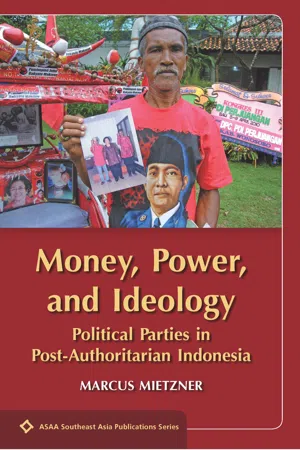
Money, Power, and Ideology
Political Parties in Post-Authoritarian Indonesia
- English
- ePUB (mobile friendly)
- Available on iOS & Android
eBook - ePub
About this book
Trusted by 375,005 students
Access to over 1.5 million titles for a fair monthly price.
Study more efficiently using our study tools.
Information
1
Indonesia’s Parties and Party Systems
A Historical and Analytical Overview
Any discussion of Indonesian party politics must start with an overview of its historical origins, an analysis of its main trends, and an introduction of the major actors. First, a historical contextualization of Indonesian parties is key to grasping the patterns of post-Suharto party politics — especially since many quantitative examinations have refrained from such a historiographical exercise (Hicken 2006; Tan 2006; Croissant and Völkel 2012). Second, a summary of major trends in Indonesia’s current party system is crucial to provide a platform from which later chapters can enter into in-depth discussions. In this short overview, the analytical tools developed by the institutionalization school will help identifying significant features of Indonesian parties. Third, it is necessary to introduce the main players. For practical reasons, the discussion here is limited to the nine parties elected to the parliament of the 2009–14 term. In later segments of the book, some newer (and also older) parties are introduced as well, but the nine parties covered in this chapter have been the leading protagonists. Naturally, the chapter’s sections on historical origins, current dimensions of institutionalization, and individual party profiles do not aim to provide an exhaustive picture of Indonesia’s parties. Rather, they provide readers with indispensable information for the further course of the book, and allow the following chapters to concentrate on thematic fields of inquiry without having to disrupt the analysis with basic narratives and data.
Indonesia’s Parties: A Short History
A narrative of the evolution of Indonesian party politics is not just a historiographical enterprise. Rather, it goes to the heart of the debate on the stability and institutionalization of Indonesian parties. Depending on how exactly we date the origins of Indonesia’s first parties and identify continuities with today’s organizations, they can either be described as relatively long lasting or, on the contrary, as fitting the East Asian stereotype of being notoriously short lived. Generally, average party age is one of the indicators for the stability of a party system (Stockton 2001: 104), and the United States and the United Kingdom have scored the highest marks in this field as their main parties go back to the nineteenth century (Hicken 2006: 37). Indonesia’s score, by contrast, has often been relatively low, with the birth dates of its key parties set in the 1960s and 1970s, or even in the years following Suharto’s fall. But a closer look suggests that some of the parties operating in Indonesia today are the direct successors to organizations founded in the 1920s, and that therefore the country’s party longevity score has so far been undervalued. In fact, this study argues that the Partai Demokrasi Indonesia Perjuangan (Indonesian Democratic Party of Struggle, PDIP) is one of the longest-operating parties in Southeast Asia, second only to the Nationalista Party of the Philippines founded in 1907. In Asia, only India’s Congress Party (1885), Taiwan’s Kuomintang (1919), the Mongolian People’s Revolutionary Party (1921), and the Japanese Communist Party (1922) are older.
Today’s PDIP has its origins in the Partai Nasional Indonesia (Indonesian National Party, PNI), which was founded in 1927. While initially established as a pluralist social movement, it adopted the name “party” in 1928. Obviously, the Dutch colonial regime imposed severe restrictions on parties, especially on those which — as the PNI — openly sought Indonesia’s independence. Unlike the British in India or the United States in the Philippines, the Dutch did not allow for party-based elections in their colony. Instead, they viewed parties as rebellious organizations and were determined to dissolve them. Thus, PNI’s leader, Indonesia’s future founding president Sukarno, was arrested in 1929 and sentenced to four years in prison in 1930 (Legge 1990). The party officially disbanded in the following year, but some of PNI’s second-tier leaders maintained its formal structures. More importantly, in the minds of many citizens, PNI had entrenched itself as a party that not only stood for anti-colonialism, but also for a multi-religious and cross-ethnic composition of a future Indonesian state. Hence, although the Dutch colonizers tried to curtail the PNI throughout the 1930s, the concept of a party as a political vehicle to promote ideas and — eventually — seek power had taken root. Of course, Indonesian nationalists had imported this concept to no small extent from the very Dutch state that now tried to destroy all parties in its own colony.
Even before the PNI began to threaten the colonial power, a communist party had emerged. Like the PNI, the Partai Komunis Indonesia (Indonesian Communist Party, PKI) had several associational predecessors before it officially became a party in 1924 (Kroef 1965). As part of a global movement, the PKI’s outlook was shaped by the Communist International, at whose First Congress in 1919 Leon Trotsky proclaimed that “our task is to [...] unify the efforts of all genuinely revolutionary parties of the world proletariat and thereby facilitate and hasten the victory of the Communist revolution throughout the world” (Trotsky 1924). Fueled by such rhetoric, some PKI leaders falsely believed by 1925 that the time was ripe to overthrow the Dutch colonial regime. High-spirited but ill-prepared, the PKI initiated a number of revolts in Batavia, Padang, Surabaya, and Banten in late 1926 and early 1927 (McVey 1965). Unsurprisingly, the government found it easy to put down this insurrection, and used the opportunity to arrest 13,000 suspects, imprison 4,500, and send 1,308 to a notorious “concentration camp” (Hindley 1964: 18) in Papua. But while the PKI was organizationally destroyed, its appeal survived. The party’s anti-elitist attitude and its promises of land reform had attracted many admirers among poor peasants and workers (particularly on Java), introducing class conflict as a key element of Indonesia’s embryonic, pre-independence party system (Mortimer 1974).
The third factor in this evolving party landscape under colonial rule was political Islam (Ricklefs 2007). For many devout Muslims, both the pluralism of Sukarno’s nationalists and the atheism of the communists were equivalent to blasphemy. Given Indonesia’s demographic composition, they were adamant that the coming Indonesian nation state had to be Islamic in nature. Initially, the main representative of this stream was Sarekat Islam (Islamic Association, SI), a heavily anti-Chinese and anti-Christian trade organization founded in 1911 (Hadiz and Teik 2011). While its leader Tjokroaminoto declared in 1913 that “Sarekat Islam is not a political party” (Blumberger 1931: 59), by the late 1910s it had — for all intents and purposes — turned into one. After internal conflict led to SI’s demise in the 1920s, the leadership of organized Islam was taken over by two groups that were formally not political parties but would play important roles in party politics to this day: Muhammadiyah, founded in 1912 by a modernist, Mecca-educated Muslim scholar who rejected the syncretistic tendencies among many followers of Islam on Java (Noer 1973; Alfian 1989); and Nahdlatul Ulama (Revival of the Islamic Scholars, NU), an association of traditionalist Muslim clerics who practiced the very syncretistic versions of Islam that the modernists opposed (Fealy 1998; Bruinessen 1994; Fananie and Sabardila 2000). Established in 1926, NU had its strongholds in East Java, while Muhammadiyah was more popular in Central Java and the Outer Islands, especially Sumatra.
The three pillars of Indonesia’s colonial party politics — nationalism, Marxism, and Islam — also formed the basis of the post-1945 party system (Kahin 1952; Lev 1967). While the war against the Dutch between 1945 and 1949 obstructed the development of strong party organizations, it also generated an unprecedented level of political activism that drew Indonesians into party politics (Feith 1957: 9). By the time the new state took shape as a parliamentary democracy in early 1950, the main parties stood ready: the PNI had been resurrected in 1946, falling “within a direct line of factional and ideological descent from the PNI of 1927” (Rocamora 1975: 15); the PKI had also been revived, although its failed 1948 coup in the East Java town of Madiun hampered its expansion; and Muhammadiyah, NU, and several other Muslim groups had founded the Majelis Syuro Muslimin Indonesia (Indonesian Muslim Advisory Council, Masyumi) as an all-Islamic party. A host of smaller parties were created as well, but most of them could also be classified as either pluralist, Marxist-socialist, or Islamic.2 The pluralist camp was strengthened by the Partai Kristen Indonesia (Indonesian Christian Party, Parkindo) and the Partai Katolik (Catholic Party) (Webb 1978). On the political left, the Partai Sosialis Indonesia (Indonesian Socialist Party, PSI), which recruited allies of Vice-President Hatta, gained much prominence, as did the Partai Musyawarah Rakyat Banyak (Party of Mass Consultation, Partai Murba), a proletarian party which was nevertheless deeply opposed to the PKI. Finally, on the Islamic side, there was the Partai Sarekat Islam Indonesia (Indonesian Islamic Association Party, PSII), the self-proclaimed successor to the old Sarekat Islam.
Altogether, 17 parties held seats in the parliament, or Dewan Perwakilan Rakyat (People’s Representative Council, DPR), of the early 1950s.3 While this condition already constituted what Giovanni Sartori (1976: 150) called “atomized multipartyism,” the party system fragmented further ahead of the 1955 elections. Most importantly, Masyumi split in 1952, with NU leaving and establishing its own political party. This division reflected deep-seated tensions between the two large streams in Indonesian Islam, but the now mostly modernist Masyumi and the traditionalist NU still had similar strategic goals: both wanted a state in which Islamic law, or sharia, was obligatory for Muslims. To be sure, there were also particularization tendencies in the pluralist camp. One of its new creations was the army-sponsored Ikatan Pendukung Kemerdekaan Indonesia (Association of Supporters of Indonesian Independence, IPKI). Only the PKI, which was quickly regaining strength after the tragic events of 1948, avoided additional fragmentation in its communist backyard. Eventually, 28 parties and groups gained seats in the 1955 parliament, with the four largest having strong roots in pre-independence politics (Feith 1957). PNI finished first by gaining 22.3 per cent of the vote, with 86 per cent of its support concentrated on Java. Masyumi, for its part, received 20.9 per cent, almost half of that outside of Java. In third place was NU, which obtained 18.4 per cent, most of it in Central and East Java. The largely Java-based PKI, finally, came in fourth, attracting 16.4 per cent support.
Thus, almost 80 per cent of the citizenry had voted for one of the four large parties and their value systems, i.e., pluralist nationalism, Marxism, and devout Islam. Significantly, Clifford Geertz’s research on Java in the 1950s found that the parties were indeed anchored in ideologically defined communities. According to Geertz, “each party has connected with it, formally or informally, women’s clubs, youth and students groups, labor unions, peasant organizations, charitable associations, private schools [...], and so forth, which serve to bind it to the local social system.” Hence, “each party [...] provides a general framework within which a wide range of social activities can be organized, as well as an over-all ideological rationale to give those activities point and direction” (Geertz 1963: 14). However, he described the various streams, or aliran, in sociological rather than purely political terms. For Geertz, there were three major aliran: the priyayi, who were part of the old Hindu-Javanese aristocracy, worked as civil servants or were their clients, and largely supported PNI; the abangan, nominal Muslims who practiced syncretistic beliefs, were peasants and workers, and sympathized with the PKI; and the santri, devout Muslims of both traditionalist and modernist orientation who were loyal to NU and Masyumi respectively. While Geertz’s classification was an oversimplification and had little relevance for non-Javanese societies, his analysis nevertheless pointed to a certain degree of social rootedness of party politics and its ideologies in the 1950s.
Yet, if measured by the analytical tools of the modern institutionalization school, both Indonesia’s party system and its parties of the 1950s were weakly institutionalized. With 28 parties in parliament and an effective number of electoral parties of 6.4, Indonesia’s party system was highly unstable. While electoral volatility cannot be measured because the 1955 elections were the only national poll in that period, local elections in Java held in 1957 indicated significant voter movement between parties, benefiting particularly the PKI. Moreover, Indonesia’s parties of the 1950s were never mass parties like their contemporaries in Western Europe. Instead, they were run by elites, with much of their activities taking place in Jakarta. “The parties’ [regional] branches,” on the other hand, “were unreal units except for their leadership” (Feith 1957: 9). Branches often handed out party memberships en masse to ordinary citizens without any obligations attached, mostly in order to gain more representation at the next party congress. Generally, “the members enrolled for the purposes of party statistics were townsmen, many of aristocratic origin and most with some Western education, who, in conformity with a conception important in nationalist thinking, believed they were demonstrating political awareness and understanding [...] by joining a party” (Feith 1957: 9). While the PKI was somewhat of an exception, in the 1950s the level of party activity in small towns and villages had declined considerably from its height during the revolution.
However, the main weakness of Indonesia’s party system in the 1950s was a factor that most institutionalization theories have failed to conceptualize: the direction of inter-party competition. While institutionalization scholars can detect ideological polarization by measuring the ENP, it lacks the instruments to grasp the effects of specific forms of competition. Sartori (1976), by contrast, has offered such a tool by distinguishing between centrifugal and centripetal competition. In centrifugal systems, most parties are located at the radical margins and compete with each other in order to achieve nothing less than regime change. In systems with centripetal inter-party competition, on the other hand, parties fight for the political center while defending the existing political framework. Undoubtedly, Indonesia in the 1950s had an extreme version of a centrifugal party system: virtually all of its parties wanted to obtain power to establish a different polity. To begin with, the PNI aimed to replace democracy with a “collectivistic society” led by Sukarno (Nasution 1992: 103); the PKI — quite obviously — wished to turn Indonesia into a communist state; and Masyumi and NU were still determined to introduce Islamic law as “real sovereignty is not vested in human society. Real sovereignty belongs to Allah” (Nasution 1992: 111). Clearly, Indonesia in the mid-1950s lacked what Green-Perdersen (2004) called “pivotal center parties” — moderate elements that could defend parliamentary democracy against its opponents from within.
Hence, Indonesia’s young democracy collapsed in the late 1950s not only because Sukarno and the army conspired against it (Lev 1994; Mackie 1994), or because “poorly developed” parties imploded (Feith 1962: 126). It also did not fail simply because of regular regional rebellions. Essentially, democracy disintegrated because none of the key parties had an interest in its long-term survival. This became very clear in the debates within the Konstituante — the body in charge of drafting a new constitution to replace the one enacted in 1950. While the Konstituante was in session between 1956 and 1959, the participating parties stubbornly refused to compromise on their respective demands — the nationalist and communist camp wanted a secular state, while the Islamic bloc demanded the introduction of sharia. Following a series of inconclusive votes on the issue, Sukarno intervened in August 1959 to declare Indonesia’s return to the 1945 constitution (Lev 1966). This document, drafted in a hurry shortly before the Japanese capi...
Table of contents
- Cover
- Title page
- Contents
- List of Tables
- Preface and Acknowledgements
- Glossary and Abbreviations
- Introduction: Political Parties in Indonesia: Domestic, Regional, and Global Patterns
- 1. Indonesia’s Parties and Party Systems: A Historical and Analytical Overview
- 2. Parties and the State: Fusion or Struggle for Hegemony?
- 3. Parties and Society: Withdrawal or Ongoing Contestation?
- 4. Party Organization and Internal Democracy: Strong Leaders, Influential Branches, Marginalized Members
- 5. Inter-Party Competition in the Post-Suharto Polity: Elections, Coalitions, and Parliaments
- 6. The Postponed End of Ideology: Parties, Ideological Orientations, and Political Action
- 7. Assessing the Systemic Functionality of Indonesian Parties: Recruitment, Articulation, Participation, Communication
- Conclusion: Money, Ideology, and Party Politics in Indonesia: Between Local Contexts and Global Trends
- List of Interviewees
- Bibliography
- Index
- Copyright page
Frequently asked questions
Yes, you can cancel anytime from the Subscription tab in your account settings on the Perlego website. Your subscription will stay active until the end of your current billing period. Learn how to cancel your subscription
No, books cannot be downloaded as external files, such as PDFs, for use outside of Perlego. However, you can download books within the Perlego app for offline reading on mobile or tablet. Learn how to download books offline
We are an online textbook subscription service, where you can get access to an entire online library for less than the price of a single book per month. With over 1.5 million books across 990+ topics, we’ve got you covered! Learn about our mission
Look out for the read-aloud symbol on your next book to see if you can listen to it. The read-aloud tool reads text aloud for you, highlighting the text as it is being read. You can pause it, speed it up and slow it down. Learn more about Read Aloud
Yes! You can use the Perlego app on both iOS and Android devices to read anytime, anywhere — even offline. Perfect for commutes or when you’re on the go.
Please note we cannot support devices running on iOS 13 and Android 7 or earlier. Learn more about using the app
Please note we cannot support devices running on iOS 13 and Android 7 or earlier. Learn more about using the app
Yes, you can access Money, Power, and Ideology by Marcus Mietzner in PDF and/or ePUB format, as well as other popular books in Politics & International Relations & Political Parties. We have over 1.5 million books available in our catalogue for you to explore.