- English
- ePUB (mobile friendly)
- Available on iOS & Android
eBook - ePub
About this book
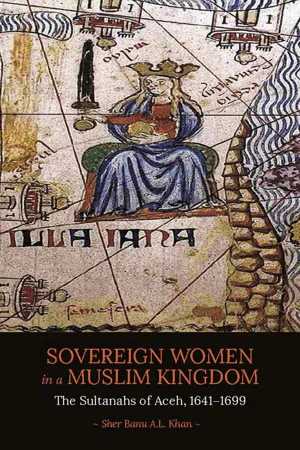
The Islamic kingdom of Aceh was ruled by queens for half of the 17th century. Was female rule an aberration? Unnatural? A violation of nature, comparable to hens instead of roosters crowing at dawn? Indigenous texts and European sources offer different evaluations. Drawing on both sets of sources, this book shows that female rule was legitimised both by Islam and adat (indigenous customary laws), and provides original insights on the Sultanah's leadership, their relations with male elites, and their encounters with European envoys who visited their court. The book challenges received views on kingship in the Malay world and the response of indigenous polities to east-west encounters in Southeast Asia's Age of Commerce.
Information
chapter 1
The Succession of the First Female Ruler of Aceh
chapter |
| |
1 |
| The Succession of the First Female Ruler of Aceh |
Criteria for Political Succession in Aceh
Few realms in the seventeenth century had written succession laws, at least not in the Malay world. The closest indication of any prerequisites for a candidate to be appointed sultan of Aceh was written in the Kanun Syarak Kerajaan Aceh [Aceh Canonical Laws] based on sharia (Islamic law).1 According to these laws, the candidate had to be a Muslim of good lineage, an adult (that is, he or she had to have reached puberty), an Acehnese citizen, courageous, wise, just, loving and soft-hearted or merciful (lembut hati), conversant with the nuances of language, a keeper of promises, not physically handicapped, truthful, loving, patient, restrained (keeping anger in check, controlling baser instincts), forgiving, firm and yet submissive to Allah’s will, and thankful to Allah.2
Most rulers could not satisfy all these qualifications. Nevertheless, they prompt the following questions—to what extent were the laws followed, what were the factors that determined political succession in the kingdom, and why was a woman ruler chosen in 1641, an unprecedented event in the kingdom’s history and, after 1699, never again? In order to analyse the factors governing succession, a brief overview of the silsilah or genealogy is necessary, looking at the rulers from the kingdom’s founder, Ali Mughayat Syah, in the sixteenth century to the reign of Sultan Badr al-Alam Syariff Hashim Jamal al-Din at the end of the seventeenth century.3
The origins of the kingdom of Aceh and its sultans are still mired in confusion. However, the sultanate of Aceh Dar al-Salam, which began in the sixteenth century, is believed to be the result of unifying two small kingdoms, Aceh in Dar al-Kamal and Lamuri in Mahkota Alam, both at the northern tip of the island of Sumatra, separated by a river.4 Constant rivalry between these two kingdoms ended when Munawwar Syah, king of Lamuri, attacked and defeated Inayat Syah, king of Aceh, and united the two realms. Sultan Shams Syah, son of Munawwar Syah, then ruled this united kingdom. To strengthen his position, Shams Syah married his son, Ali Mughayat Syah, to the daughter of Inayat Syah. Ali Mughayat Syah (r. 1514–28)5 expanded the kingdom by conquering neighbouring Daya (1520), Pidie (1521) and Pasai (1524).6 After his death, the entire northern tip of Sumatra came under the dominion of the sultanate, thus making Ali Mughayat Syah the founder and first sultan of Aceh Dar al-Salam.7
When the first sultan died, Ali Mughayat Syah’s son, Salah al-Din (r. 1528–37), succeeded him.8 Known as a weak leader, he was challenged by his younger brother, Ala al-Din al-Qahar, who took power and ruled from 1537 to 1568.9 After his death, he was succeeded by his son, Sultan Husayn, who assumed the title Sultan Ali Riayat Syah (r. 1568–75).10 A wise ruler revered by his people and the ulama, Sultan Ali Riayat Syah ruled for eight years.11 His death in 1575 was followed by a period of political instability: he was succeeded by his four-month-old son, who died seven months later. The next ruler was his uncle, Abangta Abdul al-Jalil, who took the title Sultan Sri Alam,12 but was assassinated within a year,13 allegedly because of his bad temper.14 The Hikayat Aceh depicts Sultan Sri Alam as extravagant as he had depleted the kingdom’s treasury by giving expensive gifts to certain soldiers and elites from Fansur (Baros). The Hikayat relates that the orang kaya and ulama in Aceh gathered and decided this state of affairs was injurious to the kingdom, and the sultan must be deposed.15 However, the Hikayat is silent on how this was done merely mentioning that he was replaced, in contrast to the Bustan’s account that the sultan was killed. Zayn al-Abidin, grandson of al-Qahar, became the next ruler, but he too was murdered after a few months, supposedly because of his murderous and bloodthirsty nature.16 The Hikayat Aceh also relates that Sultan Zayn al-Abidin was a bad ruler, extremely bad tempered and bloodthirsty. Again the elites of the kingdom felt that if this sultan was not stopped, it would spell disaster for them; thus they decided to depose the sultan. The Hikayat Aceh is again mysteriously silent on how this was done, merely stating that after the sultan’s two-year rule he died.17
These indigenous chronicles are silent on how the sultans were deposed or killed, and they reveal next to nothing about the identities and rights of the orang kaya and court officials, except for mentioning the highest titles. Significantly, however, the chronicles show that the elites played an important role in appointing and demoting rulers: weak rulers—those who possessed unacceptable personality traits injurious to the kingdom—were removed. This means that the nobility’s consent and acceptance of a candidate was a vital condition for a ruler’s succession.
After this period of violent successions, there ensued an era of “foreign-born rulers”—those not belonging to the lineage of Munawwar Syah, king of Lamuri, and Inayat Syah, king of Aceh. Sultan Ala al-Din, known as Mansur Syah, of Perak origin succeeded to the throne and reigned from 1577 to 1586.18 Again, the sources offer no account of the circumstances of his succession or why a foreigner was chosen to rule Aceh. The Bustan describes him as a pious and just ruler who upheld Islamic law, but he was also killed for reasons unknown.19 Next in line was Sultan Mahkota Buyung from Inderapura, who took the title Sultan Ala al-Din Riayat Syah.20 He reigned from 1586 to 1588 and, again for unknown reasons, was killed.21
Another important factor in the criteria for succession was the royal dynastic line should preferably come from the Munawwar Syah and Inayat Syah lineage, and the candidate be born in Aceh itself, though other foreign-born rulers were legitimate candidates if they were related by marriage to Aceh’s royal house. This is elaborated upon in the following section where it is shown that another foreign-born Sultan, Iskandar Thani (r.1637–41) also died in mysterious circumstances.
After a decade of reigns by foreign sultans, the succession returned to the Aceh’s Dar-al-Kamal dynasty. Sultan Ala-Addin Riayat Syah, son of Firman Syah, descendant of Inayat Syah of the Dar al-Kamal dynasty, was installed on the throne in 1588, taking the title Sultan Ali Mughayat Syah al-Mukammil.22 The orang kaya were said to have chosen him based on his advanced years when he ascended the throne, but after becoming king, he was alleged to have killed many of the orang kaya who had supported him.23 His eldest son, the ambitious Sultan Muda, ruler of Pidie, deposed him in 1604, and took the title Sultan Ali Ri’ayat Syah.24 Sultan Ali Ri’ayat Syah’s brother, Hussain Syah, then took over as ruler of Pidie. Supported by Iskandar Muda, his nephew, Hussain Syah opposed his brother’s overthrow of their old father, but their rebellion against Ali Ri’ayat Syah failed. Hussain Syah refused to surrender Iskandar Muda to his brother, and instead they fled to Pidie to avoid punishment. Ali Ri’ayat Syah, therefore, attacked Pidie, defeating Hussain Syah, and Iskandar Muda surrendered to Sultan Ali Ri’ayat Syah.25 However, he was released in 1606 when the sultan needed Iskandar Muda’s services to repel a Portuguese attack, a task in which he was successful, but immediately after, the sultan himself died of unknown causes. Iskandar Muda lost no time in getting the support of the orang kaya to place him on the throne, and his uncle from Pidie was duly captured and executed.26
The above events show that power was highly contested and diffused. Power was not necessarily contested between royalty and nobility but also internally within the groups themselves. Royalty and elite were not homogeneous, and they did not necessarily need to be in opposition where power swung from one to the other but were inter-dependent. A royal candidate who was militarily strong, such as Iskandar Muda, could capture power and put himself on the throne without being nominated by the elite, but he still needed the support of the orang kaya to maintain his place on the throne.
Iskandar Muda ruled from 1607 until his death in 1636.27 The Bustan considers him a great ruler and conqueror: under him, Aceh expanded its territories and continued attacks against the Portuguese in Melaka.28 Iskandar Muda died without leaving any direct heir of his own as he is believed to have had his only legitimate son killed a few weeks before his own death.29 He named his son-in-law, Sultan Iskandar Thani, as his successor, who became the third foreign-born ruler of Aceh. Iskandar Thani was the son of the Pahang ruler named Ahmad Syah. He was brought to Aceh at the age of seven when Iskandar Muda conquered Pahang in 1618, and was married to Iskandar Muda’s daughter, Puteri Seri Alam. Iskandar Thani died of unknown causes and childless in 1641 at the young age of 31.
There is the suspicion that Sultan Iskandar Thani might also have been killed as he was still young, and his death came so unexpectedly.30 The Dutch officials reported that Iskandar Thani was not loved by the Acehnese both because he was a foreigner, and he was wasteful, depleting the treasury.31 There had also been tensions between the VOC and Iskandar Thani in 1640—a year before his death—when he suddenly refused to help the Dutch conquer Melaka, despite his promise to do so. This was his way of registering his displeasure at the company’s decision to ally itself secretly with his vassal, Johor, without first asking for his permission.32 When the VOC conquered Melaka with Johor’s help in 1641, the regional balance of power tipped away from Aceh. Furthermore, Aceh had recently lost another vassal, Pahang (Iskandar Thani’s own birthplace), to Johor in 1638. These circumstances, plus the weakened state of the Acehnese military after the 1629 failed attempt to conquer Portuguese Melaka added to the Acehnese sense of insecurity. It is no surprise then that the elites got rid of Iskandar Thani: besides being foreign, he was a bad ruler and becoming a liability to the kingdom.
With no apparent male heir, his widow, Iskandar Muda’s daughter, succeeded him and became the first female ruler of Aceh. She took the title Taj al-Alam Safiatuddin Syah, enjoying a long reign of 35 years until her death in 1675.33 She was succeeded by another woman, Sri Sultanah Nur al-Alam Naqiyyat al-Din Syah, who ruled for three years until her death.34 According to Zainuddin, she was the daughter of Hussain Syah, ruler of Pidie and uncle of Iskandar Muda.35 Apart from this claim, there is no other information about her origin or the circumstances under which she became the sultanah. Sultanah Inayat Syah Zakiyyat al-Din Syah followed, and ruled for a decade, but again, her origins cannot be verified.36 The Bustan states that she was the daughter of a certain Sultan Muhammad Syah.37 Zainuddin claimed that she was either the daughter of Mahmud Syah or Sultan Ali Ri’ayat Syah (r. 1604–07).38 After her death in 1688, the last of four queens—Kamalat Syah—was installed; her origin seems to be totally obscure. She ruled until 1699, when she was deposed by a male challenger of Arab descent, Sultan Badr al-Alam Syariff Hashim Jamal al-Din (r. 1699–1702).39
In his analysis of the factors governing succession in Aceh in the sixteenth and seventeenth centuries, Amirul Hadi stated that the procedure for succession was less structured in Aceh than in other Malay sultanates, and concluded that the rules were, at best, obscure. This very obscurity surrounding the rules ensured that the Acehnese approach to this issue was flexible and pragmatic. On the other hand, he saw this pragmatism as constrained by ideology, and asserted that at the core an Islamic-moral paradigm prevailed.40
An examination of the events surrounding the succession of Acehnese sultans does not clarify the “rules of succession” and it cannot be seen as conforming to an “Islamic paradigm”, though all the rulers were Muslim. However, a few salient factors can be identified as important in governing succession. One factor that seems constant is that power was contested and diffused, and the ruler could not maintain his throne without the explicit or tacit consent and acceptance of the majority of the orang kaya. Powerful sultans who were assets to the kingdom, such as Ali Mughayat Syah, Ala al-Din al-Qahar, Ala-Addin Riayat Syah and Iskandar Muda, were able to gain acceptance from the majority of the orang kaya and ruled till their deaths. Rulers who were not strong enough to dominate the nobility and deemed unacceptable owing to their bad nature, such as Sultan Sri Alam and Sultan Zayn al-Abidin, were deposed or assassinated, and the nobility installed a new candidate. Another reason for a ruler to be deemed unacceptable was because of his “foreign” origin. In sum, the prerequisites for a candidate to be chosen as a ruler were Acehnese lineage, good conduct, being an asset to the kingdom and accepted by the majority of the orang kaya. These conform quite closely to the prerequisites laid out in the Kanun Syarak Kerajaan Aceh.
The significant question here is how did this practice of political succession unfold when a new criterion was introduced into the equation—the female factor in 1641? It appears that in the case of a female succession, royal lineage applied, certainly for the first sultanah, Safiatuddin Syah. This is consistent with earlier practices of male succession in which it is believed that most rulers were of royal blood. Granted that there are some inconsistencies regarding the identity of the sultans and their succession in the sixteenth century, most accounts do corroborate the dynastic lineage of the Aceh sultans, especially in the seventeenth century. The kingdom of Aceh was founded on unifying the Dar al-Kamal and Mahkota Alam dynasties, and rulers from Mughayat Syah to Zayn al-Abidin sprang from these two dynastic lines. In 1589, after the era of foreign-born rulers, al-Mukammil restarted the Dar-al-Kamal line, which ended with his son, Ali Ri’ayat Syah, in 1607. The two dynastic lines were then reunited in the person of Iskandar Muda, whose father was Mansur Syah, grandson of al-Qahar of the Mahkota Alam dynasty. His mother was Putri Raja Indra Bongsu, daughter of al-Mukammil of Dar al-Kamal.41 Safiatuddin Syah was Iskandar Muda’s daughter, clearly from a royal mother: a son of Iskandar Muda from a non-royal mother was disqualified from succeeding him.42 According to Zainuddin, Safiatuddin’s mother was Putri Sani, the daughter of Daeng Mansur while her half brother was the son of a concubine from Lam Si.43 He became the panglima (governor) of one of Aceh’s provinces instead and took the title Panglima Polem.44 Very little is known about her other legitimate siblings except for the brother who was killed on the orders of their own father, Iskandar Muda, a few weeks bef...
Table of contents
- Cover
- Title page
- Dedication page
- Contents
- Acknowledgements
- Preface
- Introduction
- 1. The Succession of the First Female Ruler of Aceh
- 2. Sultanah Safiatuddin’s Early Years: Keeping Afloat
- 3. Sultanah Safiatuddin’s Maturing Years: Politics of Consolidation
- 4. Ties That Bind? Aceh’s Overlord-Vassal Relations
- 5. Female Rulers Negotiating Islam and Patriarchy
- 6. The Practice of Queenship
- 7. The End of Female Rule and Its Legacy
- List of Illustrations
- List of Abbreviations
- Glossary
- Bibliography
- Index
- Copyright page
Trusted by 375,005 students
Access to over 1.5 million titles for a fair monthly price.
Study more efficiently using our study tools.
Frequently asked questions
Yes, you can cancel anytime from the Subscription tab in your account settings on the Perlego website. Your subscription will stay active until the end of your current billing period. Learn how to cancel your subscription
No, books cannot be downloaded as external files, such as PDFs, for use outside of Perlego. However, you can download books within the Perlego app for offline reading on mobile or tablet. Learn how to download books offline
Perlego offers two plans: Essential and Complete
- Essential is ideal for learners and professionals who enjoy exploring a wide range of subjects. Access the Essential Library with 800,000+ trusted titles and best-sellers across business, personal growth, and the humanities. Includes unlimited reading time and Standard Read Aloud voice.
- Complete: Perfect for advanced learners and researchers needing full, unrestricted access. Unlock 1.5M+ books across hundreds of subjects, including academic and specialized titles. The Complete Plan also includes advanced features like Premium Read Aloud and Research Assistant.
We are an online textbook subscription service, where you can get access to an entire online library for less than the price of a single book per month. With over 1.5 million books across 990+ topics, we’ve got you covered! Learn about our mission
Look out for the read-aloud symbol on your next book to see if you can listen to it. The read-aloud tool reads text aloud for you, highlighting the text as it is being read. You can pause it, speed it up and slow it down. Learn more about Read Aloud
Yes! You can use the Perlego app on both iOS and Android devices to read anytime, anywhere — even offline. Perfect for commutes or when you’re on the go.
Please note we cannot support devices running on iOS 13 and Android 7 or earlier. Learn more about using the app
Please note we cannot support devices running on iOS 13 and Android 7 or earlier. Learn more about using the app
Yes, you can access Sovereign Women in a Muslim Kingdom by Sher Banu Khan in PDF and/or ePUB format, as well as other popular books in History & Asian History. We have over 1.5 million books available in our catalogue for you to explore.