- 120 pages
- English
- ePUB (mobile friendly)
- Available on iOS & Android
eBook - ePub
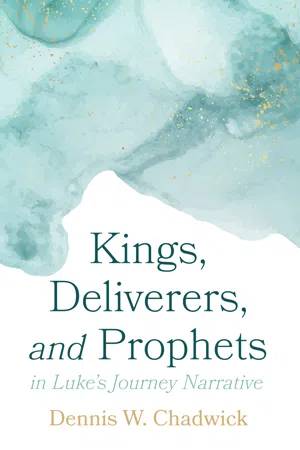
Kings, Deliverers, and Prophets in Luke’s Journey Narrative
About this book
Kings, Deliverers, and Prophets brings a new biblical perspective to the much-debated question of the meaning of Luke's journey narrative. Dennis W. Chadwick identifies and documents three extended sequences of Old Testament echoes in Luke 9-19 by which Luke confirms that Jesus is the eschatological king, the eschatological deliverer, and the eschatological prophet.
Information
Topic
Theology & ReligionSubtopic
Biblical StudiesThey placed the Chest of God on a brand-new oxcart . . . David . . . brought up
the Chest of God . . . celebrating extravagantly all the way.
2 Sam 6:3, 12 (MSG)
‘You’ll find a colt tethered, one that has never been ridden’ . . . . They helped Jesus get on.
As he rode, the people gave him a grand welcome.
Luke 19:30, 35–37 (MSG)
1
Entering In
The best-known parables of Jesus are The Good Samaritan and The Prodigal Son. These parables (along with several other strong contenders for best-known) appear only in Luke’s Gospel, and do not appear in the other canonical Gospels. The same is true of iconic encounters in Luke that Jesus had with his dinner hosts, Martha and Zacchaeus.
These famous Gospel episodes reside within just the middle chapters of the Third Gospel, in a well-defined section of the story that narrates the journey of Jesus and his disciples from Galilee to Jerusalem (Luke 9:51—19:44). Luke’s journey narrative holds the only occurrence in any of the Gospels of nine parables, three healings, three other life-changing encounters, two discourses, and one lament.1
The same journey in Matthew’s Gospel boasts only seventy-four verses of text, making up a little over two chapters (19:1—21:11). Mark describes the journey in sixty-three verses, mostly in one chapter of his Gospel (10:1—11:11). Matthew and Mark write approximately the same account of the journey.2 Luke unfolds his journey narrative in 424 verses (about ten chapters), telling a story that ends like the others do, but which otherwise is a mostly different and much longer story. Luke shapes the journey story uniquely and expansively, quite unlike Matthew’s or Mark’s telling.
And it is not simply that Luke is a more exacting storyteller when it comes to the journey to Jerusalem. If anything, Matthew and Mark propel their accounts forward more effectively than Luke does. Luke provides episode after episode, chapter after chapter, describing no discernable movement down the road, and often with little or no discernable sequence of any other kind between episodes. In his journey narrative, Luke is up to something that has little relationship to movement on the landscape or the passage of time.
Luke tells Theophilus (1:1–4) that the narrative is “orderly, kathexēs” (1:3). The evangelist once uses the word “orderly” elsewhere to mean a series of places along a route (Acts 18:23), but the narrative in Luke 9:51—19:44 does not offer such an itinerary. Yes, the journey narrative begins and ends with a few episodes following a route, but 80 percent of the narrative offers little movement. Overall order in 9:51—19:44 must be another sort of order.
Luke reports Peter using the word “orderly” as Peter recalls for his listeners the sequence in time of God’s prophets (Acts 3:24). But in Luke’s narration of the journey, transitions between reported episodes rarely emphasize one event following another in an explicitly progressive sequence of time, especially in that middle 80 percent. Collective order in the Lukan journey is an order of neither time nor place.
While the story of Jesus in the remainder of Luke’s narrative unfolds in sequences of time and place, Luke invests the journey portion with different order, a kind of literary order. Luke 9:51—19:44 systematically echoes stories of God’s great Old Testament (OT) servants. This book explores structured echoes of the OT in Luke’s journey narrative.
We will explore an echoed relationship between Luke’s journey narrative and the OT books of Numbers, Judges, 1–2 Samuel, and 1–2 Kings. We will examine how Luke 9:51—19:44, by this means, confirms texts earlier in Luke that proclaim Jesus as the eschatological deliverer, as the eschatological king, and as the eschatological prophet. Luke does so by compiling and editing a unique Galilee-to-Jerusalem journey narrative in which Jesus’ acts and words echo those of Moses (from Sinai to the Jordan) and the Judges, echo David’s odyssey to the throne, and echo the ministries of Elijah, Elisha, and other prophets to the Northern Kingdom of Israel.3
In ...
Table of contents
- Title Page
- Preface
- Acknowledgments
- Chapter 1: Entering In
- Chapter 2: Luke’s Reflections of King David’s Odyssey
- Chapter 3: Luke’s Imitation of Moses as Deliverer
- Chapter 4: Luke’s Parallels of Judges as Deliverers
- Chapter 3: Luke’s Echoes of the Prophets Elijah and Elisha
- Chapter 6: The Purpose of Luke’s Journey Narrative
- Appendix 1: The Roles of Luke 13:31–35
- Appendix 2: Richard Hays and Echoes of Scripture in the Gospels
- Bibliography
Trusted by 375,005 students
Access to over 1.5 million titles for a fair monthly price.
Study more efficiently using our study tools.
Frequently asked questions
Yes, you can cancel anytime from the Subscription tab in your account settings on the Perlego website. Your subscription will stay active until the end of your current billing period. Learn how to cancel your subscription
No, books cannot be downloaded as external files, such as PDFs, for use outside of Perlego. However, you can download books within the Perlego app for offline reading on mobile or tablet. Learn how to download books offline
Perlego offers two plans: Essential and Complete
- Essential is ideal for learners and professionals who enjoy exploring a wide range of subjects. Access the Essential Library with 800,000+ trusted titles and best-sellers across business, personal growth, and the humanities. Includes unlimited reading time and Standard Read Aloud voice.
- Complete: Perfect for advanced learners and researchers needing full, unrestricted access. Unlock 1.5M+ books across hundreds of subjects, including academic and specialized titles. The Complete Plan also includes advanced features like Premium Read Aloud and Research Assistant.
We are an online textbook subscription service, where you can get access to an entire online library for less than the price of a single book per month. With over 1.5 million books across 990+ topics, we’ve got you covered! Learn about our mission
Look out for the read-aloud symbol on your next book to see if you can listen to it. The read-aloud tool reads text aloud for you, highlighting the text as it is being read. You can pause it, speed it up and slow it down. Learn more about Read Aloud
Yes! You can use the Perlego app on both iOS and Android devices to read anytime, anywhere — even offline. Perfect for commutes or when you’re on the go.
Please note we cannot support devices running on iOS 13 and Android 7 or earlier. Learn more about using the app
Please note we cannot support devices running on iOS 13 and Android 7 or earlier. Learn more about using the app
Yes, you can access Kings, Deliverers, and Prophets in Luke’s Journey Narrative by Dennis W. Chadwick in PDF and/or ePUB format, as well as other popular books in Theology & Religion & Biblical Studies. We have over 1.5 million books available in our catalogue for you to explore.