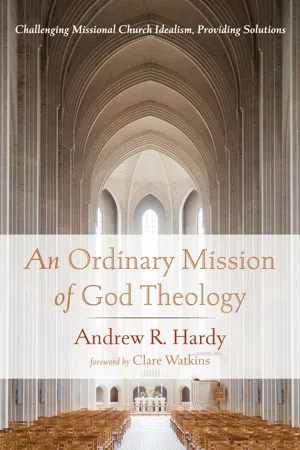
eBook - ePub
An Ordinary Mission of God Theology
Challenging Missional Church Idealism, Providing Solutions
- 250 pages
- English
- ePUB (mobile friendly)
- Available on iOS & Android
eBook - ePub
An Ordinary Mission of God Theology
Challenging Missional Church Idealism, Providing Solutions
About this book
The mission church literature seems to be dominated by idealized conceptions of the benefits of equipping congregations to participate in local mission work. This investigation challenges this idealism, by paying critical attention to congregants' ordinary theologies that develop in reaction to the communication of Missio Dei theology to them. Their voices are absent from the formal literature. The study employs rescripting methodology to modify key assumptions made in the formal ecclesiological literature by drawing on insights that come from Christians' ordinary theological voices.
The study traces how the introduction of a Missio Dei theology to a British Reformed congregation had a significant impact on them. A small team of Christian leaders communicated Missio Dei theology to this church over a period of six years. It found that mission changes came at substantial personal cost to the church's members: 1) a schism occurred when congregants attempted to remove the leader responsible for these changes from his office as church pastor, and a third of congregants left the church because they did not want to embrace the church's new mission identity; 2) three divergent groups then emerged--two of them wanted different kinds of churches that seemed incompatible; 3) two thirds of members supported and participated in the church's mission activities, which put strains on some of their families; 4) unresolved tensions continued to impact the congregation throughout the whole change process; 5) unexpectedly, for a Reformed church, a third group made up of women developed prophetic practices that arose due to the mediation of Missio Dei theology. Vitally, this thesis challenges the notion that helping churches to become mission-focused will make them thrive.
Information
Topic
Teologia e religioneSubtopic
Chiesa cristianaChapter 1
Introduction
Introduction
This book concentrates on the impact of the communication of a Mission of God theology to a congregation named Phoenix. I will explain in this chapter why it is important to concentrate on this kind of theology because of its growing influence on congregations, that are seeking to equip congregants to come to view themselves as participants in God’s mission. It will become evident in what follows that churches, like Phoenix, that have not historically concentrated on equipping their members for mission in the public square can face serious challenges when they seek to equip them for mission. I will argue that these challenges have not been given sufficient attention in the missional church literature. By paying attention to them much may be learned to avoid such challenges negatively impacting congregations in the future. I see my research as a contribution, made in all humility, to help enhance the work of respected forerunners who have been researching and writing in the field for much longer than I. My investigation seeks to provide a useful, detailed case example of what some of these challenges seem to be.
This book is based on my doctoral thesis, which I successfully completed by God’s grace in 2021. I have sought to write it in an accessible style so as to make it relevant to a wider readership, not just specialists in the field.
Stated as a question, my research asks: What impact did the communication of a Missio Dei (meaning “mission of God”) theology to Phoenix1 church have on its members? This investigation concentrates on the efforts of college2 graduates at work in this British Reformed church, who completed BAs and MAs in mission and leadership (at the college for which I worked, henceforth termed “my college”3). These graduates sought to equip members to view themselves as Christian missionaries in their church’s locality (2009–18).
It is important to note that until the employment of their new minister, Bill, in 2009, Phoenix did not seek to equip its members to engage in missionary work in its neighborhood. Bill (the senior pastor) and three other graduates (Jake, Lynda, and Becky) at work in Phoenix, learned their theology of Missio Dei from participation in my college’s missional leadership programs. I engaged in fieldwork at the church from 2016–18.
I was part of my college’s academic faculty at the time of the research and wanted to investigate the impact of Missio Dei theology, learned in its programs, on ordinary church members when it was communicated to them by college graduates. My research led to some key insights which made it clear that college programs, and much of the missional church literature, potentially need to be challenged for making some rather idealistic assumptions about the ease with which churches can be helped to become focused on local mission.
As a pilot study I initially engaged in research at Phoenix to evaluate if college programs were enabling graduates to equip congregations to become focused on mission. I noticed that a third of Phoenix’s members had left the church seemingly because some of them had reacted negatively to the experience of the congregation becoming focused on mission. Based on pilot research I found that complex tensions had developed between members because of the church’s new missional focus. This challenged a common assumption, often found in the missional church literature, that churches that become mission-focused will generally benefit because they will help their members engage in contextually relevant ministry in society.4 The evidence provided by some of Phoenix’s members suggested the need for a critical rereading of overly optimistic assumptions of this kind. In later chapters, it will become evident that my research challenges idealistic assumptions found in the formal literatur...
Table of contents
- Title Page
- Foreword
- Acknowledgments
- Abbreviations
- Glossary of Key Terms
- Chapter 1: ntroduction
- Chapter 2: Methodology
- Chapter 3: Characteristics of a Newbigin-like Missio Dei Theology
- Chapter 4: Congregational Changes
- Chapter 5: Experiences of Change
- Chapter 6: Discernment and Participation
- Chapter 7: Cost and Conflict
- Chapter 8: Conclusions and Recommendations
- Appendix A: Ethics Consent Confirmation
- Appendix B: Congregational Interviews and Consultations
- Appendix C: Sample Interview Questions
- Appendix D: Qualitative Data
- Appendix E: Congregational Questionnaire
- Appendix F: Field Notes Template
- Appendix G: Summary of Missional Projects
- Appendix H: Churches of Christ Background
- Bibliography
Trusted by 375,005 students
Access to over 1.5 million titles for a fair monthly price.
Study more efficiently using our study tools.
Frequently asked questions
Yes, you can cancel anytime from the Subscription tab in your account settings on the Perlego website. Your subscription will stay active until the end of your current billing period. Learn how to cancel your subscription
No, books cannot be downloaded as external files, such as PDFs, for use outside of Perlego. However, you can download books within the Perlego app for offline reading on mobile or tablet. Learn how to download books offline
Perlego offers two plans: Essential and Complete
- Essential is ideal for learners and professionals who enjoy exploring a wide range of subjects. Access the Essential Library with 800,000+ trusted titles and best-sellers across business, personal growth, and the humanities. Includes unlimited reading time and Standard Read Aloud voice.
- Complete: Perfect for advanced learners and researchers needing full, unrestricted access. Unlock 1.5M+ books across hundreds of subjects, including academic and specialized titles. The Complete Plan also includes advanced features like Premium Read Aloud and Research Assistant.
We are an online textbook subscription service, where you can get access to an entire online library for less than the price of a single book per month. With over 1.5 million books across 990+ topics, we’ve got you covered! Learn about our mission
Look out for the read-aloud symbol on your next book to see if you can listen to it. The read-aloud tool reads text aloud for you, highlighting the text as it is being read. You can pause it, speed it up and slow it down. Learn more about Read Aloud
Yes! You can use the Perlego app on both iOS and Android devices to read anytime, anywhere — even offline. Perfect for commutes or when you’re on the go.
Please note we cannot support devices running on iOS 13 and Android 7 or earlier. Learn more about using the app
Please note we cannot support devices running on iOS 13 and Android 7 or earlier. Learn more about using the app
Yes, you can access An Ordinary Mission of God Theology by Andrew R. Hardy in PDF and/or ePUB format, as well as other popular books in Teologia e religione & Chiesa cristiana. We have over 1.5 million books available in our catalogue for you to explore.