eBook - ePub
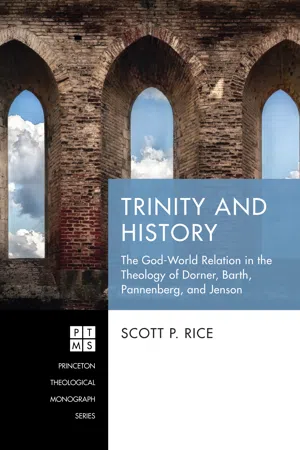
Trinity and History
The God-World Relation in the Theology of Dorner, Barth, Pannenberg, and Jenson
- 218 pages
- English
- ePUB (mobile friendly)
- Available on iOS & Android
eBook - ePub
Trinity and History
The God-World Relation in the Theology of Dorner, Barth, Pannenberg, and Jenson
About this book
How does God relate to the world? What difference does our understanding of God make for conceiving of God's relation to us? Christian theology has seen a flourishing of activity in response to these questions under a common doctrinal theme: Trinity. That said, proposals for understanding how God relates to the world through the Trinity of God's being--otherwise known as the relationship between the immanent and the economic Trinity--vary significantly. This book, reflecting on the work of four modern theologians--Dorner, Barth, Pannenberg, and Jenson--offers a set of constructive proposals on key issues relating to the God-world relation, including a way to understand divine immutability without denying God's living history with others and a trinitarian notion of divine sovereignty that demonstrates how God transcends history from within the structures of time. At each step along the way the author conveys how Trinity opens up a richer, more expansive conception of God's relation to us. This book shows how Trinity serves the practical work of theology as faith seeking understanding.
Information
Topic
Theology & ReligionSubtopic
Christian Theology1
The “Living Immutability” of God
Trinity and History in the Theology of Isaak A. Dorner
How does the doctrine of divine immutability square with the revealed vitality of God? This is the question that Lutheran mediating theologian, Isaak A. Dorner, put forth in his three-part essay for the Jahrbücher für deutsche Theologie, “On the Proper Conception of the Doctrine of God’s Immutability, with Special Reference to the Reciprocal Relation between God’s Suprahistorical and Historical Life” (1856–58).12 I begin with Dorner’s immutability essay as a way to frame the central problem of this study. The problem derives from a modified version of the question above on bridging divine immutability with God’s revealed vitality as well as, mutatis mutandis, reconciling God’s unchangeability with the living character of God’s being. I ask: How does the eternal nature of the Trinity square with the revealed vitality of God? Specifically, how does the triunity of God’s being ground and enable God’s living relation to history? The scope of these questions will include treatments of Trinity’s significance for examining divine presence, the movement of God in time, the relation between divine transcendence and immanence, and the formulation (and reformulation) of divine attributes, such as divine immutability.
This chapter, however, presents more than a mere overview of Dorner’s immutability essay that frames the basic problem of this study. My way to this problem comes through a critical engagement with the role of Trinity in Dorner’s immutability essay. I argue that Dorner applies the trinitarian understanding of God more consistently to the latter of the two problems posed above; that is, he constructively applies Trinity to the problem of reconciling immutability and the vitality of God’s being. This opens up a dynamic ontology for understanding how God relates to history through God’s triunity. But Dorner does not similarly employ Trinity for the other problem of reconciling immutability with the revealed being of God in history. The meaning of Trinity for the history that God lives with others is largely left unsaid. This lacuna in Dorner’s application of a trinitarian ontology to the God-world relation marks a gap that I attempt to fill out in subsequent chapters through engagements with the other central figures of this work. Furthermore, Dorner’s essay plays a significant role when we turn to Karl Barth’s trinitarian theology in chapter 2. While the immutability essay garnered little attention in the theological scene of Dorner’s time, it was given something of a historical lifeline shortly before the middle of the twentieth century when Barth noted his indebtedness to the work in his doctrine of God from Church Dogmatics II/1.13 In chapter 2 I use Dorner’s essay for two purposes: first, as a key point of comparison in the critical assessment of how Barth’s trinitarian theology construes God’s living relation to history; and second, to demonstrate the importance of election for a concept of immutability that includes both God’s eternal vitality and being in time.
Dorner’s constructive proposal centers on his concept of God’s ethical being in part III of the essay. In order to understand both how Dorner arrives at this notion as well as the underlying problems he identifies in the doctrine of immutability, and the role Trinity plays in fixing them, it is important to consider the immutability essay more broadly. In section 1 of this chapter I lay out Dorner’s objection to the classical understanding of immutability. Next I unpack Dorner’s initial use of trinitarian doctrine to conceive of the liveliness that underlies God’s immutability, giving specific attention to the way Dorner relates this concept to God’s involvement in creation. I then turn to Dorner’s trinitarian understanding of God’s ethical immutability. Section 2 of this chapter concludes with a critical analysis of Dorner’s account that derives the central problem of this study by recasting Dorner’s task in the immutability essay along more robustly trinitarian lines.
1: Immutability, Trinity, and the Vitality of God
1.1: The Context of the Immutability Essay
Dorner’s immutability essay is occasioned by the kenotic controversy of the mid-nineteenth century. In part I of the essay Dorner assesses this controversy. The debate, mainly between Lutheran and Reformed theologians, laid claim to the concept of the communicatio idiomatum or the communication of properties that belong to the distinct natures (human and divine) of Christ’s person. A key Lutheran figure in the debate, Gottfried Thomasius, advanced the idea that the incarnation of the Logos entails not only the non-use but the actual divestment of certain divine attributes. The Logos surrenders the relative divine attributes, or those that pertain to the divine essence in the being and activity of God ad extra (e.g., omnipotence, omnipresence) and not the necessary attributes of God such as divine love and wisdom.14
Dorner is severely critical of Thomasius’ Christology. Thomasius wants a conceivable account of the unity of divinity and humanity in Christ’s person. But to achieve this by way of a self-divestment of the Logos’ divine attributes, Dorner argues, comes at the expense of one of the very things that Thomasius wishes to uphold within the unity of Christ’s person: his deity or divine nature. Consequently, “it is not the immanent eternal Son of God, but only another, naturally subordinate ‘great man’ that becomes incarnate.”15 Moreover, Dorner takes issue with a problem that he finds endemic to the kenotic project of his contemporaries as a whole. On one hand, they dwell on a “fixed unity” between the Logos and humanity that begins at the outset of the Son’s incarnation; on the other, this unity is conceived as a goal to be attained over the course of Christ’s life. The kenoticists therefore assume an idea of divine immutability, in this case, one that dictates the terms of Christ’s personal development in time, which they otherwise oppose.16 Dorner’s dissatisfaction with the kenotic project is, however, only mildly telling of his larger aims. His constructive proposal around divine immutability becomes more clear through his foray into the doctrine of God in part II of the essay.
He begins part II with an overview of Augustine’s idea o...
Table of contents
- Title Page
- Acknowledgments
- Introduction
- Chapter 1: The “Living Immutability” of God
- Chapter 2: “Ours in Advance”
- Chapter 3: “The Trinitarian Mediated History of God”
- Chapter 4: “Unboundedly Lively”
- Conclusion: The Triune History
- Bibliography
Trusted by 375,005 students
Access to over 1.5 million titles for a fair monthly price.
Study more efficiently using our study tools.
Frequently asked questions
Yes, you can cancel anytime from the Subscription tab in your account settings on the Perlego website. Your subscription will stay active until the end of your current billing period. Learn how to cancel your subscription
No, books cannot be downloaded as external files, such as PDFs, for use outside of Perlego. However, you can download books within the Perlego app for offline reading on mobile or tablet. Learn how to download books offline
Perlego offers two plans: Essential and Complete
- Essential is ideal for learners and professionals who enjoy exploring a wide range of subjects. Access the Essential Library with 800,000+ trusted titles and best-sellers across business, personal growth, and the humanities. Includes unlimited reading time and Standard Read Aloud voice.
- Complete: Perfect for advanced learners and researchers needing full, unrestricted access. Unlock 1.5M+ books across hundreds of subjects, including academic and specialized titles. The Complete Plan also includes advanced features like Premium Read Aloud and Research Assistant.
We are an online textbook subscription service, where you can get access to an entire online library for less than the price of a single book per month. With over 1.5 million books across 990+ topics, we’ve got you covered! Learn about our mission
Look out for the read-aloud symbol on your next book to see if you can listen to it. The read-aloud tool reads text aloud for you, highlighting the text as it is being read. You can pause it, speed it up and slow it down. Learn more about Read Aloud
Yes! You can use the Perlego app on both iOS and Android devices to read anytime, anywhere — even offline. Perfect for commutes or when you’re on the go.
Please note we cannot support devices running on iOS 13 and Android 7 or earlier. Learn more about using the app
Please note we cannot support devices running on iOS 13 and Android 7 or earlier. Learn more about using the app
Yes, you can access Trinity and History by Scott P. Rice in PDF and/or ePUB format, as well as other popular books in Theology & Religion & Christian Theology. We have over 1.5 million books available in our catalogue for you to explore.