eBook - ePub
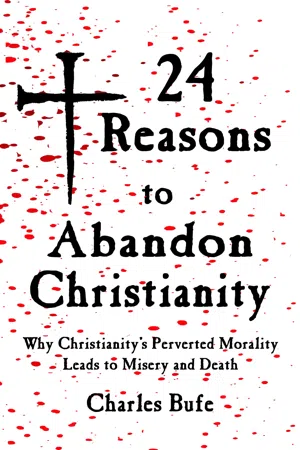
24 Reasons to Abandon Christianity
Why Christianity's Perverted Morality Leads to Misery and Death
- 340 pages
- English
- ePUB (mobile friendly)
- Available on iOS & Android
eBook - ePub
24 Reasons to Abandon Christianity
Why Christianity's Perverted Morality Leads to Misery and Death
About this book
Taking up where Christopher Hitchens'
God Is Not Great left off,
24 Reasons to Abandon Christianity reveals Christianity's cruelty, dishonesty, fear-mongering, hypocrisy, misogyny, homophobia, dogmatism, and authoritarianism, and all of the misery, destruction, and death caused by these things.
24 Reasons to Abandon Christianity also reveals the roots of these characteristics, and why Christianity leads to all of these evils. While the book treats serious topics, its tone—much like Hitchens' book—is analytical, but also breezy and biting.
Information
Topic
Theology & ReligionSubtopic
Christian Church1

Christianity Harms Children
To succeed, the theologians invade the cradle, the nursery. In the brains of innocence they plant the seeds of superstition. They pollute the minds and imaginations of children. They frighten the happy with threats of pain—they soothe the wretched with gilded lies…. Every Sunday school is a kind of Inquisition where they torture and deform the minds of children. —Robert Ingersoll, “Truth”
Emotional and Intellectual Abuse
If Christian fear mongering were directed solely at adults, it would be bad enough, but Christians routinely terrorize helpless children through grisly depictions of the endless suffering they’ll be subjected to if they don’t live obedient Christian lives; Christianity has darkened the early years of generation upon generation of children, who, ironically, victimized following generations in the same manner in which they themselves had been victimized. The nearly two thousand years of Christian terrorizing and indoctrination of children ranks as one of its greatest crimes, and it’s one that continues to this day.
As an example of Christianity’s cruel brainwashing of the innocent, consider this excerpt from an officially approved 19th-century Catholic children’s book:
Think of a coffin, not made of wood, but of fire, solid fire! And now come into this other room. You see a pit, a deep, almost bottomless, pit. Look down it and you will see something red hot and burning. It is a coffin, a red-hot coffin of fire…. It burns him [a sinful child] from beneath. The sides of it scorch him. The heavy burning lid on the top presses down close upon him; he pants for breath; he cannot breath; he cannot bear it; he gets furious … He tries with all his strength to burst open the coffin. He cannot do it. He has no strength remaining. He gives up and sinks down again. Again the horrible choking. Again he tries; again he sinks down; so he will go on forever and ever. —Rev. John Furniss, C.S.S.R.,* Tracts for Spiritual Reading: Designed for first communions, retreats, missions, &c
There are many similar passages in this sadistic little book. Commenting on it, William Meagher, Vicar-General of Dublin, states in his Approbation:
I have carefully read over this Little Volume for Children and have found nothing whatever in it contrary to the doctrines of the Holy Faith; but on the contrary, a great deal to charm, instruct and edify the youthful classes for whose benefit it has been written.
If the purpose of preaching hell to children isn’t to terrorize them, it’s hard to see what other purpose it could possibly serve. Certainly, Christians have not rushed forth to provide an answer.
As for a more modern exercise in Christian terrorizing of children, the most popular Christian feature film ever produced is Mel Gibson’s blood-curdlingly graphic torture-porn flick, The Passion of the Christ, which grossed over $600 million and is the highest earning Christian film of all time. Almost unbelievably, at least some Christian parents deliberately exposed their kids to this nonstop, nauseating exercise in gore, suffering, and sadism. One shudders to think of the emotional damage this inflicted on their innocent children; at the very least, it had to induce nightmares.
Even when indoctrination doesn’t include the induction of terror, it’s still very unfair to the child. Force feeding children absurdities as absolute truths, and insisting they shouldn’t question anything about those absurdities, short circuits their ability to think for themselves, short circuits their ability to think critically. It’s an attempt to rob children of the ability to develop a conscience of their own; it’s an attempt to rob them of the chance to determine for themselves what’s right and what’s wrong.
As Mikhail Bakunin put it in God and the State, inadvertently pointing out one of the reasons for Christianity’s emphasis on indoctrinating children:
The doctrine taught by the Apostles of Christ, wholly consoling as it may have seemed to the unfortunate, was too revolting, too absurd from the standpoint of reason, ever to have been accepted by enlightened men …
So religion—Christianity, Islam, Mormonism, Hinduism, virtually every religion—targets the young. Biologist and author Richard Dawkins explains why children are such easy prey for those who indoctrinate them:
When a child is young, for good Darwinian reasons, it would be valuable for the child to believe everything it’s told. A child needs to learn a language, it needs to learn the social customs of its people, it needs to learn all sorts of rules—like don’t put your finger in the fire, and don’t pick up snakes, and don’t eat red berries…. [T]he rule of thumb [is] ‘be fantastically gullible, believe everything you’re told by your elders and betters.’
That’s a good rule, and it works. But any rule that says ‘Believe everything you’re told’ is automatically going to be vulnerable to parasitization. Computers, for example, are vulnerable to parasitization because they believe all they’re told….
[T]he survival mechanism that makes children’s brains believe what they’re told—for good reason—is automatically vulnerable to parasitic codes such as ‘You must believe in the great juju in the sky,’ or ‘You must kneel down and face east and pray five times a day.’1
The nominally Christian Mormon Church* provides an excellent if extreme example of how childhood religious indoctrination works. From infancy, youngsters subjected to Mormon indoctrination hear day in day out that Mormonism is “true”; they’re also forced to say that they “know” that Mormonism is “true,” first in front of their families, then in front of an audience at Mormon ceremonies. To further sink in the hook, Mormon children are taught that any positive feelings they experience while praying, singing hymns, participating in Family Home Evening, testifying at worship services, etc., etc. are evidence of the truth of Mormonism. They’re also told that doubt is destructive and comes from Satan. So, they’re whipsawed between positive and negative emotions, which they’re taught to believe come either from God or the devil. The end result is that it’s very difficult for those who’ve been subjected to LDS childhood indoctrination to free themselves from it, especially so since apostates not only have to overcome their own conditioning, but all too often risk shunning by their own families if they’re open about leaving Mormonism.*
Childhood religious indoctrination sets children up for a life of obedience to others (who pretend to have a direct line to God), and who often do not have the children’s wellbeing at heart. Very often this includes channeling children into a life of fear (of the devil and hell), guilt (about sex), wasted time, and economic exploitation—wasting hours on end on Sundays and sometimes other days of the week, plus tithing to support the very institutions responsible for their indoctrination.
Just how important childhood indoctrination is to Christianity can be seen in the low adult religious conversion rate to Christianity. A 2015 Pew report showed that approximately one in three Americans have switched religious affiliation or abandoned religion entirely, and that over half of them became “nones,” with no religious affiliation;** Pew reports that 85.6% of the U.S. population was raised Christian, and 19.2% of Americans have left the various Christian sects; at the same time, converts to the various branches of Christianity made up only 4.2% of the population, an over 4 to 1 ratio.6 This means that well over 90% of American Christians are Christian because of childhood religious indoctrination.
As if to underline how fast Americans are fleeing Christianity, Pew Research reports: “Overall, 13% of all U.S. adults are former Catholics—people who were raised in the faith … By contrast, 2% of U.S. adults are converts to Catholicism—people who now identify as Catholic after having been raised in another religion (or no religion). This means that there are 6.5 former Catholics in the U.S. for every convert to the faith.”7
To put this another way, Americans are abandoning Christianity en masse. American Christianity is hemorrhaging adherents, with over half of those who leave the faith in which they were raised abandoning Christianity entirely. All of this underscores the importance to American Christian sects of the particular form of child abuse known as childhood religious indoctrination. Without it, they’d wither away.
Beyond its importance in creating religious adherence, childhood religious indoctrination invariably involves the elevation of faith over reason. It teaches children that questioning is bad, and that accepting oft-times absurd assertions at face value—in the complete lack of evidence, or in the face of contrary evidence—is somehow a good thing.
Unfortunately, habits of thought inculcated in childhood tend to carry over into adulthood. If you reject reason, evidence, and a questioning attitude in one fundamental matter, you’ll probably reject them in others. As neuroscientist Bobby Azarian puts it:
It is a combination of the brain’s vulnerability to believing unsupported facts and aggressive indoctrination that create the perfect storm for gullibility. Due to the [childhood] brain’s neuroplasticity, or ability to be sculpted by lived experiences, evangelicals literally become hardwired to believe farfetched statements.
This wiring begins when they are first taught to accept Biblical stories not as metaphors for living life practically and purposefully, but as objective truth. Mystical explanations for natural events train young minds to not demand evidence for beliefs. As a result, the neural pathways that promote healthy skepticism and rational thought are not properly developed. This inevitably leads to a greater susceptibility to lying and gaslighting by manipulative politicians, and greater suggestibility in general.8
“Manipulative politicians” want to keep it that way. A key portion of the 2012 Texas GOP platform’s education section reads as follows:
Knowledge-Based Education—We oppose the teaching of Higher Order Thinking Skill (HOTS)(values clarification), critical thinking skills and similar programs that are simply a relabeling of Outcome-Based Education (OBE) (mastery learning) which focus on behavior modification and have the purpose of challenging the student’s fixed beliefs and undermining parental authority.9
So, the evangelical-controlled Texas Republicans oppose teaching students the critical thinking skills they need to “challenge” their “fixed beliefs,” and they assert that “the purpose” of teaching critical thinking skills is to “undermin[e] parental authority.” (It’s highly unlikely that any critical-thinking-skills advocates have ever suggested “undermin[ing] parental authority.” If so, this GOP statement is an attempt to pass off a pejorative assumption, or deliberate lie, as fact.) Of course, the Republican platform also expressed opposition to sex education and early childhood education, and support for the teaching of “school subjects with emphasis on the Judeo-Christian principles upon which America was founded.”
To cite but one example of the gullibility the Texas GOP seems to prize, a 2015 Pew Research report showed that white evangelicals were the religious group most likely to be climate-change deniers, with only 28% believing that climate change is primarily due to human activity.10 In contrast, 64% of the religiously unaffiliated accepted the very well supported scientifi...
Table of contents
- Cover
- Title Page
- Copyright
- Contents
- Introduction (by Chris Edwards)
- Preface
- Acknowledgments
- 1. Christianity harms children
- 2. Christian dishonesty and hypocrisy
- 3. Christianity is based on fear
- 4. Christianity encourages cruelty to oneself
- 5. Christianity encourages cruelty to others
- 6. The Christian persecution complex
- 7. Christian egocentrism
- 8. Christian authoritarianism
- 9. Christian opposition to free speech
- 10. Christianity’s anti-scientific attitude
- 11. Christian science denial’s deadly effects
- 12. Christianity’s morbid preoccupation with sex
- 13. Christianity’s narrow, legalistic view of morality
- 14. Christianity reduces morality to an individual matter
- 15. Christianity accepts real evils while condemning imaginary evils
- 16. Christianity degrades and devalues the natural world
- 17. The Christian chosen people mentality and its deadly consequences
- 18. Christianity’s all too comfortable relationship with slavery
- 19. Christian misogyny
- 20. Christian opposition to reproductive rights
- 21. Christian homophobia
- 22. Christian antisemitism
- 23. The Bible is cruel, disorganized, and irrational
- 24. The Bible is not a reliable guide to Christ’s words
- Appendix A. Some enlightening Bible verses
- Appendix B. Some useful resources
- Bibliography
Trusted by 375,005 students
Access to over 1.5 million titles for a fair monthly price.
Study more efficiently using our study tools.
Frequently asked questions
Yes, you can cancel anytime from the Subscription tab in your account settings on the Perlego website. Your subscription will stay active until the end of your current billing period. Learn how to cancel your subscription
No, books cannot be downloaded as external files, such as PDFs, for use outside of Perlego. However, you can download books within the Perlego app for offline reading on mobile or tablet. Learn how to download books offline
Perlego offers two plans: Essential and Complete
- Essential is ideal for learners and professionals who enjoy exploring a wide range of subjects. Access the Essential Library with 800,000+ trusted titles and best-sellers across business, personal growth, and the humanities. Includes unlimited reading time and Standard Read Aloud voice.
- Complete: Perfect for advanced learners and researchers needing full, unrestricted access. Unlock 1.5M+ books across hundreds of subjects, including academic and specialized titles. The Complete Plan also includes advanced features like Premium Read Aloud and Research Assistant.
We are an online textbook subscription service, where you can get access to an entire online library for less than the price of a single book per month. With over 1.5 million books across 990+ topics, we’ve got you covered! Learn about our mission
Look out for the read-aloud symbol on your next book to see if you can listen to it. The read-aloud tool reads text aloud for you, highlighting the text as it is being read. You can pause it, speed it up and slow it down. Learn more about Read Aloud
Yes! You can use the Perlego app on both iOS and Android devices to read anytime, anywhere — even offline. Perfect for commutes or when you’re on the go.
Please note we cannot support devices running on iOS 13 and Android 7 or earlier. Learn more about using the app
Please note we cannot support devices running on iOS 13 and Android 7 or earlier. Learn more about using the app
Yes, you can access 24 Reasons to Abandon Christianity by Charles Bufe in PDF and/or ePUB format, as well as other popular books in Theology & Religion & Christian Church. We have over 1.5 million books available in our catalogue for you to explore.