How technological advances and colonial fears inspired utopian geoengineering projects during the late nineteenth and early twentieth centuries
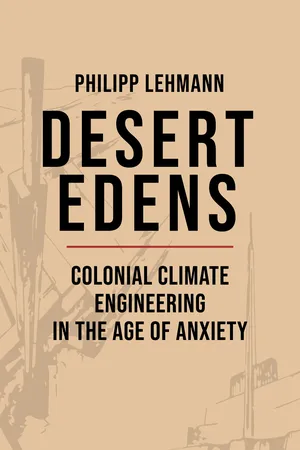
From the 1870s to the mid-twentieth century, European explorers, climatologists, colonial officials, and planners were avidly interested in large-scale projects that might actively alter the climate. Uncovering this history, Desert Edens looks at how arid environments and an increasing anxiety about climate in the colonial world shaped this upsurge in ideas about climate engineering. From notions about the transformation of deserts into forests to Nazi plans to influence the climates of war-torn areas, Philipp Lehmann puts the early climate change debate in its environmental, intellectual, and political context, and considers the ways this legacy reverberates in the present climate crisis.
Lehmann examines some of the most ambitious climate-engineering projects to emerge in the late nineteenth and early twentieth centuries. Confronted with the Sahara in the 1870s, the French developed concepts for a flooding project that would lead to the creation of a man-made Sahara Sea. In the 1920s, German architect Herman Sörgel proposed damming the Mediterranean in order to geoengineer an Afro-European continent called “Atlantropa,” which would fit the needs of European settlers. Nazi designs were formulated to counteract the desertification of Eastern Europe and Central Asia. Despite ideological and technical differences, these projects all incorporated and developed climate change theories and vocabulary. They also combined expressions of an extreme environmental pessimism with a powerful technological optimism that continue to shape the contemporary moment.
Focusing on the intellectual roots, intended effects, and impact of early measures to modify the climate, Desert Edens investigates how the technological imagination can be inspired by pressing fears about the environment and civilization.
- English
- ePUB (mobile friendly)
- Available on iOS & Android
eBook - ePub
About this book
Information
Publisher
Princeton University PressYear
2022Print ISBN
9780691239347
9780691168869
eBook ISBN
9780691238289
Table of contents
- Cover Page
- Series Page
- Title Page
- Copyright Page
- Epigraph
- Contents
- Acknowledgments
- Introduction: Climate Change and Changing Climates
- 1. A Science of Sand: The Sahara as Archive and Warning
- 2. Flooding the Desert: Roudaire’s Sahara Sea Project
- 3. New Garden Edens: The Rise of Colonial Climate Engineering
- 4. A New Climate for a New Continent: Herman Sörgel’s Atlantropa
- 5. Europe’s Last Hope: Active Geopolitics and Cultural Decline
- 6. Slavic Steppes and German Gardens: Desertification in the Third Reich
- 7. Eastern Deserts: Climate and Genocide in the Generalplan Ost
- 8. Epilogue: Global Desertification and Global Warming
- Notes
- Archives
- Index
Trusted by 375,005 students
Access to over 1.5 million titles for a fair monthly price.
Study more efficiently using our study tools.
Frequently asked questions
Yes, you can cancel anytime from the Subscription tab in your account settings on the Perlego website. Your subscription will stay active until the end of your current billing period. Learn how to cancel your subscription
No, books cannot be downloaded as external files, such as PDFs, for use outside of Perlego. However, you can download books within the Perlego app for offline reading on mobile or tablet. Learn how to download books offline
Perlego offers two plans: Essential and Complete
- Essential is ideal for learners and professionals who enjoy exploring a wide range of subjects. Access the Essential Library with 800,000+ trusted titles and best-sellers across business, personal growth, and the humanities. Includes unlimited reading time and Standard Read Aloud voice.
- Complete: Perfect for advanced learners and researchers needing full, unrestricted access. Unlock 1.5M+ books across hundreds of subjects, including academic and specialized titles. The Complete Plan also includes advanced features like Premium Read Aloud and Research Assistant.
We are an online textbook subscription service, where you can get access to an entire online library for less than the price of a single book per month. With over 1.5 million books across 990+ topics, we’ve got you covered! Learn about our mission
Look out for the read-aloud symbol on your next book to see if you can listen to it. The read-aloud tool reads text aloud for you, highlighting the text as it is being read. You can pause it, speed it up and slow it down. Learn more about Read Aloud
Yes! You can use the Perlego app on both iOS and Android devices to read anytime, anywhere — even offline. Perfect for commutes or when you’re on the go.
Please note we cannot support devices running on iOS 13 and Android 7 or earlier. Learn more about using the app
Please note we cannot support devices running on iOS 13 and Android 7 or earlier. Learn more about using the app
Yes, you can access Desert Edens by Philipp Lehmann in PDF and/or ePUB format, as well as other popular books in History & Economic History. We have over 1.5 million books available in our catalogue for you to explore.