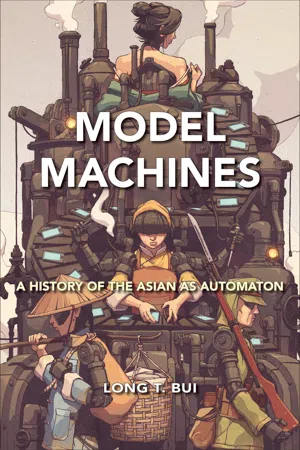
Model Machines
eBook - PDF

Model Machines

A History of the Asian as Automaton

  1. English
  2. PDF
  3. Available on iOS & Android
eBook - PDF

Model Machines

A History of the Asian as Automaton

About this book

In the contemporary Western imagination, Asian people are frequently described as automatons, which disavows their humanity. In Model Machines, Long Bui investigates what he calls Asian roboticism or the ways Asians embody the machine and are given robotic characteristics. 

Bui offers the first historical overview of the overlapping racialization of Asians and Asian Americans through their conflation with the robot-machine nexus. He puts forth the concept of the "model machine myth," which holds specific queries about personhood, citizenship, labor, and rights in the transnational making of Asian/America. 

The case studies in Model Machines chart the representation of Chinese laborers, Japanese soldiers, Asian sex workers, and other examples to show how Asians are reimagined to be model machines as a product of globalization, racism, and colonialism. Moreover, it offers examples of how artists and everyday people resisted that stereotype to consider different ways of being human. Starting from the early nineteenth century, the book ends in the present with the new millennium, where the resurgence of China presages the "rise of the machines" and all the doomsday scenarios this might spell for global humanity at large.

Frequently asked questions

Yes, you can cancel anytime from the Subscription tab in your account settings on the Perlego website. Your subscription will stay active until the end of your current billing period. Learn how to cancel your subscription.
No, books cannot be downloaded as external files, such as PDFs, for use outside of Perlego. However, you can download books within the Perlego app for offline reading on mobile or tablet. Learn more here.
Perlego offers two plans: Essential and Complete
  • Essential is ideal for learners and professionals who enjoy exploring a wide range of subjects. Access the Essential Library with 800,000+ trusted titles and best-sellers across business, personal growth, and the humanities. Includes unlimited reading time and Standard Read Aloud voice.
  • Complete: Perfect for advanced learners and researchers needing full, unrestricted access. Unlock 1.4M+ books across hundreds of subjects, including academic and specialized titles. The Complete Plan also includes advanced features like Premium Read Aloud and Research Assistant.
Both plans are available with monthly, semester, or annual billing cycles.
We are an online textbook subscription service, where you can get access to an entire online library for less than the price of a single book per month. With over 1 million books across 1000+ topics, we’ve got you covered! Learn more here.
Look out for the read-aloud symbol on your next book to see if you can listen to it. The read-aloud tool reads text aloud for you, highlighting the text as it is being read. You can pause it, speed it up and slow it down. Learn more here.
Yes! You can use the Perlego app on both iOS or Android devices to read anytime, anywhere — even offline. Perfect for commutes or when you’re on the go.
Please note we cannot support devices running on iOS 13 and Android 7 or earlier. Learn more about using the app.
Yes, you can access Model Machines by Long T. Bui in PDF and/or ePUB format, as well as other popular books in Social Sciences & Asian American Studies. We have over one million books available in our catalogue for you to explore.

Table of contents

  1. Contents
  2. List of Images
  3. Acknowledgments
  4. Introduction: The Model Machine Myth
  5. 1. Labor Machines: Fighting the Mechanized Coolie in the Age of Industrial Slavery
  6. 2. War Machines: Assembling the Robotic Japanese Soldier under the Shadow of Empire
  7. 3. Sex Machines: Exploiting the Bionic Woman of Color for the Cold War Economy
  8. 4. Virtual Machines: Containing the Alien Cyborg during the Era of Late Capitalism
  9. 5. Global Machines: Reconfiguring the Roboticized Asian within the New Millennium
  10. Epilogue: On Posthuman Historical Futures
  11. Notes
  12. Bibliography
  13. Index