"The Meddlers is an eye-opening, essential new history that places our international financial institutions in the transition from a world defined by empire to one of nation states enmeshed in the world economy."
—Adam Tooze, Columbia University
An award-winning history traces the origins of global economic governance—and the political conflicts it generates—to the aftermath of World War I.
International economic institutions like the International Monetary Fund and World Bank exert incredible influence over the domestic policies of many states. These institutions date from the end of World War II and amassed power during the neoliberal era of the late twentieth century. But as Jamie Martin shows, if we want to understand their deeper origins and the ideas and dynamics that shaped their controversial powers, we must turn back to the explosive political struggles that attended the birth of global economic governance in the early twentieth century.
The Meddlers tells the story of the first international institutions to govern the world economy, including the League of Nations and Bank for International Settlements, created after World War I. These institutions endowed civil servants, bankers, and colonial authorities from Europe and the United States with extraordinary powers: to enforce austerity, coordinate the policies of independent central banks, oversee development programs, and regulate commodity prices. In a highly unequal world, they faced a new political challenge: was it possible to reach into sovereign states and empires to intervene in domestic economic policies without generating a backlash?
Martin follows the intense political conflicts provoked by the earliest international efforts to govern capitalism—from Weimar Germany to the Balkans, Nationalist China to colonial Malaya, and the Chilean desert to Wall Street. The Meddlers shows how the fraught problems of sovereignty and democracy posed by institutions like the IMF are not unique to late twentieth-century globalization, but instead first emerged during an earlier period of imperial competition, world war, and economic crisis.
eBook - ePub
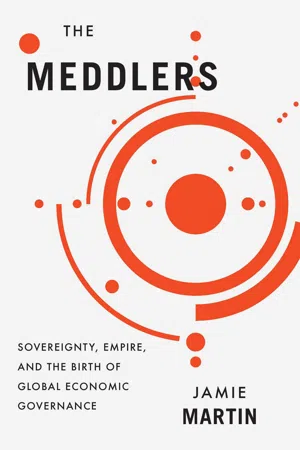
The Meddlers
Sovereignty, Empire, and the Birth of Global Economic Governance
- 345 pages
- English
- ePUB (mobile friendly)
- Available on iOS & Android
eBook - ePub
About this book
Information
CHAPTER 1 Managing the Global Economy during the First World War
THE OUTBREAK OF THE First World War appeared to bring an era of global economic integration to a disastrous end.1 The establishment of wartime exchange controls, the suspension of the gold standard, and the weaponization of commerce severed ties that linked merchants and bankers around the world and precipitated a slump in the total volume of global trade, which had grown exponentially in the decades before. But the war itself was also a profoundly global event. It was waged with soldiers, workers, and resources from around the world and led to the establishment of the first international institutions to wield real governmental powers over the global capitalist system.2
These institutions emerged out of imperial efforts to organize the world economy for the sake of the Allied war effort against the Central Powers. They were established over the course of the war, and with accelerated speed in 1918, to ensure the Allies a steady supply of energy resources, raw materials, and food, and an efficient means of arranging their transport from all corners of the earth. Well before the outbreak of the war, it had become obvious that the dependence of European powers on overseas sources of important goods left them vulnerable to blockade.3 During the First World War, Britain exploited this vulnerability by targeting Germany with a comprehensive seaborne strategy of resource denial; Germany countered with a campaign of submarine warfare designed to starve Britain into defeat before it brought the United States into the war. With the resumption of unrestricted attacks on Allied and neutral shipping by German U-boats in early 1917, competition between the Allies over scarce goods and ships began to jeopardize their war effort. Waging total war in a globalized world economy required radically new institutions. The innovation of the Allies was to replace the market-driven allocation of goods and ships with a system of government purchasing, price-fixing, distribution, and transport. This was, in effect, a system of international economic planning. After the United States entered the war, this system provided an institutional framework for managing what was, until that point, the single greatest concentration of economic power in human history. It offered the Allies a crucial strategic advantage and laid the foundations for the first postwar experiments in governing the world economy.4
These Allied arrangements raised fraught questions about the degree of autonomy that governments were willing to relinquish and the sacrifices that they could be expected to demand of private interests. Conflict broke out among governments over the stakes of opening metropolitan and colonial resources, merchant shipping, and the activities of domestic firms to the reach of other powers. Private firms, chafing under new regulations, fought against them. Still, many in the European Allied countries saw these bodies as laying the foundations for something new: a postwar international institution that could be used to enforce economic sanctions against Germany, facilitate industrial reconstruction, and prevent unemployment at home. Such an institution would need to exercise real powers over the domestic economic policies of sovereign states: setting prices for strategic resources, deciding export and import rules, and coordinating global transport. Whether these arrangements would be possible or desirable after the emergency conditions of the war had passed was a question that affected governments, businesses, and workers from Europe to Latin America, and that led to disputes among liberals, socialists, and conservatives.
By 1920, however, the transformation of the wartime Allied bodies into a postwar international institution had, in part, been realized. These bodies provided a direct institutional foundation for the creation of the Economic and Financial Organization of the League of Nations—the world’s first peacetime intergovernmental economic institution.5 But this transformation played out in ways that were distinct from what many had imagined during the war. The League inherited from the wartime bodies new procedures for intergovernmental cooperation: the coordination of national bureaucracies through a standing international body that did not itself wield executive powers over domestic policy-making. This form of intergovernmental cooperation lay at the heart of the League’s many technical agencies, as well as future institutions of the European Union; it was no coincidence that one of founders of the Allied system, Jean Monnet, later became one of the pioneers of European integration.6 Yet this foundational moment of technocratic internationalism also marked a significant departure and a chastening of ambitions. The creation of the League involved the abandonment of far more interventionist plans for a system of international resource control that would have entailed an unprecedented degree of external involvement in the domestic production and trade policies of the resource-rich Allied empires and the United States.
Allied economic cooperation in 1918 offered postwar planners two competing lessons. First, the international coordination of national bureaucracies could be used to solve complex international economic problems in ways that could be sold to national governments anxious about foreign interference in their domestic affairs. Second, an international institution controlling global supplies of raw materials and foodstuffs could be used as a powerful tool to punish enemies and reward friends. After the war, the League of Nations was designed with the first lesson in mind, in part to avoid the sacrifices demanded by the second. The birth of the first peacetime institution of global economic governance was made possible only once its jurisdictional reach was clarified: It would not be permitted to encroach on the domestic affairs of the Great Powers, even as they continued to exercise similar powers over many other countries around the world.
The Evolution of Inter-Allied Economic Cooperation
Wartime Allied experiments in controlling global trade and shipping were inaugurated in response to the unprecedented logistical challenges of an industrialized conflict that was waged from East Africa to Flanders to Mesopotamia and that by 1918 had come to involve nearly every sovereign country on the earth. They were made possible by the prior expansion of national economic powers in all major European belligerents, as well as in the colonial territories of the Allied empires. This process began in 1914–1915. As hopes for a short conflict fizzled, attritional warfare along the Western Front required extraordinary levels of industrial mobilization. In August 1914, a raw materials office was set up in the Prussian War Ministry under the German industrialist Walther Rathenau to requisition and allocate goods for war production. It is widely considered the world’s first experiment in national economic planning.7 In Britain and France, new ministries were created in 1915 to direct the production of munitions after a severe shortage of shells exposed the need for further government intervention in industry. As the war continued, states developed additional economic powers, including controls over imports and exports, shipping, and supplies of food and raw materials. New forms of taxation were introduced. Central banks, many of which had long enjoyed de facto political independence, were mobilized to help finance the costs of war. This was true in the United States as well. After it joined the war in April 1917, Bernard Baruch, a financier and adviser to Woodrow Wilson, was put in charge of a controversial public-private institution to coordinate US industrial mobilization: the War Industries Board.8
The Allied powers gradually coordinated some of these national economic controls to establish new forms of intergovernmental economic cooperation. This was done in response to two related problems: first, the inflation of prices for key goods caused by competitive purchasing between the Allies; and second, a shortage of ships needed to transport raw materials; food; energy resources; and later, US troops to Europe. The first Allied supply organization was created at the beginning of the war to coordinate Allied orders for purchases in Britain in order to prevent competitive bidding from pushing up the prices of important goods too high. Another was set up in 1916 to arrange the joint purchase, allocation, and transportation of wheat. The so-called Wheat Executive was designed, as one French account later put it, to replace a “chaotic system” with “a rational and complete organization.”9 As the war became more complex in 1917–1918, controlling global supply chains moved to the center of Allied strategy.
The development of new institutions of inter-Allied economic cooperation accelerated in 1917 as the lethality of the German submarine campaign led to a crisis of Allied shipping. Throughout the war, France and Italy had relied heavily on Britain’s merchant fleet to carry their imports. In the first months of 1917, the resumption of unrestricted submarine warfare complicated the ad hoc provision of British ships. Even after the development of the convoy system later that year reduced losses of tonnage, unexpectedly poor harvests in France and Italy exacerbated these countries’ dependence on imports of food. The US entry into the war in April 1917 threatened to place additional burdens on transport. That summer, French officials pleaded with their British counterparts to establish a system for pooling all available ships according to need.10 They claimed that France faced the prospect of a “food revolution” that would force it out of the war—a clear reference to the revolution that had broken out that winter among a Russian population radicalized by hunger. From the vantage point of the British War Cabinet, the dire situation faced by France and Italy was fundamentally a problem of shipping. Any solution to it required a tough choice between prioritizing the feeding of civilians or the supply of raw materials and munitions.11
The French request for a shipping pool reflected the importance by 1917 of controlling the seas, and the resources carried across them, to a conflict that is remembered most vividly as a grinding war of attrition in the trenches.12 While solving these supply problems was critical to Allied success, the French request had dramatic implications for the British Empire. It was, in effect, a demand for Britain to relinquish full sovereign control over a principal source of its national strength: its unrivaled shipping capacity. At first, the British government rebuffed this demand. But in late 1917, an agreement was reached with France and Italy to allocate Allied shipping according to national food-import requirements. A more extensive system of shipping control involving the US government was finalized in the final weeks of the year. At inter-Allied meetings in Paris, which took place just after the Bolsheviks seized power in Petrograd, an agreement was reached to establish an Allied shipping council. Its purpose was to arrange the most efficient allocation of all available tonnage on the basis of each country’s import requirements, whether of raw materials, food, energy resources, or munitions.13
The plans for this organization were guided by the ideas of two young French and British technocrats. One was Jean Monnet, then in his twenties, who before the war had worked in his family’s cognac business before joining the French state and becoming an influential deputy to the minister of commerce, Étienne Clémentel. The other was Arthur Salter, an ambitious career civil servant in his thirties, who had risen up the ranks of the British Admiralty and Ministry of Shipping. Their efforts to create the Allied Maritime Transport Council were guided by a simple but profound insight: It was easier to deal with international economic problems if they were removed from the politicized domain of diplomacy and given to ostensibly nonpolitical bureaucrats who could coordinate their work across national lines. Their attempts to put this insight into practice launched their intertwined, decades-long careers, as they became the leading lights of a generation of European economic internationalists—collaborating as architects in the foundation and early economic work of the League of Nations, overseeing development work in Nationalist China, and again managing problems of Allied supply and shipping during the Second World War.14
Their first act of collaboration in 1917–1918 involved navigating a thorny political question: how to create an international institution powerful enough to be effective on the national level without appearing to threaten governments with the prospect of foreign involvement in domestic policies that implicated problems of security or distribution. While the British had been the first to drag their feet over plans for a shipping pool when the French proposed it in the summer of 1917, it was the Wilso...
Table of contents
- Cover
- Title Page
- Copyright
- Dedication
- Contents
- Introduction
- 1. Managing the Global Economy during the First World War
- 2. Enforcing Austerity in Postwar Europe
- 3. An Independent International Bank
- 4. The Origins of International Development
- 5. Controlling Commodities
- 6. Sovereignty and the IMF
- Conclusion
- Abbreviations
- Notes
- Acknowledgments
- Index
Trusted by 375,005 students
Access to over 1.5 million titles for a fair monthly price.
Study more efficiently using our study tools.
Frequently asked questions
Yes, you can cancel anytime from the Subscription tab in your account settings on the Perlego website. Your subscription will stay active until the end of your current billing period. Learn how to cancel your subscription
No, books cannot be downloaded as external files, such as PDFs, for use outside of Perlego. However, you can download books within the Perlego app for offline reading on mobile or tablet. Learn how to download books offline
Perlego offers two plans: Essential and Complete
- Essential is ideal for learners and professionals who enjoy exploring a wide range of subjects. Access the Essential Library with 800,000+ trusted titles and best-sellers across business, personal growth, and the humanities. Includes unlimited reading time and Standard Read Aloud voice.
- Complete: Perfect for advanced learners and researchers needing full, unrestricted access. Unlock 1.5M+ books across hundreds of subjects, including academic and specialized titles. The Complete Plan also includes advanced features like Premium Read Aloud and Research Assistant.
We are an online textbook subscription service, where you can get access to an entire online library for less than the price of a single book per month. With over 1.5 million books across 990+ topics, we’ve got you covered! Learn about our mission
Look out for the read-aloud symbol on your next book to see if you can listen to it. The read-aloud tool reads text aloud for you, highlighting the text as it is being read. You can pause it, speed it up and slow it down. Learn more about Read Aloud
Yes! You can use the Perlego app on both iOS and Android devices to read anytime, anywhere — even offline. Perfect for commutes or when you’re on the go.
Please note we cannot support devices running on iOS 13 and Android 7 or earlier. Learn more about using the app
Please note we cannot support devices running on iOS 13 and Android 7 or earlier. Learn more about using the app
Yes, you can access The Meddlers by Jamie Martin in PDF and/or ePUB format, as well as other popular books in History & Economic History. We have over 1.5 million books available in our catalogue for you to explore.