As social media dominates our lives in increasing intensity, the need for developers to understand the theory and applications is ongoing as well. This book serves that purpose.
Social network analysis is the solicitation of network science on social networks, and social occurrences are denoted and premeditated by data on coinciding pairs as the entities of opinion.
The book features:
Social network analysis from a computational perspective using python to show the significance of fundamental facets of network theory and the various metrics used to measure the social network.
An understanding of network analysis and motivations to model phenomena as networks.
Real-world networks established with human-related data frequently display social properties, i.e., patterns in the graph from which human behavioral patterns can be analyzed and extracted.
Exemplifies information cascades that spread through an underlying social network to achieve widespread adoption.
Network analysis that offers an appreciation method to health systems and services to illustrate, diagnose, and analyze networks in health systems.
The social web has developed a significant social and interactive data source that pays exceptional attention to social science and humanities research.
The benefits of artificial intelligence enable social media platforms to meet an increasing number of users and yield the biggest marketplace, thus helping social networking analysis distribute better customer understanding and aiding marketers to target the right customers.
Audience
The book will interest computer scientists, AI researchers, IT and software engineers, mathematicians.
1 Overview of Social Network Analysis and Different Graph File Formats
Abhishek B.1* and Sumit Hirve2
1Department of Mechanical Engineering, University of Applied Sciences, Emden Leer, Germany
2Department of Computer Engineering, College of Engineering Pune, Pune, India
Abstract
Evaluating the public data from person-to-person communication destinations through the social network could create invigorating outcomes and bits of knowledge on the general assessment of practically any product, administration, or conduct. One of the best and precise public notion pointers is through information mining from social networks, as numerous clients seem to state their viewpoints on the social networks. The innovation in the Internet technologies figured out how to expand action in contributing to a blog, labeling, posting, and online informal communication. Therefore, individuals are beginning to develop keen on mining these immense information assets to evaluate the viewpoints. The Social Network Analysis (SNA) is the way toward researching social designs using graph hypothesis and networks. It integrates an assortment of procedures for analyzing the design of informal organizations, in addition with the hypotheses that target describing the hidden elements and the patterns in this framework. It is an intrinsically integrative field, which initially emerged from the sectors of graph hypothesis, statistics, and sociopsychology. This chapter will cover the hypothesis of SNA, with a short prologue to graph hypothesis and data spread. Then discuss the role of Python in SNA, followed up by building and suggesting informal communities from genuine Pandas and text-based data sets.
Keywords: Data mining, SNA, viewpoint dynamics, graph hypothesis, Python
1.1 Introduction—Social Network Analysis
A network of interactions, where the nodes comprise of number of people, and the edges comprise of interaction among the people are termed as social network [1]. The numbers of social networks and the strategies to analyze them are available since the past decades [2]. Statistics, graph theory, and sociology are the basics for the development of the area of social networks and are used in number of fields, such as business, economy, and information science [3, 4]. The analysis of a social network is analogous to the analysis of a graph because of the presence of graph, like topology of the social network. Graph analysis consists of a number of strategies but is not suitable to analyze the social networks [5–7] because of its complex characteristics. A very large-sized social network comprises of millions of edges and nodes, where the node generally possess number of attributes. The complex and large graph of social network cannot be managed using the old graph analysis strategies [8].
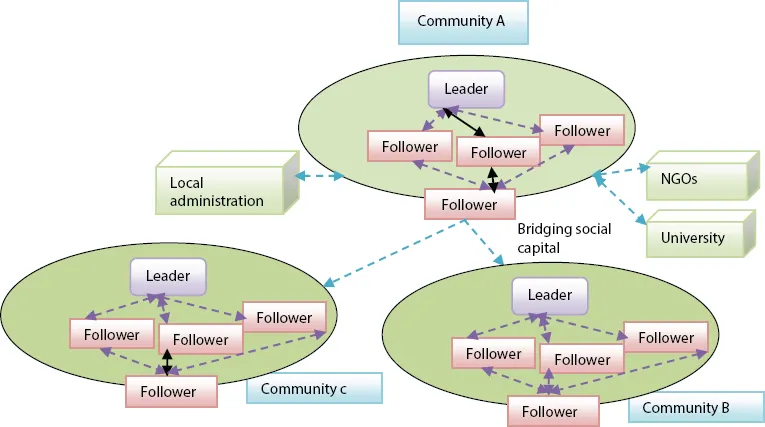
Email network, collaboration network, and telephone network are the various types of social networks. However, recent online social networks, like Twitter, Facebook, and LinkedIn, have gained increased popularity within a short period with a greater number of users. It was found with a survey that Facebook has crossed more than 500 million users in the year 2010 [8]. Social media acts as a highly recognized platform with rich source of data assisting well in the field of marketing of various brands, responding to changes in marketing, enhancing the brands through promotion, and eventually attaining a large number of customers [9–11]. In particular, the role of social network is very important in the area of healthcare applications. As such, the healthcare sector requires discovering new traditions to control the provider practice and measure the best practices to satisfy and improve the health outcomes. Social network analysis (SNA) concentrates on evaluating the relation among individuals, who are attached by one or more knot of interdependency, like friendship, love, trust, cooperation, or communication. Social network analysis can provide imminent into evaluating and understanding the specialized networks of communication and, hence, developing effective interventions in the network to enhance the performance of the provider and eventually, the outcomes related to health [12]. The diagrammatic representation of SNA is shown in Figure 1.1.
For illustration, let us consider that the application of online social network in analyzing the contagious diseases originated with the biological pathogens, such as influenza, chickenpox, measles, and the sexually spread viruses that transfer from one person to another [13–15].
Figure 1.1 Social network analysis.
Recent studies have observed the prologue of a number of SNA models that try to clarify how opinions develop in a population [16], with the consideration of a number of social theories. These models possess a number of common characteristics with that of the spreading and epidemics. Generally, people are considered as agents with a certain state and attached by a social network. The social links is indicated using a complete graph or with more sensible complex networks. The state of the node is typically identified using the variables, which can either be discrete or continuous, with the probability to select either one or another option [17]. The nature of individuals varies with respect to time, depending on a number of update rules, mainly with the interaction of neighbors.
1.2 Important Tools for the Collection and Analysis of Online Network Data
In the recent years, the SNA has attained more concentration in various fields of research, which is because of the flexibility in operation provided by the graph theory that is involved in reducing the countless phenomena to a basic analytical form in terms of bricks and nodes. Certainly, the social relations, transportation, trading, communication strategies, and even the brain can be framed as a network and can be analyzed. This assists in the visibility of the studies related to network analysis, leading to be advantageous in education centers, academies, and universities particularly, healthcare. A number of tools were developed to make it available to a large amount of people. The SNA library and the graphical tools are made available to physicists, mathematicians, computer scientists, and so on. The SNA, being an active area of research, can also be used for unfolding human interactions and opinion diffusions. More number of dedicated tools and libraries are available even for certain peculiar applications. However, it is a time-consuming process to select the appropriate tool for a particular task, making it inconvenient for the users.
Some of the openly available tools and libraries are discussed in this section. A multilevel solution aiming on epidemic spreading simulation is represented as Network diffusion library (NDlib), which possesses a number of significant features and is available highly to the SNA practitioners as compared with other tools. Unlike other tools, the NDlib tool is accessible to technicians, like researchers, programmers, and to non-technicians, like students and analysts. NDlib helps in rectifying the drawbacks associated with the existing libraries with reduced complexity in usage. The three elements of the generic diffusion process are the graph topology, the diffusion model, and the configuration of the model.
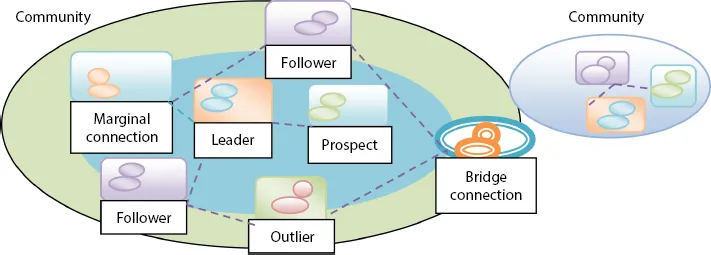
The configuration of the model is devised in such a way to provide the final user with negligible and logical interface to choose the diffusion processes. The simulation configuration interface finally permits the user to completely indicate the three different groups of data, such as the model-specific parameters, the attributes of nodes and edges, and finally, the preliminary condition of the epidemic process. The configuration model has an important role in library logic in such a way that it concentrates on the description of the experiment, thus leading the definition of the simulation logical over all the models [18]. The next significant software package is the NetworKit [19], which generally provide the graph algorithms, and is efficient in analyzing the capabilities of the network. It involves balancing certain combination of strength with its two-layer hybrid feature aware code [12]. Figure 1.2 illustrates the SNA using Python.
Social Network Importer: The SN organization is a module for NodeXL6, which is the unrestrained Excel 2010/2007 format for dissecting organization in the well-known Excel application software circumstance. The Bernie Hogan of Oxford Internet Institute delineates the NameGen7, which is considered as the antecedent of SN organization [20].
Social Network Organization Importer: SN organization makes inquiries to Facebook Administration Programming Interface (API) and permits the extortion of inner self-organization information for a provided Facebook client. Contingent upon account protection settings for conscience and revamp, the apparatus will likewise gather Facebook portrait information and restore the 1.5 degree sense of self-organization. As per the Facebook API protocols and regulation, the information must be gathered for a conscience who has given their Facebook username and secret word, and henceforth Social Network Importer is as of now basically valuable for analysts who need to gather their own inner self-organization information or that of few members who might have to utilize NodeXL on a machine that influence scientific approaches. In contradiction, NameGen is accessible as an application of Facebook, and it has permitted the designers of NameGen to gather a sense of self-organization information for individuals who assented to take part in the evaluation, where the assent was conceded by means of the establishment and utilization of the NameGen Facebook implementation. Although the SN Importer effectively conceals the interaction between the researcher and the Facebook API, the Tweepy Python library established for Twitter API is significantly more truncated level in that its utilization requires the specialist to have the option to program in Python [21]. Common utilization of Tweepy may include the specialist questioning the Twitter Search API to track down all new tweets that consist of a specific hashtag.
Figure 1.2 Social network analysis using Python.
The API of ...
Table of contents
Cover
Table of Contents
Title Page
Copyright
Preface
1 Overview of Social Network Analysis and Different Graph File Formats
2 Introduction To Python for Social Network Analysis
3 Handling Real-World Network Data Sets
4 Cascading Behavior in Networks
5 Social Network Structure and Data Analysis in Healthcare
6 Pragmatic Analysis of Social Web Components on Semantic Web Mining
7 Classification of Normal and Anomalous Activities in a Network by Cascading C4.5 Decision Tree and K-Means Clustering Algorithms
8 Machine Learning Approach To Forecast the Word in Social Media
9 Sentiment Analysis-Based Extraction of Real-Time Social Media Information From Twitter Using Natural Language Processing
10 Cascading Behavior: Concept and Models
11 Exploring Social Networking Data Sets
Index
End User License Agreement
Trusted by 375,005 students
Access to over 1.5 million titles for a fair monthly price.
Study more efficiently using our study tools.
Frequently asked questions
Yes, you can cancel anytime from the Subscription tab in your account settings on the Perlego website. Your subscription will stay active until the end of your current billing period. Learn how to cancel your subscription
No, books cannot be downloaded as external files, such as PDFs, for use outside of Perlego. However, you can download books within the Perlego app for offline reading on mobile or tablet. Learn how to download books offline
Perlego offers two plans: Essential and Complete
Essential is ideal for learners and professionals who enjoy exploring a wide range of subjects. Access the Essential Library with 800,000+ trusted titles and best-sellers across business, personal growth, and the humanities. Includes unlimited reading time and Standard Read Aloud voice.
Complete: Perfect for advanced learners and researchers needing full, unrestricted access. Unlock 1.5M+ books across hundreds of subjects, including academic and specialized titles. The Complete Plan also includes advanced features like Premium Read Aloud and Research Assistant.
Both plans are available with monthly, semester, or annual billing cycles.
We are an online textbook subscription service, where you can get access to an entire online library for less than the price of a single book per month. With over 1.5 million books across 990+ topics, we’ve got you covered! Learn about our mission
Look out for the read-aloud symbol on your next book to see if you can listen to it. The read-aloud tool reads text aloud for you, highlighting the text as it is being read. You can pause it, speed it up and slow it down. Learn more about Read Aloud
Yes! You can use the Perlego app on both iOS and Android devices to read anytime, anywhere — even offline. Perfect for commutes or when you’re on the go. Please note we cannot support devices running on iOS 13 and Android 7 or earlier. Learn more about using the app
Yes, you can access Social Network Analysis by Mohammad Gouse Galety,Chiai Al Atroshi,Buni Balabantaray,Sachi Nandan Mohanty in PDF and/or ePUB format, as well as other popular books in Technology & Engineering & Electrical Engineering & Telecommunications. We have over 1.5 million books available in our catalogue for you to explore.