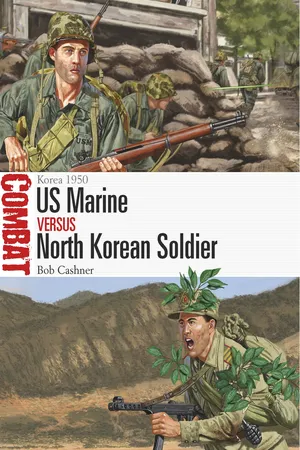
This absorbing study casts light on the tactics, weapons and combat effectiveness of the US Marines and North Korean soldiers who fought one another in August and September 1950.
Equipped with Soviet tanks and bolstered by a cadre of combat veterans returning from the Chinese Civil War, North Korea's army launched its surprise offensive against the Republic of Korea on 25 June 1950; within days Seoul had fallen and the majority of South Korea's divisions had been shattered. American ground troops rushed to Korea also seemed incapable of stopping the rapidly advancing North Koreans. By August, the remnants of the South Korean and US Army divisions had been pushed into a small corner around the port of Pusan, their backs to the sea. Time was also running out for the North Koreans; virtually all of their planning and preparations were based on a two-month campaign. Although the North Korean People's Army had enjoyed an impressive string of victories, its losses were no longer being replaced in the needed quantity or quality. It was truly a do-or-die moment for both sides.
Despite its heavily slashed budget and manpower, the Marine Corps responded swiftly and decisively. Using first-hand accounts and specially commissioned artwork, this study assesses the KPA and US Marine Corps troops participating in three crucial battles – Hill 342, the Obong-Ni Ridge and the Second Battle of Seoul – to reveal the tactics, weapons and combat effectiveness of both sides' fighting men in Korea in 1950.
- 81 pages
- English
- PDF
- Available on iOS & Android
eBook - PDF
About this book
Information
Table of contents
- Cover
- Contents
- Introduction
- The Opposing Sides
- Hill 342: August 2–9, 1950
- Obong-ni Ridge: August 17–18, 1950
- Seoul: September 25–27, 1950
- Analysis
- Aftermath
- Unit Organizations
- Bibliography
- Index
- Imprint
Trusted by 375,005 students
Access to over 1.5 million titles for a fair monthly price.
Study more efficiently using our study tools.
Frequently asked questions
Yes, you can cancel anytime from the Subscription tab in your account settings on the Perlego website. Your subscription will stay active until the end of your current billing period. Learn how to cancel your subscription
No, books cannot be downloaded as external files, such as PDFs, for use outside of Perlego. However, you can download books within the Perlego app for offline reading on mobile or tablet. Learn how to download books offline
Perlego offers two plans: Essential and Complete
- Essential is ideal for learners and professionals who enjoy exploring a wide range of subjects. Access the Essential Library with 800,000+ trusted titles and best-sellers across business, personal growth, and the humanities. Includes unlimited reading time and Standard Read Aloud voice.
- Complete: Perfect for advanced learners and researchers needing full, unrestricted access. Unlock 1.5M+ books across hundreds of subjects, including academic and specialized titles. The Complete Plan also includes advanced features like Premium Read Aloud and Research Assistant.
We are an online textbook subscription service, where you can get access to an entire online library for less than the price of a single book per month. With over 1.5 million books across 990+ topics, we’ve got you covered! Learn about our mission
Look out for the read-aloud symbol on your next book to see if you can listen to it. The read-aloud tool reads text aloud for you, highlighting the text as it is being read. You can pause it, speed it up and slow it down. Learn more about Read Aloud
Yes! You can use the Perlego app on both iOS and Android devices to read anytime, anywhere — even offline. Perfect for commutes or when you’re on the go.
Please note we cannot support devices running on iOS 13 and Android 7 or earlier. Learn more about using the app
Please note we cannot support devices running on iOS 13 and Android 7 or earlier. Learn more about using the app
Yes, you can access US Marine vs North Korean Soldier by Bob Cashner,Johnny Shumate in PDF and/or ePUB format, as well as other popular books in History & Military & Maritime History. We have over 1.5 million books available in our catalogue for you to explore.