This highly illustrated title traces the development of mercenary soldiering from individuals and small units in the African wars of the 1960s–90s to today's state-employed corporate military contractors.
The phenomenon of mercenary soldiering has constantly recurred in the news since the 1960s and has always attracted lively interest. The concept of 'mercenaries' began in the former Belgian Congo during the 1960s when men such as Mike Hoare and Bob Denard assembled hundreds of military veterans to 'do the fighting' for a particular leader or faction. This idea soon evolved into small teams of individuals training and leading local forces with varying success, from veterans of Rhodesia and on South Africa's borders to the wars in the former Yugoslavia. Former officers with recent experience set up sophisticated commercial companies to identify and fill the needs of governments whose own militaries were inadequate.
The aftermath of wars in Iraq and Afghanistan has seen such contractors taking on some of the burden of long-term security off major national armies, while the subsequent rise of ISIS/Daesh has added a parallel strain of ideological volunteers. Using first-hand accounts, photos and detailed illustrations, this book presents a compelling snapshot of the life, campaigns and kit used by mercenary operatives engaged in fighting within both larger and more specific conflicts around the world.
eBook - ePub
Soldiers of Fortune
Mercenaries and Military Adventurers, 1960–2020
- 64 pages
- English
- ePUB (mobile friendly)
- Available on iOS & Android
eBook - ePub
Soldiers of Fortune
Mercenaries and Military Adventurers, 1960–2020
About this book
Information
AFRICA
THE CONGO
Katanga, 1960–63
On 30 June 1960 the Belgian Congo celebrated independence following 52 years of colonial rule. Within days there was turmoil, with President Joseph Kasa-Vubu and Prime Minister Patrice Lumumba unable to control the vast nation’s many diverse tribes. An uprising within the ranks of the Force Publique (soon to be renamed the Congolese National Army – l’Armée Nationale Congolaise, ANC) led to Belgian military intervention, with mutineers disarmed and disbanded. However, in the mineral-rich south-eastern province of Katanga, troops loyal to the regional leader Moïse Tshombe were retained as his own army – la Gendarmerie Katangaise. On 11 July, as European residents were subjected to an increasing wave of violence throughout the Congo, Tshombe proclaimed the secession of Katanga.

These are some of the first mercenaries (or ‘volunteers’) to arrive in Katanga in 1961. They are uniformly kitted out with Belgian camouflage smocks copied from the British Denison pattern, and bush hats with a Katanga Gendarmerie badge (see Plate A1). The weapons are 7.62mm NATO FN rifles. (Nigel Osborn)
Two weeks after independence, the first troops of a United Nations peacekeeping force (ONUC) began to arrive, preparatory to taking over from departing Belgian forces. Soon afterwards, South Kasai was also declared an autonomous state by its provincial leader, Albert Kalonji. Disappointed by the ineffectiveness of the UN, Lumumba sought to resolve matters by turning to Russia for aid. Soon, his forces were sufficiently equipped to overrun Kasai, but an attempt to reclaim neighbouring Katanga failed.

This unidentified volunteer of Mike Hoare’s 5 Commando in the Congo carries a 7.62mm NATO FN MAG belt-fed general-purpose machine gun; capable of firing at up to 1,000rpm, this has impressive stopping-power. He wears 5 Cdo’s green beret (here in French style, pulled to the left) with the ANC brass badge, a Belgian smock in ‘brush-stroke’ camouflage, green drab trousers, and brown double-buckle boots. (James D. N. MacKenzie)
Tshombe faced immediate threats not just from the Congolese central government in Léopoldville (Kinshasa) and the UN, but also from the Baluba, his tribal and political rivals in northern Katanga. His solution was to bolster his forces with white mercenaries – a move that was welcomed by Katanga’s powerful Belgian-operated mining industry and resident European community.
On 14 September 1960, discord within the Léopoldville government led to the ANC chief of staff, Col Joseph Désiré Mobutu, taking control in a bloodless coup, and expelling Lumumba’s Soviet and Communist-bloc advisers. Lumumba would be assassinated in captivity a few months later. In response, Lumumbists under Antoine Gizenga formed a rival government in Stanleyville (Kisangani) in the north-eastern Orientale Province.
In February 1961, Kasa-Vubu was re-appointed as president, and in August the now-MajGen Mobutu replaced interim premier Joseph Iléo with Cyrille Adoula. Before long, the rival regimes in Léopoldville and Stanleyville were reconciled by means of a division of spoils, with key posts assigned to Gizenga and his political ally Christophe Gbenye. Unsurprisingly, such an arrangement did not sit easily with Moïse Tshombe.
By this time, 500 or more Belgian, French and English-speaking mercenaries were employed in Katanga, as well as Belgian officers seconded on contract to the Gendarmerie. At the end of August 1961 the UN conducted an operation to rid the Gendarmerie of foreign irregular and regular military personnel. Several hundred were expelled (although many would return and resume their activities). On 13 September, UN troops seized control of key points throughout Katanga. The next day, a combined mercenary/ Katangese force responded with the first in a series of assaults, against a UN company of Irish troops (A Coy, 35th Bn) at Jadotville. The attacking forces suffered heavy losses over several days, but the garrison was eventually forced to surrender (none had been killed, and the prisoners were exchanged a month later).
There followed a brief lull until 5 December 1961. Mercenaries captured by the UN were still being deported, but recruiting continued. This volatile situation continued for another year, before the UN demanded an end to Katanga’s secession. When the ultimatum was rejected, UN troops went on the offensive. Tshombe’s mercenaries and several thousand Katangese gendarmes were forced to withdraw across the southern border into the Portuguese colony of Angola. (The mercenaries included a French veteran of the Navy and colonial police who called himself Bob Denard, leading a small 1er Choc assault unit.) In mid-January 1963, Tshombe finally conceded defeat and went into exile; Katanga was reintegrated as a province of the Congo, and for a while enjoyed a period of relative calm.
The Congo, 1964–68
Early in 1964 there was an uprising in the Kwilu region of western Congo, instigated primarily by Pierre Mulele, who had received military training in China. Spearheaded by a force of teenage jeunesse, the revolt of the Simba (‘Lions’) rapidly spread. The UN, with no enthusiasm for continued involvement in the region, withdrew from the Congo on 30 June. At the same time, President Kasa-Vubu terminated Cyrille Adoula’s premiership, prior to entrusting Moïse Tshombe – returned from voluntary exile in Spain – with forming a new Congolese government. Tshombe attempted to resolve the worsening crisis by negotiation; however, by August 1964 rebel leaders were in control of more than half the country, which they renamed the Popular Republic of the Congo (la République populaire du Congo).
For Tshombe, the answer was to again employ a force of white mercenaries. He entrusted the task to Jeremiah (‘Jerry’) Puren, a World War II veteran of the South African Air Force and the RAF. Puren had been a mercenary platoon commander in Katanga, and later chief of the embryo Katangese Air Force. He was now to head air operations, and would also arrange initial recruitment of mercenaries. Puren reached out to another ex-Katanga mercenary, South African-resident former British Army officer Mike Hoare, who was given the rank of major and invited to create a mercenary unit to spearhead a ground offensive by Tshombe’s gendarmes.
Although more than 1,000 men had been recruited, only 38 arrived at Kamina air base in time for Hoare’s first operation. When told that they were to go straight into action, nine of them promptly resigned, but Hoare chose to press on. His plan was to fly his force to Kamipini, then move by road to Moba, before boating 100 miles (160km) north along Lake Tanganyika to Albertville (Kalimié). Once there, Hoare intended to secure the nearby airfield, await the landing of reinforcements, and then advance on the town.
A
KATANGA & CONGO, 1961–64
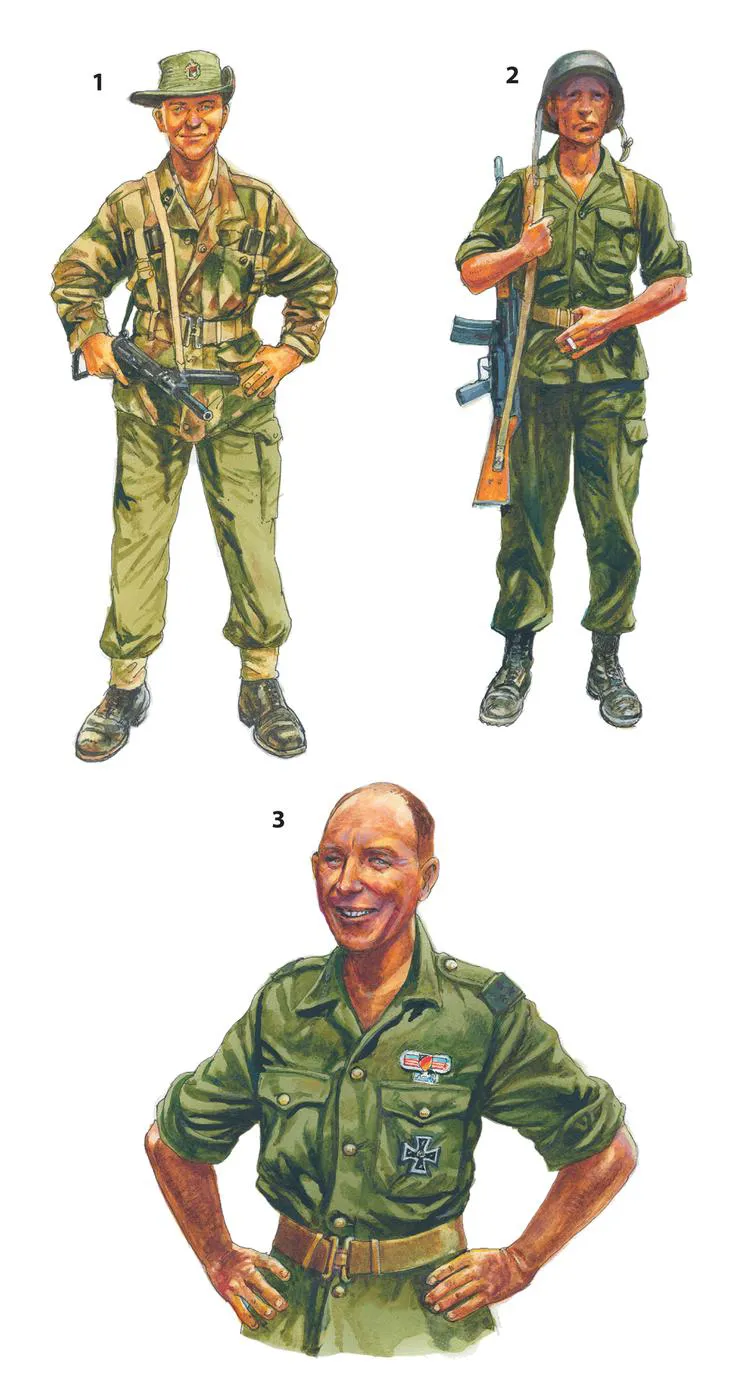
(1) Volunteer Nigel Osborn; 4 Commando, Katanga, 1961
Among the first mercenaries to arrive in Katanga in 1961 was Londoner Nigel Osborn. He had previously served in 13th/18th Royal Hussars , before joining the Compagnie Internationale (subsequently renamed 4 Commando) in Katanga. His uniform, issued in Elizabethville (Lumumbashi), comprised a Belgian Army camouflage smock, khaki trousers, and bush hat with a Katanga Gendarmerie badge. Equipment included Belgian-made British 37 Pattern web belt and shoulder braces with brace attachments, anklets, and a small pack; according to Osborn, both the uniform and webbing ‘did a good job’. Like everyone else, he was issued with a new Belgian 7.62mm FN FAL semi-automatic rifle, and as a proficient shot he was also provided with an FN49. In addition, he managed to acquire a 9mm Sten Mk II sub-machine gun (illustrated) – preferred for short-range work in close country – and nine magazines, which he carried in his chest pockets. Osborn was expelled from Katanga by the United Nations, but returned, eventually serving there for six months before departing with the rank of sergeant. He later joined the Royal Navy. and became a Fleet Air Arm helicopter pilot.
(2) Sergeant Donald Grant; 5 Commando, Congo, 1964
According to his CO Mike Hoare. Scotsman Don Grant had been awarded the Military Medal while serving with the Black Watch, and had served in Katanga before becoming a senior NCO in 5 Commando. Hoare would write that Grant ‘was a hard man, with an inbred love of fighting for itself.’ Sergeant Grant is shown wearing olive-drab uniform, British 37 Pattern web belt and a small back-pack, and an M1 helmet (all probably Belgian-made). The rifle is a Spanish M58 selective-fire CETME B chambered for the 7.62mm NATO round, but designed for use with reduced-power Spanish ammunition. This noticeably reduced the recoil, especially when firing on automatic.
(3) Captain Siegfried Müller; 5 Commando, Congo, 1964
Probably the best-known of a number of German Congo mercenaries, Müller claimed to have been in the Wehrmacht throughout World War II, serving on the Eastern Front and rising to the rank of Leutnant in April 1945, when he was awarded the Iron Cross 1st Class. After fleeing the Soviet advance, and a spell in a US prisoner-of-war camp, he joined the American-administered Labor Service. He arrived in the Congo in 1964, took part in Hoare’s failed first amphibious operation to Albertville, and was soon given command of 52 Commando. The Iron Cross is displayed on his left breast pocket, below the Labor...
Table of contents
- Cover
- Title Page
- Table of Contents
- Preface: Venezuela, May 2020
- Introduction
- Africa
- The Indian Ocean
- South America
- The Break-Up of Yugoslavia
- War in the 21st Century
- Dealing with the Fall-Out
- Select Bibliography
- eCopyright
Trusted by 375,005 students
Access to over 1.5 million titles for a fair monthly price.
Study more efficiently using our study tools.
Frequently asked questions
Yes, you can cancel anytime from the Subscription tab in your account settings on the Perlego website. Your subscription will stay active until the end of your current billing period. Learn how to cancel your subscription
No, books cannot be downloaded as external files, such as PDFs, for use outside of Perlego. However, you can download books within the Perlego app for offline reading on mobile or tablet. Learn how to download books offline
We are an online textbook subscription service, where you can get access to an entire online library for less than the price of a single book per month. With over 1.5 million books across 990+ topics, we’ve got you covered! Learn about our mission
Look out for the read-aloud symbol on your next book to see if you can listen to it. The read-aloud tool reads text aloud for you, highlighting the text as it is being read. You can pause it, speed it up and slow it down. Learn more about Read Aloud
Yes! You can use the Perlego app on both iOS and Android devices to read anytime, anywhere — even offline. Perfect for commutes or when you’re on the go.
Please note we cannot support devices running on iOS 13 and Android 7 or earlier. Learn more about using the app
Please note we cannot support devices running on iOS 13 and Android 7 or earlier. Learn more about using the app
Yes, you can access Soldiers of Fortune by Anthony Rogers,Peter Dennis,Peter Dennis,Peter Dennis in PDF and/or ePUB format, as well as other popular books in History & 20th Century History. We have over 1.5 million books available in our catalogue for you to explore.