An illustrated study of the little-known history of the failed Allied bombing campaign designed to shatter German defenses on D-Day.
D-Day is one of the most written-about events in military history. One aspect of the invasion, however, continues to be ignored: the massive pre-assault bombardment by the Allied Expeditionary Air Force (AEAF), reinforced by RAF Bomber Command and the US Eighth Air Force on June 6 which sought to neutralize the German defenses along the Atlantic Wall. Unfortunately, this failed series of attacks resulted in death or injury to hundreds of soldiers, and killed many French civilians.
Despite an initial successful attack performed by the Allied forces, the most crucial phase of the operation, which was the assault from the Eighth Air Force against the defenses along the Calvados coast, was disastrous. The bombers missed almost all of their targets, inflicting little damage to the German defenses, which resulted in a high number of casualties among the Allied infantry. The primary cause of this failure was that planners at Eighth Air Force Headquarters had changed aircraft drop times at the last moment, to prevent casualties amongst the landing forces, without notifying either Eisenhower or Doolittle.
This book examines this generally overlooked event in detail, answering several fundamental questions: What was the AEAF supposed to accomplish along the Atlantic Wall on D-Day and why did it not achieve its bombardment objectives? Offering a new perspective on a little-known air campaign, it is packed with illustrations, maps and diagrams exploring in detail the features and ramifications of this mission.
eBook - ePub
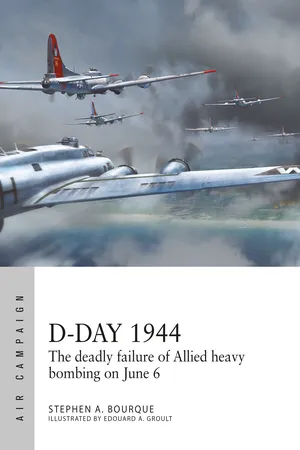
D-Day 1944
The deadly failure of Allied heavy bombing on June 6
- 96 pages
- English
- ePUB (mobile friendly)
- Available on iOS & Android
eBook - ePub
About this book
Information
THE CAMPAIGN
The invasion begins
Operation overview
Allied air attacks in support of Operation Neptune had been going on for several months before June 6. They began with medium and heavy bombers destroying French and Belgian rail yards in March and April. The purpose of these assaults, referred to as the Transportation Plan, was to prevent strategic deployment of German reserves from the Eastern Front or Italy. Then, in early May, while attacks on railyards continued, Leigh-Mallory directed his medium and fighter bombers to destroy bridges, first across the River Seine. Then, towards the end of the month, he ordered the Eighth Air Force to do the same on those across the Loire. The 21st Army Group hoped that demolishing the bridges would further delay the German operational reserves, those already in France or Belgium, from reaching the coast. Then, in support of Operation Fortitude, the deception component of Operation Overlord, Eighth Air Force bombers began attacking German troop positions and artillery batteries in the Pas de Calais. These missions were intended to reinforce the Nazi High Command’s belief that the attack would occur in the Calais–Dunkirk–Boulogne region.

One of the four H683 casemates with its 150mm gun at the Saint-Marcouf (Crisbecq) Battery. This complex was one of Bomber Command’s first targets on D-Day. However, the raid had little effect and it remained active throughout June 6, fighting with warships from the Allied naval task force all day, sinking the destroyer USS Corry. The garrison fought with the 4th Infantry Division until June 11, when it ran out of ammunition and evacuated to Cherbourg. (Jean-Erick Pasquier/Gamma-Rapho via Getty Images)
Soon after midnight on June 6, the first bombardment of the operation began. As identified earlier, what linked this series of attacks was their unified purpose: to damage or neutralize the German defensive positions and artillery batteries so the ground troops could get ashore. As the troops landed and secured their objectives, the heavy and medium bombers would shift their attention to other targets – such as bridges, rail yards, and towns – further to the rear. None of these attacks were “strategic” missions. Much to the disgust of the bomber commanders, Eisenhower was using their aircraft as flying artillery in direct tactical support of the ground units – a condition they universally detested.
Operation Flashlamp
Because of its ability to operate at night, Bomber Command was extremely busy the night of June 5/6. Operation Flashlamp, the bombardment of coastal artillery batteries, was only one of several separate actions carried out that morning by Harris’s Bomber Command. These actions included:
Operation Glimmer. Using Chaff, essentially small metal strips to deceive enemy radar, bombers conducted a convoy simulation, hoping to add confusion to the German intelligence agencies and indicate the invasion would take place in the north.
As the airborne troops were in the air, the command executed Operation Mandrel, a radio jamming effort to protect the assaulting force, and Operation ABC, with the intent of radio jamming Luftwaffe fighter control stations.
Operations Titanic I, II, and IV, designed to simulate three airborne assaults and provide diversionary cover for the actual drops. These included the parachute dummies, nicknamed Rupert or Oscar, that increased confusion among German defenders.
The main effort, however, was Operation Flashlamp, Bomber Command’s most massive operation of the war to date. By the time it was over, Harris’s bombers had dropped more than 5,000 tons of bombs on their assigned targets, “the heaviest load yet dropped during any night of the war.”

B-17 bombers from the 381st Bomb Group, seen from the ground. This is a good illustration of the heavy bomber formation used on D-Day. (USAAF, Eberly Family Special Collections Library, Penn State University Libraries)
On the receiving end of this ordnance were ten coastal artillery batteries. Planners identified five of these massive concrete installations in the American sector and five in the British and Canadian sector. Generally, about 100 aircraft dropped a total of about 500 (UK) tons on each target. Harris deployed 1,136 aircraft on these attacks. The pathfinders from No 8 Group used Oboe to mark the targets the best they could. The bombers used, in most cases, 1,000lb bombs, seeking to damage and disorient the enemy as much as possible.

Crisbecq Battery
The Crisbecq coastal battery (3rd Battery, 1261st Coast Artillery Regiment), commanded by Navy Lieutenant Walter Ohmsen and located between Saint Marcouf and Fontenay-sur-Mer, was the most dangerous installation on the southern Cotentin Peninsula. Situated on a ridge two miles west of the coast and ten miles northwest of the Utah Beach landing sector, it had a spectacular view of the naval approaches and most of the beach area. Its primary weapons were three Skoda 210mm naval guns with a range of more than 16 miles. By June 6, two were in their R683 casemates; another was operational but not yet protected. The Germans planned to mount a fourth gun, but it was not ready for combat. The installation also had a Krupp 150mm naval gun mounted in an M272 casemate with a range of about nine miles. It had a robust antiaircraft presence, with four 20mm guns and six Schneider 75mm guns, as well as eight machine-gun positions for additional close-in defense, with mines and barbed wire surrounding the entire installation. Air Vice-Marshal Edward Rice’s No 1 Group of Bomber Command hit this target at 0031hrs on June 6, with 92 Lancaster bombers dropping 598 (US) tons of ordnance. Just two of the five assigned Mosquitoes from the 8th Pathfinder Group made it to the target, so the bomb crews could only pick up a few of the target indicator flares. The crews reported light antiaircraft fire. The two guns in the casemates and anything else under concrete protection survived. The chateau in Saint Marcouf, where many German soldiers lived, took a direct hit, killing more than a dozen of them.

OPERATION FLASHLAMP
Shortly after midnight on June 5/6, 94 Lancaster bombers from No 1 Group struck the massive coastal artillery battery at Crisbecq. For the next five hours, bomber streams from other groups hit nine more coastal installations with the intent of preventing them from interfering with the Allied invasion force. By dawn, when the mission ended, 1,136 Lancaster and Halifax bombers had dropped 5,896 tons of bombs on these positions.
However, the bombers killed more than the enemy. The 120 or so citizens who remained in the villages of Saint Marcouf and Fontenay-sur-Mer went to bed on the night of June 5, knowing that the Allied invasion would happen soon. Everyone knew it was coming; the only questions were when and where? Many years later, Yvette Moreau, from Saint Marcouf, recalled: “Everyone in Normandy shared the hope that the landings would take place elsewhere. Farther north, in the Nord, of course!”
For two years, they had lived in the shadow of the German naval artillery battery at Crisbecq, less than a mile away from where many people had lived, farmed, and worked for generations. Veterans of the previous war probably had some foreboding of the danger they were in if the invasion took place on the eastern beaches of the Cotentin Peninsula. Then, soon after midnight, Mosquito bombers arrived overhead. There was no warning, and the sleepy villagers had to immediately choose between staying put in their homes or running to the shelter. In Saint Marcouf, the air raid shelter was in the church, about 300 meters east of the village center. Many never made it. Rene Millett, the mayor of the small town, remembered 50 years later the wounded crying for help and the sight of the dead, those who could not reach the shelter, lying in the road. Over the next few days, amid the fighting around them, the survivors would search the shattered homes and recover the dead. The Bazin family (Claude, Georges, Louis, Marie, and Valentine), the Carré family (Alexander Gustave, Alexander Louis, Juliette, René, Renée, and Thérèse) all perished in the attack. The Tixier family (Armandine, Etienne, Gertrude, and Michael) also died, and the list goes on. Forty-five French civilians, approximately a third of the population of these two villages, died that morning in the opening rounds of the invasion.

Concrete shelters, such as this one that still stands behind Utah Beach, offered German defenders some protection from Allied bombardment. (Richard Drew, Atlantikwall.com)

Navy Lieutenant Walter Ohmsen commanded the Crisbecq Battery and kept it operational for almost a week after its bombardment. After several days of ground attack by the US 4th Infantry Division, he exfiltrated his survivors back to Cherbourg. His defense of Crisbecq highlights the ineffectiveness of Bomber Command’s attack on June 6. (Bundesarchiv, Bild 183-R63849, Fotograf(in): Scherl)
The battery itself not only survived, but fought a credible naval duel with five major US Navy ships (three battleships and two cruisers) until 0900hrs on June 6. One of the guns, incapable of engaging the naval targets, continued to bombard the Utah Beach landing area. Its commander, Navy Lieutenant Walter Ohmsen, working in conjunction with the nearby Azeville Battery, essentially stopped the US 4th Infantry Division in its tracks for several days, inflicting on it heavy casualties and requiring VII Corps to surround and isolate the position. On June 11, a week after the invasion, Ohmsen and his remaining defenders left the battery and infiltrated their way back to Cherbourg.
Saint-Martin-de-Varreville Battery
One of the older firing positions in the region, the 2nd Battery, 1261st Coast Artillery Regiment, occupied an area south of Saint-Martin-de-Varreville. It consisted of four Soviet-made 122mm K390 guns, with a range of about 20 kilometers, which could interfere with the landing on U...
Table of contents
- Cover
- Title Page
- Table of Contents
- Introduction
- Chronology
- Attacker’s Capabilities
- Defender’s Capabilities
- Campaign Objectives
- The Campaign
- Aftermath and Assessment
- Further Reading
- eCopyright
Trusted by 375,005 students
Access to over 1.5 million titles for a fair monthly price.
Study more efficiently using our study tools.
Frequently asked questions
Yes, you can cancel anytime from the Subscription tab in your account settings on the Perlego website. Your subscription will stay active until the end of your current billing period. Learn how to cancel your subscription
No, books cannot be downloaded as external files, such as PDFs, for use outside of Perlego. However, you can download books within the Perlego app for offline reading on mobile or tablet. Learn how to download books offline
Perlego offers two plans: Essential and Complete
- Essential is ideal for learners and professionals who enjoy exploring a wide range of subjects. Access the Essential Library with 800,000+ trusted titles and best-sellers across business, personal growth, and the humanities. Includes unlimited reading time and Standard Read Aloud voice.
- Complete: Perfect for advanced learners and researchers needing full, unrestricted access. Unlock 1.5M+ books across hundreds of subjects, including academic and specialized titles. The Complete Plan also includes advanced features like Premium Read Aloud and Research Assistant.
We are an online textbook subscription service, where you can get access to an entire online library for less than the price of a single book per month. With over 1.5 million books across 990+ topics, we’ve got you covered! Learn about our mission
Look out for the read-aloud symbol on your next book to see if you can listen to it. The read-aloud tool reads text aloud for you, highlighting the text as it is being read. You can pause it, speed it up and slow it down. Learn more about Read Aloud
Yes! You can use the Perlego app on both iOS and Android devices to read anytime, anywhere — even offline. Perfect for commutes or when you’re on the go.
Please note we cannot support devices running on iOS 13 and Android 7 or earlier. Learn more about using the app
Please note we cannot support devices running on iOS 13 and Android 7 or earlier. Learn more about using the app
Yes, you can access D-Day 1944 by Stephen Bourque,Edouard A. Groult in PDF and/or ePUB format, as well as other popular books in History & Military & Maritime History. We have over 1.5 million books available in our catalogue for you to explore.