The crossing of the river Rhine marked the beginning of the end of the Third Reich, but the Wehrmacht would fight ferociously on its home soil until the fall of Berlin.
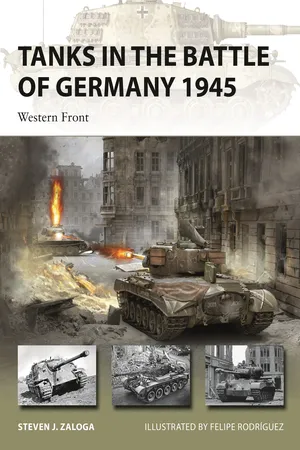
The Battle of Germany saw the most advanced tanks of the Allies pitted against the remnants of the once-formidable Panzerwaffe, now exhausted and lacking many of the essentials of armored warfare, but equipped with the biggest and most powerful tanks they would ever field.
In these last months the Allies were now equipped with the most advanced Shermans such as the M4A3E8, as well as some of the types that would go on to have successful postwar careers such as the Pershing, Comet, and Chaffee. In contrast the Panzer forces had pinned their hopes on small numbers of monstrous types such as the Jagdtiger and Tiger II, as well as the workhorse Sturmgeschütz and Panzer IVs and Vs. But with German forces crumbling, the Panzerwaffe lacked trained crews, replacement vehicles and fuel, while the Allies' well-supported tank forces advanced through Germany in spectacular combined-arms fashion.
Packed with information on tank numbers, types, and comparative performance, this book sheds new light on the two sides' tanks, organization, and doctrine, and explains how the ultimate tank battles of World War II were really fought.
- 48 pages
- English
- ePUB (mobile friendly)
- Available on iOS & Android
eBook - ePub
About this book
Information
TECHNICAL FACTORS
Wehrmacht
The technical composition of the Panzerwaffe during the final campaign in Germany in 1945 was essentially similar to the Ardennes campaign, except for the far more battered condition of most Panzer units.1 The Panzerwaffe continued to decline in both quantity and quality. At the end of the Ardennes campaign, about 59 percent of tanks and AFVs in OB West were operational, the remainder being battle damaged or under mechanical repair. The operational fraction of the tank inventory shrunk to 55 percent by February 5, 1945 and only 40 percent on March 15.
The backbone of the tank force remained the PzKpfw IV and its derivatives. Production of the PzKpfw IV Ausf. H ended at Vomag and Krupp in July 1944, and the subsequent PzKpfw IV Ausf. J was manufactured only at the Nibelungenwerke until March 1945, when it ceased altogether. As a result, the proportion of PzKpfw IV tanks declined steadily in 1945. At the start of the Ardennes offensive, the PzKpfw IV represented 41 percent of the tank force. This fell to only 28 percent by February 5, and only 25 percent by March 15.

A PzKpfw IV Ausf. J number 223 of 2./Panzer-Regiment.33, 9.Panzer-Division, one of three knocked out on February 27, 1945, by the T26E3 Pershing tank of Sgt Nicholas Mashlonik of Co. E, 33rd Armored, 3rd Armored Division on the outskirts of the town of Elsdorf. Panzer-Regiment.33 was named after Prinz Eugen and so carried the insignia of a knight on a charging horse, visible immediately on the front of the turret skirt.
Ideally, the Wehrmacht would have liked to up-gun the PzKpfw IV Ausf. J with the longer PaK 42 L/70 gun used in the Panther. However, this was not practical due to the recoil limits of its smaller turret ring. However, it was possible to mount the L/70 gun in the tank destroyer version of the PzKpfw IV, the Jagdpanzer IV. When this upgrade entered production in August 1944, it was redesignated as the Panzer IV/70 to indicate that it could be used as a tank substitute. The original version, manufactured by Vomag, was designated as the Panzer IV/70 (V). Nibelungenwerke also manufactured a comparable version but with a higher superstructure, named the Panzer IV/70 (A).
The Panzer IV/70 had a number of advantages over the basic tank version, including the more powerful PaK 42 L/70 gun and better frontal armor. However, the gun was mounted in a fixed casemate, making the vehicle less effective in close-combat due to the limited traverse of the gun. The main problem with the vehicle was that the long gun barrel was a significant hindrance when driving cross-country, especially in the Vomag version with its very low superstructure. The gun barrel could easily be slammed into the ground if the vehicle moved into a depression. The forward-mounted gun and heavy glacis armor also created greater stress on the front of the suspension. The vehicle’s side armor was mediocre, and the location of ammunition on the casemate side walls made the vehicle prone to catastrophic ammunition fires when hit on the sides. Nevertheless, the Panzer IV/70 was a formidable tank killer when employed from ambush position, a circumstance which was relatively common during the final months of the war.

A Panzer IV/70 (A), possibly from StuG.Brigade.341, knocked out in March 1945 during fighting with the US 78th Division in the grounds of Haus Neuglück near Bennerscheid, Germany, possibly by the 745th Tank Battalion. This version of the Panzer IV/70 had a higher superstructure than the type produced at Vomag. The four front roadwheels here are the resilient steel type, instead of the normal rubber rimmed type, used to accommodate the higher weight load on the front of the chassis.
By the time of the Ardennes offensive, the Panther had become the single most common German tank type. The percentage of Panthers in the Panzerwaffe in the West increased due to the decline of PzKpfw IV production. On January 15, 1945 the Panthers accounted for 39 percent of the total, 56 percent on February 5, and 63 percent on March 15, not counting the Panzer IV/70 in the final tally. At the same time, it should be noted that the Panzerwaffe in the West was shrinking catastrophically with only 49 operational Panthers on the whole front on March 15, declining to only 24 on April 10. The Panther was still a formidable rival to any Allied tank, but it was available in such puny numbers, thus it was rarely a threat after January 1945. It continued to be plagued by mechanical problems, especially its weak final drive. For example, of 152 Panthers in OB West’s hands on March 15, only 49 (32 percent) were operational. This was due to the declining quality of German manufacturing, which was exacerbated by the poor training of new drivers, as well as a chronic shortage of spare parts.
The Tiger saw combat in very small numbers in 1945, though its importance has been greatly exaggerated due to the tendency of Allied tank crews to refer to any German AFV they encountered as a Tiger. To put this in some perspective, there were only twenty-six operational in the West on February 5, six on March 15, and ten on April 10. Only two regular units in the West still operated the Tiger, s.Pz.Abt.(FKL).301 using the older Tiger I, and s.Pz.Abt.506 using the Tiger II. Due to the presence of the Tiger manufacturing plant at Kassel and a nearby Tiger training facility, there was an upsurge in improvised Tiger II deployment in March 1945 during the fighting for the Ruhr pocket. This involved hastily formed units such as Panzer Brigade Westfalen, which was mentioned earlier, as well as smaller improvised units, hastily thrown into action with Tiger tanks.
There was a small number of other tank types that saw combat in Germany in 1945. The PzKpfw III was operational in modest numbers, though most serving under OB West were the Beobachtungs artillery observer tanks. The last regions in which the normal tank version was in widespread use were in peripheral theaters such as Norway and Denmark. A number of obsolete and captured types saw combat in 1945, usually in desperate last-ditch stands by training units.

The PzKpfw III was uncommon in the West in 1945 except in peripheral theaters such as Norway. This is the surrender of Panzer-Brigade Norwegen at Trandum, Norway to British officers in May 1945. Most of the tanks here are the final PzKpfw III Ausf. N version. There were 68 PzKpfw IIIs in service in Norway in 1945.
The StuG III, like the PzKpfw IV, was a declining presence in the Wehrmacht due to reduced production. A low-cost substitute, the “Sturmgeschütz neuer Art,” was developed, based on a modified Czech PzKpfw 38(t) chassis. It entered production in April 1944 as the Jagdpanzer 38. The change in designation was largely due to the influence of the General Inspector of Panzer Troops, Heinz Guderian, who became army chief of staff in July 1944. Guderian had long been an opponent of the Sturmgeschütz, complaining that it took away precious industrial resources from his favored Panzerwaffe. In the event, the Jagdpanzer 38 was used primarily in the Panzerjäger battalions of the infantry and Volksgrenadier divisions as a substitute for the StuG III assault gun. In contrast, the dedicated StuG brigades were generally supplied from the existing inventory of StuG III and StuG IV assault guns. Dedicated Panzerjäger battalions tended to use the Panzer IV/70 or heavier types.

One of the more obscure German AFVs was the Flammpanzer 38, a flamethrower derivative of the Jagdpanzer 38 tank destroyer, fitted with a Köbe Flammenwerfer instead of a gun. This vehicle was ordered specifically by Hitler for use in the Nordwind offensive in Alsace in early 1945, and it was used by ...
Table of contents
- Cover
- Title Page
- Table of Contents
- Introduction
- The Campaign
- Doctrine and Organization
- Technical Factors
- Battle Analysis
- Further Reading
- eCopyright
Trusted by 375,005 students
Access to over 1.5 million titles for a fair monthly price.
Study more efficiently using our study tools.
Frequently asked questions
Yes, you can cancel anytime from the Subscription tab in your account settings on the Perlego website. Your subscription will stay active until the end of your current billing period. Learn how to cancel your subscription
No, books cannot be downloaded as external files, such as PDFs, for use outside of Perlego. However, you can download books within the Perlego app for offline reading on mobile or tablet. Learn how to download books offline
Perlego offers two plans: Essential and Complete
- Essential is ideal for learners and professionals who enjoy exploring a wide range of subjects. Access the Essential Library with 800,000+ trusted titles and best-sellers across business, personal growth, and the humanities. Includes unlimited reading time and Standard Read Aloud voice.
- Complete: Perfect for advanced learners and researchers needing full, unrestricted access. Unlock 1.5M+ books across hundreds of subjects, including academic and specialized titles. The Complete Plan also includes advanced features like Premium Read Aloud and Research Assistant.
We are an online textbook subscription service, where you can get access to an entire online library for less than the price of a single book per month. With over 1.5 million books across 990+ topics, we’ve got you covered! Learn about our mission
Look out for the read-aloud symbol on your next book to see if you can listen to it. The read-aloud tool reads text aloud for you, highlighting the text as it is being read. You can pause it, speed it up and slow it down. Learn more about Read Aloud
Yes! You can use the Perlego app on both iOS and Android devices to read anytime, anywhere — even offline. Perfect for commutes or when you’re on the go.
Please note we cannot support devices running on iOS 13 and Android 7 or earlier. Learn more about using the app
Please note we cannot support devices running on iOS 13 and Android 7 or earlier. Learn more about using the app
Yes, you can access Tanks in the Battle of Germany 1945 by Steven J. Zaloga,Felipe Rodríguez in PDF and/or ePUB format, as well as other popular books in Geschichte & Deutsche Geschichte. We have over 1.5 million books available in our catalogue for you to explore.