Explores the critical battle of Carrhae, a fascinating tale of treachery, tactics, and topography in which Rome experienced one of its most humiliating defeats.
The Battle of Carrhae is from a heady moment in Roman history – that of the clever carve-up of power between the 'First Triumvirate' of Caius Iulius Caesar, Cnaeus Pompeius Magnus and Marcus Licinius Crassus (the Roman general who had famously put down the Spartacan revolt). It is a fascinating tale of treachery, tactics, and topography in which Rome experienced one of its most humiliating defeats at the hands of the Parthians, not far from a trade-route town hunkered down on the fringes of the arid wastes of northern Mesopotamia, sending shock waves through the Roman power structure.
In this work, classical historian Dr Nic Fields draws out the crucial psychological and political factors (including Crassus' lust for military glory and popular acclaim) that played a key role in this brutal battle. Despite being heavily outnumbered, the Parthian general Surena's horsemen completely outmanoeuvered Crassus' legionaries, killing or capturing most of the Roman soldiers. The detailed battlescene artworks reveal the tactics and techniques of the Parthian horse archers, and Roman and Parthian equipment and weaponry, and the approach to battle is clearly explained in 2d maps and 3D bird's-eye views.
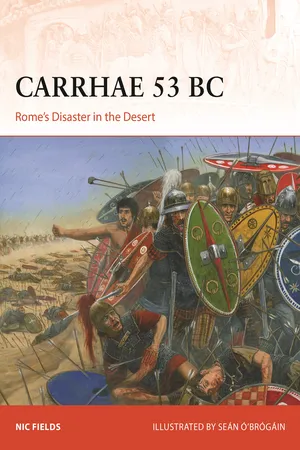
- 96 pages
- English
- ePUB (mobile friendly)
- Available on iOS & Android
eBook - ePub
About this book
Information
THE BATTLE OF CARRHAE
INTO PARTHIA
Having set sail from the seaport of Brundisium for the opposite port of Dyrrhachium, Crassus marched overland, arriving in Syria during April or May of 54 BC, his headquarters being at Antioch, the former western Seleukid capital. Here he announced his intention of extending Rome’s authority to Bactria and India, and took over the command and the troops of Aulus Gabinius, the outgoing governor of Syria. With the garrison of Syria, the pro consule had seven legions under his command. It is possible that Crassus had a somewhat inflated view of his military abilities; although in fairness to him he did have on his staff contubernales, younger men who would exhibit some aptitude for campaigning in a hostile land. His quaestor was Caius Cassius Longinus (Plut. Crass. 18.5); his legates Vargontinus and Octavius. His youngest son, Publius Crassus, was to join him at a later date, who was accompanied by Censorinus, a young noblis whose gens name was almost certainly Marcius, and Megabacchus, whose origin is uncertain,4 ‘both of them comrades of Publius and nearly of the same age’ (ibid. 25.3). We also have one of the names of the military tribunes, a certain Petronius (ibid. 30.5, 31.4).
In the spring, to twist Tennyson, a young man’s fancy turns to war. But Crassus was no longer in his prime, let alone youthful. Relying on his long-neglected military skills, Crassus’ initial operation across the Euphrates into Mesopotamia met with modest success. Somewhere near Ichnai, ‘a Greek city … situated on the river Balicha’ (Isidoros of Charax Mansiones Parthicæ §1.2), the small force of Silaces, the local Parthian satrap, was easily scattered and its leader wounded. Silaces retired to report to Orodes the news of the Roman invasion, sufficient Parthian troops being unavailable to attempt any further resistance.
In this first year of minor operations, Crassus also seized or won over several cities along the Euphrates. Zenodotion, a polis of Osrhoëne, near Kallinikos (Raqqa, Syria), was the only Mesopotamian city that offered significant resistance. The small Roman garrison that had been initially installed there had been massacred. For this, Crassus sacked Zenodotion, levelled its walls, caused considerable damage to its urban fabric, and sold its citizens into slavery. He was hailed imperator by his soldiers for this feat, or as Plutarch sardonically labels it, ‘a trifling acquisition’ (Crass. 17.3). After leaving two cohortes from each legion – a total of 7,000 legionaries and 1,000 horsemen to garrison the captured cities – Crassus returned to Syria for the winter months (ibid. 17.4). This Syrian sojourn allowed the pro consule to strip the temple at Jerusalem of such money and gold Pompey had left (Joseph. BJ 1.8 §179, AJ 14.1 §105), loot the temple of Atargatis at Hierapolis-Bambyce (Membidj, Syria), and enrol a few additional recruits for his army (Plut. Crass. 17.5). He was also waiting for his son Publius and a detachment of 1,000 hand-picked Gaulish horsemen sent to him by Caesar, who could join him from Gaul (ibid. 17.4). True to form, Plutarch frames things this way: it was a fatal decision, for Crassus lost the initiative and allowed the Parthians time to make their war preparations. Hindsight truly is a fine thing.

Crassus crosses the frontier at Zeugma (Seleukeia)
Oddly enough, the campaign featured a number of face-to-face contacts, and in one interview a Parthian envoy demanded the reason for this unprovoked invasion. If the war was being waged without the consent of the Roman people, as Orodes had been informed, then the king would show mercy and take pity on the advanced age of Crassus; but if the invasion was official, then it was to be a war without truce or treaty. Provoked to fury, Crassus replied that he would answer the king’s demands in Seleukeia-on-Tigris. Vagises, the eldest of the envoys, then stretched out the palm of his hand and swore to Crassus: ‘Sooner will hair grow here than you shall reach Seleukeia’ (Dio 40.16.3, cf. Plut. Crass. 18.1–2).

A distinctly Roman-figured mosaic (Gaziantep, Zeugma Mozaik Müzesi, inv. 4112), featuring the wedding of Dionysos and Adriane, House of Dionysos and Adriane, Zeugma. According to Pausanias, writing in the 2nd century AD, the god of wine bridged the Euphrates for the first time here: ‘and at the present day the cable is still preserved with which he spanned the river (τὸν ποταμὸν ἔζευξεν); it is plaited with branches of vine and ivy’ (10.29.4). The city, ‘the site of the most convenient river crossing’ (Tac. An. 12.12), was one of the few points where armies, such as that of Crassus, merchants and travellers could cross the Euphrates in antiquity. At a later date the poet Statius calls Zeugma ‘the road of peace’ (Latinae / pacis iter, Silv. 3.2.137–8), and implies it was a place of arms. (Dosseman/Wikimedia Commons/CC-BY-SA-4.0)
The following summer − May 53 BC − Crassus set out just to do that. It was already hot at that time and the harvests were gathered. He crossed the Euphrates once again, this time at Zeugma (Plut. Crass. 19.3, Flor. 1.46.3), leading seven legions, 4,000 lightly armed troops, and 4,000 horsemen (Plut. Crass. 20.1), including the 1,000 Gaulish horsemen Publius had brought with him, many of whom were destined to meet a grave in the blistering gravel of Parthia on this expedition. Numbers are notoriously unreliable in ancient sources, but if the legions were at full strength, this would mean around 43,000 on the Roman side, which is certainly more credible than the 11 legions mentioned by Florus (1.46.2) and the figure of 100,000 men given by Appian (B. civ. 2.3 §18). Then again, these seven legions could have been below nominal strength, for it is said Crassus lost many ships, and presumably recruits too, on the voyage from Brundisium (Plut. Crass. 17.1), though these manpower losses could have been made up during his recruitment drive in Syria over the previous winter.
Having crossed the Euphrates with his army, and with little knowledge of the country, the climate or of the Parthian army and its tactical methods, Crassus stubbornly refused to take advice from Cassius, his quaestor, to maintain the protection afforded by the life-giving Euphrates (Plut. Crass. 20.2), the route of Xenophon and the Ten Thousand. According to Isidoros of Charax, the distance between Zeugma and Seleukeia-on-Tigris, by not departing far from the Euphrates, was ‘171 schoĩnoi’ (Mansiones Parthicæ §1.3), roughly 5km per schoínos, one hour at caravan pace, which makes the distance some 855km. Maintaining a rate of 25km per day (a day’s march for the Roman army normally consisted of 24–29km), it would have taken Crassus’ army around 34 days to reach its objective, assuming, of course, there were no rest days or unexpected delays en route.

German woodcut illustration (leaf [m] 8 versus, folio cviii) c. 1474 depicting Porcia Catonis counselling her husband Marcus Iunius Brutus, Caesar’s murder at the hands of Brutus and Cassius and Porcia’s suicide in 42 BC. Caius Cassius Longinus was a far better commander and politician than Brutus, but lacked Brutus’ moral authority. Plutarch held Cassius in low regard, describing him as a man who was not well liked and who ruled his soldiers through fear. That being so, Cassius had entered the sweep of Roman history back in 53 BC as a quaestor on the staff of Crassus during the ill-fated invasion of Parthia. Cassius’ sound tactical advice was consistently ignore...
Table of contents
- Cover
- Title Page
- Table of Contents
- Origins of the Campaign
- Opposing Commanders
- Opposing Forces
- The Background to War
- The Battle of Carrhae
- Analysis
- Aftermath
- Abbreviations
- Bibliography
- eCopyright
Trusted by 375,005 students
Access to over 1.5 million titles for a fair monthly price.
Study more efficiently using our study tools.
Frequently asked questions
Yes, you can cancel anytime from the Subscription tab in your account settings on the Perlego website. Your subscription will stay active until the end of your current billing period. Learn how to cancel your subscription
No, books cannot be downloaded as external files, such as PDFs, for use outside of Perlego. However, you can download books within the Perlego app for offline reading on mobile or tablet. Learn how to download books offline
Perlego offers two plans: Essential and Complete
- Essential is ideal for learners and professionals who enjoy exploring a wide range of subjects. Access the Essential Library with 800,000+ trusted titles and best-sellers across business, personal growth, and the humanities. Includes unlimited reading time and Standard Read Aloud voice.
- Complete: Perfect for advanced learners and researchers needing full, unrestricted access. Unlock 1.5M+ books across hundreds of subjects, including academic and specialized titles. The Complete Plan also includes advanced features like Premium Read Aloud and Research Assistant.
We are an online textbook subscription service, where you can get access to an entire online library for less than the price of a single book per month. With over 1.5 million books across 990+ topics, we’ve got you covered! Learn about our mission
Look out for the read-aloud symbol on your next book to see if you can listen to it. The read-aloud tool reads text aloud for you, highlighting the text as it is being read. You can pause it, speed it up and slow it down. Learn more about Read Aloud
Yes! You can use the Perlego app on both iOS and Android devices to read anytime, anywhere — even offline. Perfect for commutes or when you’re on the go.
Please note we cannot support devices running on iOS 13 and Android 7 or earlier. Learn more about using the app
Please note we cannot support devices running on iOS 13 and Android 7 or earlier. Learn more about using the app
Yes, you can access Carrhae 53 BC by Nic Fields,Seán Ó’Brógáin,Seán Ó'Brógáin in PDF and/or ePUB format, as well as other popular books in History & Military & Maritime History. We have over 1.5 million books available in our catalogue for you to explore.