After the Gulf War of 1990, No Fly Zones (NFZ) were established over northern and southern Iraq and the Tornado GR 1 force stepped up to operations over the southern NFZ.
The Tornado GR 4 took responsibility for RAF combat air operations in Afghanistan from the Harrier force in 2009, and in 2011 was involved in missions against the Gaddafi regime in Libya. The unique multirole capabilities of the aircraft enabled it to support ground operations with the Raptor reconnaissance pod, Brimstone missiles and Paveway IV laser-guided bombs until withdrawal in 2014. The Tornado GR 4 was also used for operations over Iraq and Syria against the ISIL terrorist organisation. Intensive air operations were flown between 2014 and 2019, when the Tornado GR 4 was finally withdrawn from RAF Service.
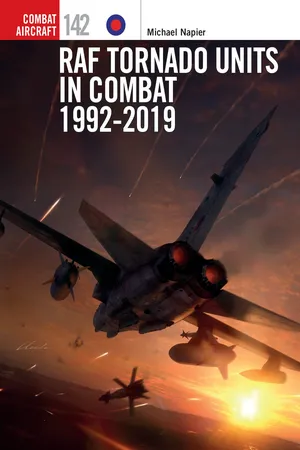
This volume, written by former RAF pilot Michael Napier, provides detailed first-hand accounts of the missions undertaken by the Tornado crews during the most recent conflicts over the Middle East and the Balkans.
- 96 pages
- English
- ePUB (mobile friendly)
- Available on iOS & Android
eBook - ePub
RAF Tornado Units in Combat 1992-2019
About this book
Information
CHAPTER ONE
IRAQ 1992–99
OPERATION JURAL
At the end of Gulf War I, the United Nations (UN) had established a No-Fly Zone (NFZ) over northern Iraq in order to protect the Kurdish population from air attack by the Iraqi regime. The NFZ effectively prevented Iraqi forces from operating any aircraft north of the 36th Parallel. RAF Jaguars had been deployed to the Turkish base at Incirlik as part of the British contribution to air operations (known as Operation Warden). By mid-1992, it was apparent that a similar arrangement was needed to protect the Shi’ite Arabs in southern Iraq from punitive operations by Iraqi government forces.

Wearing the Desert Pink camouflage originally used during Operation Granby (Gulf War I) and the markings of No 617 Sqn, Tornado GR 1 ZA470 is carrying a TIALD pod during an Operation Jural sortie over southern Iraq in December 1992 (Author’s Collection)
Originally, it was envisaged that the British contribution to this new NFZ would comprise a small number of Tornado GR 1A reconnaissance aircraft, which would operate at low-level in much the same way as they had done, with great success, in Gulf War I. They would be used to gather intelligence about, and to monitor, Iraqi ground forces, while US and French fighters prevented the Iraqi Air Force (IrAF) from flying south of the 32nd Parallel.
Unfortunately for this plan, the US leadership of the Coalition formed to undertake this operation had already decreed that no aircraft were to operate below 10,000 ft. The Tornado Infra-Red Reconnaissance System had been specifically designed for low-level operations, so it was quickly apparent that the Tornado GR 1A was the wrong platform to use. Instead, the two existing GEC-Ferranti Thermal Imaging Airborne Laser Designator (TIALD) pods would be used by Tornado GR 1s as ‘mobile security cameras’ to film activity on the ground below the NFZ. The US/Coalition operation was known as Operation Southern Watch, and the British participation was codenamed Operation Jural. Six Tornado GR 1s from No 17 Sqn deployed to Dhahran, in Saudi Arabia, in August 1992 to commence operations.
The prototype TIALD pods used during Gulf War I had been replaced in service by two early production pods – these were despatched to Dhahran, where they were known as ‘Becky’ and ‘Rachel’.
The daily Operation Jural routine was to mount an operational four-ship made up of two pairs, each in turn comprising a TIALD-armed reconnaissance aircraft and a ‘shooter’ escort. All aircraft carried live guns and missiles. Once in Iraqi airspace, the four-ship would split into its constituent pairs to cover the reconnaissance task. Each TIALD aircraft was allocated a number of ‘points of interest’ in Iraq to film, as well as various line searches following roadways through the marsh area to the south of the Euphrates River and to the east of the southern reaches of the Tigris River.
At medium level, and with the navigator very much ‘heads in’ while monitoring the TIALD picture, the reconnaissance aircraft was vulnerable to attack either by fighter aircraft or SAMs, hence the need for the ‘shooter’ escort. In practice, the four Tornados would make up only part of a much larger Coalition package operating within the NFZ, and there was an almost continuous presence of Coalition air defence aircraft such as USAF F-15C Eagles and Armée de l’Air Mirage 2000Cs.
Each squadron was responsible for providing crews for a three-month period, but rather than the entire unit deploying for the whole period, a system of ‘roulement’ was introduced whereby crews were cycled through Dhahran for a six-week tour. Staggered starting dates for each pair of crews meant that there would be a continuous presence of locally experienced pilots and navigators. No 617 Sqn took over from No 17 Sqn, which, in turn, handed over to No 14 Sqn in November 1992.
Describing a mission flown on 16 December, one pilot detailed a typical task for an Operation Jural sortie. This involved flying ‘across to the marshes to run up the road to Al Amarah, then back across the marshes, back up to Al Amarah to check out a barracks, across to look for a SA-2 SAM site in the middle of the desert, down to Nasiriyah to look for another troop concentration and then home’. A flight like this would last around three hours.
The winter weather was not altogether helpful for reconnaissance operations, and sorties frequently had to be curtailed or re-tasked when cloud obscured the ground. Nevertheless, the Tornado detachment flew nearly every day. This included Christmas and New Year’s Days, which was a new experience for crews used to the festive stand-downs of the Cold War! As a result, most crews flew about 40 hours a month during the detachment – well over twice the typical total for flying at Brüggen.
The high tempo of operations and relatively long sortie lengths swiftly brought up the landmark of 1000 hours flown by Tornado GR 1s on Operation Jural. This milestone was achieved on 29 November during the first trip in-theatre by Flt Lts D K Roxburgh, D J A Potter, K A Ward and Flg Off L P Williams of No 14 Sqn.
Although Coalition forces enjoyed air supremacy over southern Iraq, the Iraqi forces still represented a credible threat to individual aircraft operating in the NFZ. There were SA-3 SAM sites around some of the larger airfields, for example Basrah and Tallil, which were ‘no-go areas’ for Coalition aircraft, and Iraqi air defence radars monitored operations in the NFZ. IrAF fighters also periodically flew into the NFZ in the hope, perhaps, of finding an unescorted reconnaissance aircraft. It was for this reason that Coalition aircraft were always armed and flew in pairs while over Iraq.
The daily reconnaissance task had become routine by mid-December, but there were strong indications that the Iraqis intended to contest the NFZ. SAM systems were deployed south of the 32nd Parallel and, later in the month, IrAF fighters began to make high-speed dashes into the NFZ. Then, on 27 December, an IrAF MiG-25 was shot down by an American F-16D Fighting Falcon – the first air-to-air kill both for a USAF F-16 and for an AIM-120 AMRAAM. Although reconnaissance tasks continued, planning started for an air attack by Coalition aircraft to force the Iraqis to withdraw their air defence systems from the NFZ.
OPERATION INGLETON
On the evening of 13 January 1993, a force of around 100 Coalition aircraft, including escort and support aircraft, set out from airfields in Saudi Arabia and Bahrain and from the aircraft carrier USS Kitty Hawk (CV-63) sailing in the Northern Arabian Gulf, to attack the nodal points of the Iraqi air defence system south of the 32nd Parallel. Known SA-3 sites in the NFZ were also targeted. The RAF contribution to the action, codenamed Operation Ingleton, comprised four Tornado GR 1s led by Sqn Ldr M J W Napier and Flg Off C Platt. The aircraft operated in two pairs, each comprising a bomber armed with three Paveway II 1000-lb Laser-Guided Bombs (LGBs) and a ‘spiker’ equipped with a TIALD pod.
This first Operation Ingleton mission was tasked against the Al Amarah Integrated Operations Centre (IOC) – a large complex near Musay’idah, about ten miles south of the city of Al Amarah itself. The targets within the IOC included the headquarters building, several control bunkers and a number of radar systems and radio relay antennae. The lead pair of Tornados was detailed to attack the headquarters building, while the target for the second pair was a radar control bunker. Other targets within the complex would be dealt with by USAF and US Navy assets.
After air-to-air refuelling (AAR) from a Bahrain-based Victor K 2 tanker, the Tornados crossed the border. Flt Lt C D Bearblock, the No 3 pilot, described his experiences of the mission;
‘The first bombs to go off will be the big American strike on Tallil as we pass to the east. Eyes left and five, four, three, two, one. FLASH. Wow! The whole night sky lights up right on zero hour with the flash of multiple bomb explosions. It’s the most impressive sight I’ve ever seen. I discuss with Taff [Bearblock’s navigator], “They know we’re coming now; expect to see the RHWR [Radar Homing and Warning Receiver] light up”. For the first time the flight ceases to be like all other training missions – this time they’re really going to shoot at us!

A pair of Desert Pink Tornado GR 1s refuel from a Victor K 2 of No 55 Sqn prior to ‘pushing’ into the southern NFZ for an Operation Jural mission in late 1992 or early 1993. The last of the Victor K 2s were retired when No 55 Sqn disbanded on 15 October 1993 (Author’s Collection)
‘Soon afterwards the upper winds are stronger than forecast, and I start to fall behind the timeline using max dry power. The only way to catch up is to use burner, but this will be visible to all those on the ground for miles around – the Iraqis won’t need radar – they’ll be able to see us! We have no choice but to use it. Burner in for seven agonising seconds, all the time waiting for the RHWR to light up as the Iraqis lock onto me and “Taff”. Burners out, back on the timeline. Nothing happens. Immense relief!
‘“Taff” finds the IP [initial point] on the radar and all is looking good. I hear Mike and “Spiv” making all the calls between spiker and bomber that tell me that all is running to plan for the front pair. Mike calls “bombs released”, and shortly after another almighty flash lights up the sky ahead of us. I hold the course steady and release our weapons in turn. I call “bombs released” and I can’t turn away from the target fast enough. As I turn, I see the flashes from my bombs – great relief that they went off. I hope that they hit the target! I also see flashes of AAA, but no guidance on the RHWR – they’re firing blind into the night, and all being well, we should be above it.’
From the rear cockpit of the No 4 aircraft, Flg Off C M Craghill used his TIALD pod to mark the target. ‘The thermal picture was good’, he reported. ‘The site was easy enough to find, and we “captured” in good time. The bomber released and we started to lase. “Cookie” [Flg Off M Cook] had been giving me a countdown, but he stopped at what should have been bomb impact. I called “keep talking”, to which his reply was a thoroughly helpful “keep lasing!” Then the bombs impacted, and it looked to me like they had gone short by maybe 100 ft or so, but with all the dust kicked up by the impact it was difficult to get any clear picture of the damage.
‘Some time later, when a Bomb Damage Assessment [BDA] photo of the target surfaced, it showed that while the first bomb did indeed go short by 100 ft, the second was a direct hit. What had been a square building was now missing most of its eastern and southern walls.’
Five days later, on 18 January, the four Tornados flew a second mission, this time in daylight, against the radar control building at An Najaf. ‘Our attack was planned from west to east, with the spiker actually running about two miles north of the NFZ on the run-in, as the target was so close to the line’, recalled Flg Off Craghill. ‘After rel...
Table of contents
- Cover
- Title Page
- Table of Contents
- Introduction
- Chapter One: Iraq 1992–99
- Chapter Two: Air Defence Operations 1992–2011
- Chapter Three: Kosovo 1999
- Chapter Four: Iraq 2000–09
- Chapter Five: Afghanistan and Libya 2009–14
- Chapter Six: Iraq and Syria 2014–19
- Appendices
- Colour Plates Commentary
- eCopyright
Trusted by 375,005 students
Access to over 1.5 million titles for a fair monthly price.
Study more efficiently using our study tools.
Frequently asked questions
Yes, you can cancel anytime from the Subscription tab in your account settings on the Perlego website. Your subscription will stay active until the end of your current billing period. Learn how to cancel your subscription
No, books cannot be downloaded as external files, such as PDFs, for use outside of Perlego. However, you can download books within the Perlego app for offline reading on mobile or tablet. Learn how to download books offline
Perlego offers two plans: Essential and Complete
- Essential is ideal for learners and professionals who enjoy exploring a wide range of subjects. Access the Essential Library with 800,000+ trusted titles and best-sellers across business, personal growth, and the humanities. Includes unlimited reading time and Standard Read Aloud voice.
- Complete: Perfect for advanced learners and researchers needing full, unrestricted access. Unlock 1.5M+ books across hundreds of subjects, including academic and specialized titles. The Complete Plan also includes advanced features like Premium Read Aloud and Research Assistant.
We are an online textbook subscription service, where you can get access to an entire online library for less than the price of a single book per month. With over 1.5 million books across 990+ topics, we’ve got you covered! Learn about our mission
Look out for the read-aloud symbol on your next book to see if you can listen to it. The read-aloud tool reads text aloud for you, highlighting the text as it is being read. You can pause it, speed it up and slow it down. Learn more about Read Aloud
Yes! You can use the Perlego app on both iOS and Android devices to read anytime, anywhere — even offline. Perfect for commutes or when you’re on the go.
Please note we cannot support devices running on iOS 13 and Android 7 or earlier. Learn more about using the app
Please note we cannot support devices running on iOS 13 and Android 7 or earlier. Learn more about using the app
Yes, you can access RAF Tornado Units in Combat 1992-2019 by Michael Napier,Janusz Swiatlon,Gareth Hector in PDF and/or ePUB format, as well as other popular books in History & 20th Century History. We have over 1.5 million books available in our catalogue for you to explore.