A detailed, illustrated exploration of the land, sea and air units that defended Malta, and the repeated Axis attempts to bring the crucial Allied island fortress to its knees.
On 11 June 1940, the British crown colony of Malta – which dominated the central Mediterranean and all-important sea routes to and from North Africa – was bombed for the first time by aircraft of the Italian Regia Aeronautica. The Italians were joined in their efforts by the German Luftwaffe in January 1941. Malta was effectively beleaguered for nearly two and a half years, dependent for survival on naval supply convoys and reliant for defence on often-outnumbered fighter aircraft and anti-aircraft guns.
Anthony Rogers provides a retelling of these events, drawing on accounts from both sides. This work features carefully selected photographic images, some previously unpublished. Seven specially commissioned colour maps explore the strategic situation in the Mediterranean in this period, the military sectors into which Malta's defence was divided, and German minelaying operations around the island.
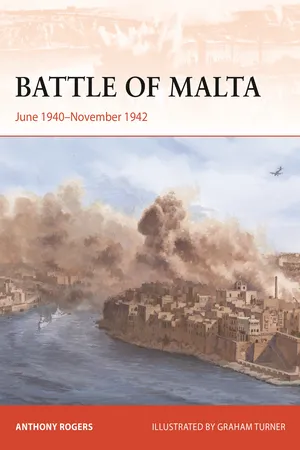
The three stunning battle scene artworks and 3D bird's-eye views show key events from the battle, including the 26 July 1941 German attack on the Grand Harbour, and the major Luftwaffe raid 21 March 1942.
- 96 pages
- English
- ePUB (mobile friendly)
- Available on iOS & Android
eBook - ePub
About this book
Information
THE BATTLE
START OF THE AIR WAR
In May 1940, the C-in-C, Mediterranean, at the request of the AOC, Mediterranean, had agreed to the loan of four Sea Gladiators, then in storage at Kalafrana. Six RAF pilots, none of whom had previous fighter experience, were hastily trained and, on 4 June 1940, a fighter flight was formed at Ħal Far. On the outbreak of war, a continuous stand-by of two Gladiators was maintained during daylight hours (those still in storage provided a ready source of spare parts). This small improvised unit won the admiration of all, although, and probably because it was rare to ever see four in the air, the perception was such that there were only three such aircraft. It is not known who christened the machines ‘Faith’, ‘Hope’ and ‘Charity’, or even when. Neither is it certain which, if any, were actually referred to by name. But an enduring myth had been created.
The Battle of Malta began shortly before 07:00hrs on 11 June 1940, when air raid sirens warned of an imminent attack. Ground observers noted that two air formations, each of five Italian S.79s, approached at 12,000 to 14,000 feet before dropping bombs in the vicinity of Ħal Far and the Dockyard area. During the next 40 minutes, successive waves carried out further attacks. Aircraft were engaged by AA guns and intercepted by Gladiators, albeit with little effect. At Fort St Elmo, six ORs of the Royal Malta Artillery lost their lives and at nearby French Creek one OR of the Royal Artillery was killed. There would be several air raid warnings but no further bombing raids until that evening. Grand Harbour was the main target, but bombs also fell elsewhere, including at Verdala barracks, resulting in injuries to 15 infantrymen. AA guns were again in action as were, according to some reports, Malta’s Gladiators. Coastal guns also opened fire on what were thought to be enemy motor torpedo boats off Grand Harbour. What were, in fact, three Royal Navy small craft, were all sunk; at least four Maltese naval ratings died. There would be little material damage during the day, but in addition to military casualties, at least 16 civilians lost their lives and many more were injured. Raids continued on an almost daily basis for the rest of the month.
Malta’s Gladiators withstood 2a Squadra Aerea until the end of June. By that time, the RAF and Fleet Air Arm (FAA) had been provided with additional aircraft. With the fall of France expected imminently, two naval Swordfish training squadrons, then in French North Africa, were re-tasked. A dozen or so were flown to Gibraltar. A similar number went to Malta, where they would operate as 830 Squadron, thus providing a limited anti-shipping striking force. Even more welcome was the acquisition on 21 and 22 June of five Hurricanes. These had been destined for North Africa but were retained at Malta by permission of the AOC-in-C, Middle East. They arrived just in time, for on the 21st, two Gladiators had been written off in landing accidents (one aircraft was subsequently rebuilt from the wrecks). One of two American-built Lockheed Hudsons, which had led the Hurricanes during their flight from Britain, was also retained and put to use as a long-range reconnaissance machine.

Initially, Malta had only Italian raids to contend with. In 1940, the standard bomber was the Savoia-Marchetti S.79 ‘Sparviero’, such as this machine of 258a Squadriglia, 109o Gruppo, 36o Stormo B.T., operating out of Castelvetrano, Sicily. Italian bomber crews were known for operating at high-level, achieving little in the process. These early raids did little to weaken the resolve of the Maltese.
On the 22nd, the RAF achieved its first air victory when Gladiators were scrambled to intercept an S.79. Flight Lieutenant George Burges in Gladiator N5519 carried out a successful stern attack. The Italian machine, with both engines on fire, fell in the sea off south-east Malta. There were two survivors, both of whom became prisoners of war. The next day, Burges, again flying N5519, accounted for an MC.200. This, too, crashed offshore, the pilot baling out and being taken prisoner. The first success by a Hurricane pilot is thought to have occurred on 3 July, when an S.79 was brought down off the coast. The Hurricane was attacked by an Italian fighter when landing and crashed as a result. The pilot was unhurt, but his aircraft was a write-off.
On Tuesday morning, 16 July, Flight Lieutenant Peter Keeble was scrambled together with Pilot Officer Allan McAdam, the former in a Hurricane and the latter in a Gladiator. At 09:11hrs, the pair was informed about approaching bombers and fighters. Keeble acknowledged. Before long, those monitoring events heard machine-gun fire. Keeble’s Hurricane was then seen, trailing smoke and diving with a CR.42 close behind. The two fighters crashed close together near Marsaskala. Peter Keeble was the first RAF fighter pilot to lose his life in the defence of Malta. Machine-gunners of 1st Battalion The Dorsetshire Regiment claimed to have brought down the CR.42. The pilot, tenente Mario Benedetti, who had somehow survived the crash, died of his injuries in hospital.
On the last day of July, a CR.42 and a Gladiator were shot down. The Italian pilot, capitano Antonio Chiodi, died. Flight Lieutenant Peter Hartley baled out. He was rescued from just offshore, badly burned, but would survive. His would be the only Gladiator lost in combat.
FIRST NAVAL SURFACE ENGAGEMENTS
The evacuation from Malta of some civilians (mainly British naval officers’ families) had begun shortly before Italy’s entry into the war. A further operation was postponed in late June 1940, after Royal Navy warships tasked with escorting merchant ships east from Malta clashed with Italian destroyers transporting an anti-tank unit to Libya. Submarines had already accounted for several ships in the Mediterranean, but this would be the first surface engagement between the region’s naval powers. The Italian Regia Marina destroyer Espero was sunk with heavy loss of life. The British cruiser HMS Liverpool sustained minor damage. An anti-submarine operation by destroyers and aircraft resulted in four successes within three days. Console Generale Liuzzi was scuttled after being depth-charged and forced to the surface; the commander stayed on board after the order to abandon ship. They became prisoners of war, as did the crew from Uebi Scebeli. There were no known survivors from Argonauta and nearly all perished on Rubino.
The delayed operation took place some day...
Table of contents
- Cover
- Title Page
- Table of Contents
- Introduction
- Chronology
- Opposing Commanders
- Opposing Forces
- Opposing Plans
- The Battle
- Summary
- The Battlefield Today
- Acronyms and Abbreviations
- Bibliography
- eCopyright
Trusted by 375,005 students
Access to over 1.5 million titles for a fair monthly price.
Study more efficiently using our study tools.
Frequently asked questions
Yes, you can cancel anytime from the Subscription tab in your account settings on the Perlego website. Your subscription will stay active until the end of your current billing period. Learn how to cancel your subscription
No, books cannot be downloaded as external files, such as PDFs, for use outside of Perlego. However, you can download books within the Perlego app for offline reading on mobile or tablet. Learn how to download books offline
Perlego offers two plans: Essential and Complete
- Essential is ideal for learners and professionals who enjoy exploring a wide range of subjects. Access the Essential Library with 800,000+ trusted titles and best-sellers across business, personal growth, and the humanities. Includes unlimited reading time and Standard Read Aloud voice.
- Complete: Perfect for advanced learners and researchers needing full, unrestricted access. Unlock 1.5M+ books across hundreds of subjects, including academic and specialized titles. The Complete Plan also includes advanced features like Premium Read Aloud and Research Assistant.
We are an online textbook subscription service, where you can get access to an entire online library for less than the price of a single book per month. With over 1.5 million books across 990+ topics, we’ve got you covered! Learn about our mission
Look out for the read-aloud symbol on your next book to see if you can listen to it. The read-aloud tool reads text aloud for you, highlighting the text as it is being read. You can pause it, speed it up and slow it down. Learn more about Read Aloud
Yes! You can use the Perlego app on both iOS and Android devices to read anytime, anywhere — even offline. Perfect for commutes or when you’re on the go.
Please note we cannot support devices running on iOS 13 and Android 7 or earlier. Learn more about using the app
Please note we cannot support devices running on iOS 13 and Android 7 or earlier. Learn more about using the app
Yes, you can access Battle of Malta by Anthony Rogers,Graham Turner in PDF and/or ePUB format, as well as other popular books in History & 20th Century History. We have over 1.5 million books available in our catalogue for you to explore.