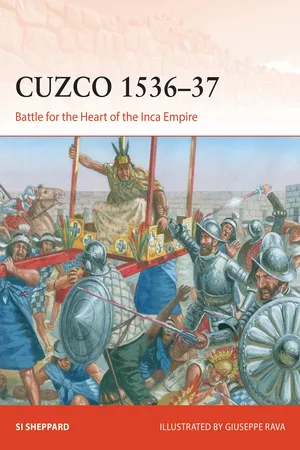
A highly illustrated and detailed study of one of the most important campaigns in the colonization of the Americas, the Spanish conquest of the vast Inca Empire.
In April 1532 a bloody civil war between two brothers ended with one of them, Atahualpa, as master of the mighty Inca Empire. Now the most powerful man in South America, his word was law for millions of subjects spread across thousands of square miles, from the parched deserts of the coast to the lush rainforest of the Amazon and along the spine of the soaring Andes Mountains.
But the time of the Incas was coming to an end. In November of that year a handful of Spanish conquistadors led by Francisco Pizarro seized Atahualpa at Cajamarca, extorted his treasure, murdered him, and then marched on the Inca capital Cuzco to elevate a puppet, Manco, to the vacant throne. In 1536, however, Manco roused his people against the intruders, and the Spaniards found themselves isolated and fighting for their lives.
This fascinating and beautifully illustrated book brings to life the background to and progress of the desperate 10-month siege of Cuzco; the opposing commanders, their fighting men, tactics, and military technologies; the key clashes, from Sacsayhuamán to Ollantaytambo; and how the outcome shaped our world today.
- 96 pages
- English
- ePUB (mobile friendly)
- Available on iOS & Android
eBook - ePub
About this book
Information
THE SIEGE OF CUZCO, 1536–37
The day after entering Cuzco, Pizarro set the seal on his authority by staging the coronation of Manco, personally placing the royal borla upon the head of the new sapa inca. But while Manco possessed the title, he had not even the shadow of real power. Pizarro and his brothers took possession of the royal palaces while men of all ranks, particularly those who had arrived with Almagro and thereby missed out on the distribution of Atahualpa’s ransom at Cajamarca, proceeded to systematically loot the city, despoiling its tombs and temples for their treasures. In March 1534, Pizarro distributed the proceeds which, according to the official account, amounted to 580,200 gold pesos. Many conquistadors, deciding to quit while they were ahead, immediately departed for Spain, leaving fewer than 500 Spaniards behind to lord over an empire of more than ten million people. To build up the settler population, on March 23, Pizarro founded a Spanish municipality in Cuzco, enrolling 88 of his compañeros as citizens and providing them with repartamientos (distributions) of encomiendas (estates) and the subject peoples to work them.
THE END OF THE REBEL INCA GENERALS
Because Quizquiz remained at large, Pizarro ordered Soto and Almagro to hunt him down; in this they were supported by Manco who, as proof of his loyalty to his Spanish benefactors, personally led a contingent of Inca warriors and auxiliaries against the man now dubbed a rebel against his own authority as the legitimate sapa inca. Quizquiz had massed his forces against the handful of Spaniards under Riquelme left at Jauja, but on the eve of his assault, the town was reinforced by a column of newly arrived conquistadors under Rojas pushing up from the coast. Thus bolstered, this garrison was able to hold out until relieved. To avoid being trapped between the town and the mobile force of Spaniards incoming from Cuzco, Quizquiz pulled back north, intending to make for Quito, which was still occupied by Atahualpa’s other surviving general, Rumiñawi.
Meanwhile, a new threat was metastasizing in this region. Pizarro received the alarming report from Rojas that the Governor of Guatemala, Pedro de Alvarado, had departed the isthmus on January 23 in a fleet of 12 ships piloted by Juan Fernández and was making for the coast of Ecuador. This armada made landfall at Puerto Viejo on February 25 with a massive force of more than 500 conquistadors, 119 horses, and 4,000 forcibly conscripted Guatemalan porters. Determined to preempt any entrepreneurial empire building on his turf, Pizarro dispatched Almagro to deal with the interloper. Almagro expected to join forces at San Miguel with Benalcázar who, after the distribution of treasure at Cajamarca in 1533, had opted to preside over the town rather than follow Pizarro on to Cuzco. However, after dropping off Alvarado, Juan Fernández had sailed on to San Miguel, alerting Benalcázar, who had immediately set out for Quito with some 200 men and 62 horses. He advanced to Tumibamba, where he secured an alliance with the Cañari nation.

Inca remains at the imperial stronghold of Tumibamba (modern Cuenca, Ecuador), showing the primary outer walls of the site, which has several kallankas (meeting halls), a possible sun temple, underground canals and tunnels, and several Inca baths. Tumibamba was the primary jumping-off point for Inca campaigns to the north. (Courtesy Amber Anderson)
This combined force encountered the army of Rumiñawi in the high-altitude Battle of Teocajas at the beginning of May. It was a hard-fought affray, with four Spaniards and as many horses killed. After outflanking the Incas’ position, Benalcázar lost another five Spaniards in fighting outside Riobamba, and his continued advance was bitterly contested, with more pitched battles at the crossing of the Ambato River, at Latacunga, and at Pancallo. Benalcázar finally fought his way into Quito on about June 22, only to find that Rumiñawi had ordered it be put to the torch after dispersing the city’s trove of treasure for safekeeping, and then pulled back into the mountains. He launched a night attack on the Spaniards garrisoned in the burned-out shell of Quito that led to a desperate struggle for the city, but the tide turned with the dawn.
Benalcázar’s search for the treasure was cut short by the arrival of Almagro. In the event, Pizarro’s surrogates found negotiating with Alvarado easier than they had anticipated. Blundering through the swamps and jungles of the interior, he had led his men on a nightmarish march across the Andes that left countless frozen corpses of men and beasts scattered across the mountains. He was only too eager to conclude a deal on August 26 whereby, in exchange for 100,000 pesos, he would return to Guatemala after handing over his fleet of 12 ships and allowing any of his men who so desired to enlist with Almagro.
These reinforcements came at an opportune moment, for as Almagro began his return south he was almost immediately confronted by the Inca army commanded by Quizquiz, who had been retreating gradually northward since abandoning the siege of Jauja. Quizquiz had the better of their first encounter, where Almagro lost three horses killed and 20 wounded in a frontal assault on a prepared Inca position, and 14 Spaniards were surprised and subsequently beheaded by an Inca flanking force. However, Inca morale was shattered when the army, having advanced to Quito, found it occupied by Benalcázar’s garrison. After two years on campaign, from Quito to Cuzco and back again, the levies now yearned only to return to their homes and farms. When his officers prevailed on him to come to terms with the Spaniards, Quizquiz refused; they then turned on him, one impaling him with a spear, the others then rushing forward to finish him off with their clubs and battleaxes. Benalcázar then pursued Rumiñawi to his fortified position near Píllaro. A long, hard struggle ensued, but the Incas finally broke. Rumiñawi was run to ground, captured, and dragged back to Quito for execution. Thus ended the last resistance to the Spanish conquest, and the last of the loyalists to Atahualpa. Had Quizquiz and Rumiñawi been able to concentrate their forces, and had Alvarado elected to assert his claim to Quito by challenging Almagro to resolve their differences on the battlefield, thereby shattering the always precarious façade of Spanish unity, it might have ended differently.
CONQUISTADOR DIVISIONS AND MANCO’S UPRISING
Pizarro, meanwhile, had departed Cuzco for the coast to establish a new capital for his empire. Prior to leaving he called for a moratorium on all individual looting and instructed Soto, who he appointed as corregidor (lieutenant-governor) of Cuzco in his absence, and his brothers, Juan and Gonzalo, to recognize and respect the rights and property of the Incas, “because if the natives are molested by being asked for gold and silver they might rebel. This must be avoided now and until there are more Spaniards.” Pizarro then marched west to the verdant Rimac Valley where on January 18, 1535, he founded his new capital, El Ciudad de los Reyes (the City of the Kings), named in honor of the kings of Spain and of the Magi; the city would later be renamed Lima.
Almagro, who, rightfully, felt he was owed something for his services to his erstwhile partner, stopped at Lima to consult with Pizarro, who suggested he take over from Soto as lieutenant-governor of Cuzco. Almagro accepted the offer, arriving at the city in late January 1535. Complicating the picture, word had just arrived from Spain that Charles V had decided to split the Inca Empire in two, with the northern half to be governed by Pizarro and the southern by Almagro. The devil lay in the details; the boundary of their respective authorities was left ambiguous. Most dangerously, there was no definition as to who would inherit the prize jewel of Cuzco.

Almagro and his expedition depart Cuzco and set out on their great exploratory campaign into Chile, July 3, 1535, by Pedro Subercaseaux. The fact he always remained subordinate to Pizarro rankled Almagro, who sought by this initiative to carve out an empire of his own in the New World. Pizarro, who, of course, was only too happy to put as much distance as possible between them, actively encouraged the venture, which rapidly evolved into an unmitigated disaster. Hundreds of Spaniards, and thousands of press-ganged native porters, were lost over 20 months of fruitless campaigning in search of a civilization to despoil equal to that of the Incas. Starving men trekking back toward Cuzco were forced to eat the horses they had lost on the outward trail, their bodies perfectly preserved in the dry cold of the Andes. (Public Domain)
The conquistadors Almagro had acquired from Alvarado gave him the manpower he needed to face down Juan and Gonzalo Pizarro, but their arrival in Cuzco triggered another wave of looting and rape. With Soto and Manco gravitating into Almagro’s camp, the situation was explosive. “All of them were so frenzied and full of envy of each other that it was a wonder that they did not all kill each other,” Cieza de León recorded. Only the intervention of a newly arrived royal official, Antonio Téllez de Guzmán, prevented the escalating rivalry between the two Spanish factions from erupting into civil war. “Had the Christians fought one another the Indians would have attacked those who survived,” Guzmán later explained to Charles V.
When news of this spiraling hostility reached Lima, Pizarro felt compelled to ride back to Cuzco to enforce a settlement. Sidestepping the incendiary issue of which of them had the legitimate claim to Cuzco, his solution was to satisfy Almagro’s ambition by encouraging him to take immediate possession of his assigned territories in the unexplored regions to the south.
On July 3, Almagro departed Cuzco at the head of 570 Spanish cavalry and foot soldiers and 12,000 Incas, including Manco’s half-brother Paullu and his high priest, the Villac Umu. Shortly afterward, Pizarro returned to the coast. Manco was left to govern Cuzco under the watchful eye of the two younger Pizarro brothers, Juan (whom Francisco had appointed lieutenant-governor of the city) and Gonzalo.

Inca warriors rise up against their Spanish overlords, by Felipe Guáman Poma de Ayala. The native peoples had been driven to this extremity by the insatiable avarice of conquistador exploitation, for by 1536, the rank and file who arrived with Pizarro, “[g]reengrocers, peddlers, tailors, shoemakers, pastry cooks, and bakers were calling themselves Don.” Beyond any authority but their own, the conquistadors, who had risen from humble means, ruled as petty autocrats. “After they had conquered and stolen, the Spaniards began taking the women and maidens ...
Table of contents
- Cover
- Title Page
- Table of Contents
- Origins of the Campaign
- Chronology
- Opposing Commanders
- Opposing Forces and Plans
- The Siege of Cuzco, 1536–37
- Aftermath
- Bibliography
- eCopyright
Trusted by 375,005 students
Access to over 1.5 million titles for a fair monthly price.
Study more efficiently using our study tools.
Frequently asked questions
Yes, you can cancel anytime from the Subscription tab in your account settings on the Perlego website. Your subscription will stay active until the end of your current billing period. Learn how to cancel your subscription
No, books cannot be downloaded as external files, such as PDFs, for use outside of Perlego. However, you can download books within the Perlego app for offline reading on mobile or tablet. Learn how to download books offline
Perlego offers two plans: Essential and Complete
- Essential is ideal for learners and professionals who enjoy exploring a wide range of subjects. Access the Essential Library with 800,000+ trusted titles and best-sellers across business, personal growth, and the humanities. Includes unlimited reading time and Standard Read Aloud voice.
- Complete: Perfect for advanced learners and researchers needing full, unrestricted access. Unlock 1.5M+ books across hundreds of subjects, including academic and specialized titles. The Complete Plan also includes advanced features like Premium Read Aloud and Research Assistant.
We are an online textbook subscription service, where you can get access to an entire online library for less than the price of a single book per month. With over 1.5 million books across 990+ topics, we’ve got you covered! Learn about our mission
Look out for the read-aloud symbol on your next book to see if you can listen to it. The read-aloud tool reads text aloud for you, highlighting the text as it is being read. You can pause it, speed it up and slow it down. Learn more about Read Aloud
Yes! You can use the Perlego app on both iOS and Android devices to read anytime, anywhere — even offline. Perfect for commutes or when you’re on the go.
Please note we cannot support devices running on iOS 13 and Android 7 or earlier. Learn more about using the app
Please note we cannot support devices running on iOS 13 and Android 7 or earlier. Learn more about using the app
Yes, you can access Cuzco 1536–37 by Si Sheppard,Giuseppe Rava in PDF and/or ePUB format, as well as other popular books in History & Early Modern History. We have over 1.5 million books available in our catalogue for you to explore.