A detailed study of the Syrian and Lebanon campaign of World War II.
In June 1941, Australian, British, Indian and Free French forces invaded the Vichy French-controlled mandate of Syria and Lebanon. They faced an enemy that had more artillery, tanks and aircraft. They fought in rocky, mountainous terrain, through barren valleys and across swollen rivers, and soon after the initial advance faced a powerful Vichy French counter-attack on key strategic positions. Despite these difficulties, the Allies prevailed, and in doing so ensured that the territory did not fall into German or pro-German hands, and thus provide a springboard from which Axis forces could attack British oil interests in Iraq, the key territory of Palestine or the Suez Canal. This book examines the high military and political strategy that lay behind the campaign, as well as the experiences and hardships as endured by the men on the ground.
The battles in Syria and Lebanon were complex actions, often at the battalion level or below, and this work uses extensive war diaries and available records to make sense of the actions and examine how they affected the wider campaign.
eBook - ePub
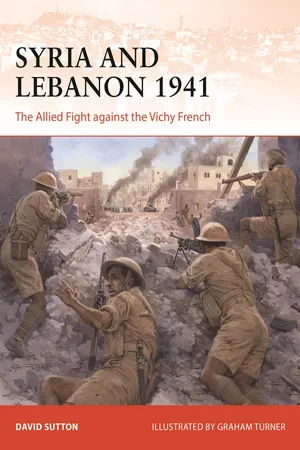
Syria and Lebanon 1941
The Allied Fight against the Vichy French
- 96 pages
- English
- ePUB (mobile friendly)
- Available on iOS & Android
eBook - ePub
About this book
Information
THE CAMPAIGN
COASTAL COLUMN, 7–15 JUNE 1941
For the coastal advance on Beirut, Brigadier Jack Stevens’ 21st Australian Brigade would attack in two columns. On the left, Lieutenant-Colonel Murray Moten’s force, based on the 2/27th Battalion and designated ‘Motcol’, would advance with speed along the well-constructed road hugging the Mediterranean coast. Further inland, Lieutenant-Colonel Alex MacDonald’s ‘Doncol’, based on the 2/16th Battalion, would protect the flank of the coastal advance in the foothills of the Lebanon ranges. Doncol would need to seize key Vichy border posts, take the winding road to Tibnine, and then approach Tyre from the east.
The remaining unit of the 21st Brigade, the 2/14th Battalion, along with the Cheshire Yeomanry, were under command of the brigade’s headquarters. Parts of the 2/14th would be the first to cross the border closest to the coast before Motcol passed through. The Cheshire Yeomanry would operate further inland in the hills, protecting the flank of the advancing Australians, detachments of each being used as necessary in the initial phase of the invasion.
The invasion began on the evening of 7 June. Australian patrols, some aided by local guides, snuck into Vichy territory in rubber-soled shoes to cut telephone lines, overcome border guards and remove any charges on roads and bridges that they could find. The main body of troops crossed the border at 0200hrs on 8 June 1941.
During the first hours of the campaign the coastal column advanced steadily, though not as easily as expected. One mile from the coast at Labouna, a platoon of the 2/14th, after having been held up by the rough terrain, had to take the border post in a tough fight that included a bayonet charge. At 0700hrs, they heard a loud explosion: the French had blown up the main road south of Iskandaroun where it ran precipitously along a coastal cliff edge. The detonation created a crater 100ft long and 10ft deep. It could still be crossed by foot, but it would not be possible for vehicles to pass until 0500hrs on 9 June.
Further inland, the 2/16th Battalion crossed over from Palestine and took their border-post objectives while A Company of the 2/2nd Pioneer Battalion worked through the night to build a road linking El Malikiya in Palestine with Aitaroun in Lebanon. Once completed at 0400hrs, this allowed Allied vehicles (a squadron of the 6th Australian Division Cavalry and two troops of the 1st Royal Dragoons) to cross the border and advance further north.
The first day was a success: throughout 8 June Doncol units pushed forward, passed the former Ottoman castle at Tibnine and, after a series of skirmishes against retreating Algerian Spahis, entered Tyre without opposition at 1400hrs.
The next day, Allied forces massed in preparation for the major attack on the first main Vichy strongpoint that stood in their way – the heavily defended Litani River. The battle began in some confusion. As the 2/16th Battalion moved into position just before first light on the 9th, troops of C Company heard the unsettling sound of troops approaching at their rear. They soon realized that they had not been outflanked by enemy troops but were instead being approached by a group of Scottish commandos who had mistakenly landed south of the Litani and behind the advancing Australians.
The commandos had intended to make an amphibious landing north of the Litani on 8 June to prevent the French from destroying the stone bridge over the river and to sow confusion behind French lines. Their attack, split into three separate groups, was delayed by rough seas and when they made their landing in the early hours of 9 June, the operation proved a disaster. ‘Force Z’, commanded by Captain George More, made a safe landing two miles north of the Litani and within an hour had captured dozens of prisoners of war. They then became caught in a confusing fight in which prisoners escaped and attacked their captors. To make matters worse, French reinforcements arrived in armoured cars and they took friendly fire from the Australians to the south.
Lieutenant-Colonel Richard Pedder’s ‘Force Y’ landed further south, but came under heavy fire as it landed. Pinned down on an exposed beach and seeking shelter in their landing crafts, when they attempted to push forward the reinforced Vichy French rained increasingly heavy fire on their positions. The commandos suffered 123 soldiers killed in action that morning.
Major Geoffrey Keyes’ ‘Force X’ mistakenly (though perhaps luckily) landed south of the Litani, and assisted the Australians of the 2/16th Battalion in their fight to cross the river. Keyes would later become the posthumous recipient of a Victoria Cross for his actions in North Africa.

The Litani River, 1941. The destruction of the stone bridge near this bend in the river forced Australians of the 2/16th Battalion and Scottish commandos to make a perilous crossing by canvas boat under heavy enemy fire. (Public Domain)
The 2/16th Battalion, working with the remnants of the commandos, faced a formidable task crossing the Litani. Near the coast the river, 100ft wide and flowing swiftly, was flanked by flat, exposed farmland. Further inland near a bend in the river, a series of ridges and ravines gave the defenders an excellent elevated position from which to pour fire on attackers below.
At first light on 9 June the 2/16th Battalion was waiting on the south side of the Litani when it received a series of rude shocks. First, news came that the only bridge in the area had been blown by the Vichy French. Then the Vichy defenders – 3e Bataillon, 22e Régiment de Tirailleurs Algériens – opened fire. Machine-gun, mortar and artillery fire was so heavy that members of the unit who had served in World War I described that barrage as being as intense as anything they encountered on the Western Front.
COASTAL COLUMN, 7–9 JUNE 1941
The hard fighting encountered by Allied troops on 8 and 9 June on the coast proved that Operation Exporter was not going to be as easy as hoped. As Vichy French forces retreated north, they delayed the Allied advance through strategic demolitions and tough rear-guard actions. The Allied forces advancing inland were introduced to the mountainous terrain that dominated the campaign, and at the Litani River, the Allied attackers faced a fierce, determined and well-planned defensive position that made good use of the natural geography of the region.
Note: gridlines are shown at intervals of 5km (3.1 miles)

VICHY
1. I/8e Régiment de Spahis Algériens.
2. III/22e Régiment de Tirailleurs Algériens with artillery support.
3. Vichy French destroyers Guépard and Valmy.
ALLIED
A. 2/14th Australian Infantry Battalion (less C Company and elements of B Company); 2/27th Australian Infantry Battalion.
B. D Company, 2/14th Australian Infantry Battalion; 11 and 12 platoons, 2/14th Australian Infantry Battalion; patrol formed from 12 men of 2/14th Australian Infantry Battalion and three local guides.
C. Naval squadron comprising HM Ships Phoebe, Ajax, Kandahar, Kimberley, Janus and Jackal.
D. HMS Glengyle escorted by HM Ships Isis and Hotspur.
E. ‘Force Z’, C Battalion, Special Service Brigade.
F. ‘Force Y’, C Battalion, Special Service Brigade.
G. ‘Force X’, C Battalion, Special Service Brigade.
H. C and D companies, 2/16th Australian Infantry Battalion.
I. A and B companies, 2/16th Australian Infantry Battalion; A Company, 2/2nd Pioneer Battalion; elements of 2/27th Australian Infantry Battalion; two troops of the 1st Royal Dragoons; A Squadron, 6th Australian Division Cavalry; Cheshire Yeomanry (less one squadron); artillery and engineers.

7 June
1. 2130hrs: Patrols from 2/14th Australian Infantry Battalion move out from Hanita, and set up roadblocks on coast road near Iskandaroun and north of Naqoura.
8 June
2. 0200hrs: Elements of 2/14th Australian Infantry Battalion move out from Hanita to attack Alma Chaab (D Company after a fight) and Labouna (B Company, without opposition).
3. 0200hrs: C and D companies, 2/16th Australian Infantry Battalion cross border and take Aitaroun (C Company, without opposition), Yaroun (D Company, without opposition) and Bennt Jbail (D Company, heavy fight after which 70 Algerian Spahis withdraw to the north). Their advance is preceded by a three-man patrol from C Company, which cuts telephone lines radiating from Bennt Jbail.
4. 0300hrs: 10 Platoon, 2/14th Australian Infantry Battalion attacks French border post at Naqoura. A platoon of 2/27th Australian Infantry Battalion, along with carriers, anti-tank guns and engineers, probes north of Naqoura and encounters a strong French party covering coast road.
5. 0400hrs: A Company, 2/2nd Pioneer Battalion completes construction of road allowing Allied troops to cross frontier from El Malikiya to Aitaroun (construction begins 0200hrs). Advance troops push north through Bennt Jbail towards Tibnine.
6. 0630hrs: Allied forces pass through Bennt Jbail and push north to Tibnine, where they engage in battle with retreating spahis. The spahis eventually withdraw in the direction of Nabatiyeh. An 80ft crater blown into the road and surrounding minefields delays the bulk of the units’ progress until 1430hrs. Cheshire Yeomanry travels cross-country from Tibnine to Litani, covering right flank of Allied advance.
7. 0700hrs: Vichy French blow coast road on cliff south of Iskandaroun. The 2/14th Australian Infa...
Table of contents
- Cover
- Title Page
- Table of Contents
- Origins of the Campaign
- Chronology
- Opposing Commanders
- Opposing Forces
- Opposing Plans
- The Campaign
- Aftermath
- Bibliography
- eCopyright
Trusted by 375,005 students
Access to over 1.5 million titles for a fair monthly price.
Study more efficiently using our study tools.
Frequently asked questions
Yes, you can cancel anytime from the Subscription tab in your account settings on the Perlego website. Your subscription will stay active until the end of your current billing period. Learn how to cancel your subscription
No, books cannot be downloaded as external files, such as PDFs, for use outside of Perlego. However, you can download books within the Perlego app for offline reading on mobile or tablet. Learn how to download books offline
Perlego offers two plans: Essential and Complete
- Essential is ideal for learners and professionals who enjoy exploring a wide range of subjects. Access the Essential Library with 800,000+ trusted titles and best-sellers across business, personal growth, and the humanities. Includes unlimited reading time and Standard Read Aloud voice.
- Complete: Perfect for advanced learners and researchers needing full, unrestricted access. Unlock 1.5M+ books across hundreds of subjects, including academic and specialized titles. The Complete Plan also includes advanced features like Premium Read Aloud and Research Assistant.
We are an online textbook subscription service, where you can get access to an entire online library for less than the price of a single book per month. With over 1.5 million books across 990+ topics, we’ve got you covered! Learn about our mission
Look out for the read-aloud symbol on your next book to see if you can listen to it. The read-aloud tool reads text aloud for you, highlighting the text as it is being read. You can pause it, speed it up and slow it down. Learn more about Read Aloud
Yes! You can use the Perlego app on both iOS and Android devices to read anytime, anywhere — even offline. Perfect for commutes or when you’re on the go.
Please note we cannot support devices running on iOS 13 and Android 7 or earlier. Learn more about using the app
Please note we cannot support devices running on iOS 13 and Android 7 or earlier. Learn more about using the app
Yes, you can access Syria and Lebanon 1941 by David Sutton,Graham Turner in PDF and/or ePUB format, as well as other popular books in History & French History. We have over 1.5 million books available in our catalogue for you to explore.