A gripping and detailed study of the brutal urban battle for Budapest, which saw German and Hungarian troops struggling to halt the joint Soviet-Romanian offensive to take the key city on the Danube.
The 52-day-long siege of Budapest witnessed some of the most destructive urban fighting of the war. The Transdanubia region was strategically vital to Nazi Germany for its raw materials and industry, and because of the bridgehead it allowed into Austria. As a result, Hitler declared Budapest a fortress city in early December 1944.
The battle for the city pitted 90,000 German and Hungarian troops against 170,000 Soviet (2nd and 3rd Ukrainian Fronts) and Romanian attackers. The operations to take the city ran across several phases, from the initial Soviet approach to Budapest commencing in late October 1944, through the encirclement of city first on the Pest side of the Danube, and then on the Buda bank, and on to the savage urban fighting that began in December 1944 for the Hungarian capital.
This superbly detailed work analyses the background, chronology and consequences of the siege from both a military and political perspective, and documents the huge losses in military and civilian casualties and material damage.
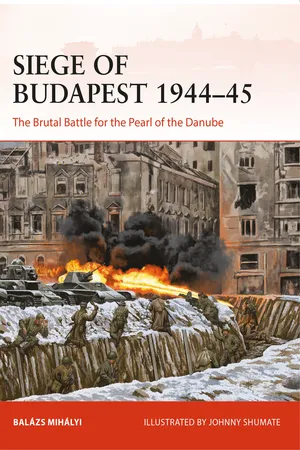
eBook - ePub
Siege of Budapest 1944–45
The Brutal Battle for the Pearl of the Danube
- 96 pages
- English
- ePUB (mobile friendly)
- Available on iOS & Android
eBook - ePub
Siege of Budapest 1944–45
The Brutal Battle for the Pearl of the Danube
About this book
Information
THE SIEGE OF BUDAPEST
THE FIRST SOVIET ATTACK: 29 OCTOBER–6 NOVEMBER 1944
Malinovsky’s offensive started on 29 October between the villages of Rém and Alpár, on a 95km-wide front. Following a preparatory artillery bombardment of 30 minutes, Soviet forces attacked and broke through.
The offensive managed to break through the Hungarian positions all along the line, and inflicted heavy losses on the defenders, yet the goals set for the day were not fully achieved. Despite the breakthrough, Hungarian forces fought back hard in many places. The Hungarian 1st Armoured Division attempted to impede the main attack, which followed the Kiskunfélegyháza–Kecskemét line, but to little effect. The Hungarian units then withdrew and established a new line of defence south of Kecskemét.
Army Group South commander Friessner initially ignored the Soviet attack – he did not trust the Hungarians, and also doubted the reports he received. He expected the attack on Budapest to come from the direction of Szolnok. The German 24th Panzer Division, on the other hand, was on the move near Kecskemét that night, and ran into the Soviet forces; a struggle for the possession of Kecskemét began.
On 30 October, the vanguard of the 4th Guards Mechanized Brigade reached Kecskemét, where the units of the Hungarian 1st Cavalry Division and the Hungarian 8th Replacement Infantry Division were encamped on the outskirts of the city, and the German 23rd Panzer Division was also nearing the town’s western perimeter.
The Soviets decided to try to take Kecskemét using speed. The vanguard of the 4th Guards Mechanized Brigade spearheaded the attack the following morning, but failed. Only a few T-34s managed to break through the line of defence and enter the city, but the defenders took out four Soviet tanks in short order. In parallel, further to the east, the assault of the 6th Guards Mechanized Brigade also failed, losing six tanks in the attack. After these unsuccessful efforts, the Soviets decided to encircle Kecskemét. The 4th Guards Mechanized Brigade sought to outflank the town from the west, while the 6th Guards Mechanized Brigade tried to engage the defenders from the front.
By this time, Friessner realized the aim of the Soviet attack was to take Budapest. To slow the Soviet advance, the German 4th Air Fleet increased its attacks in the area, destroying five tanks near Kecskemét that day. The German counter-attack was to be delivered by the Hungarian 1st Armoured Division, now subordinated to the LVII Panzer Corps, and the German 1st, 23rd and 24th Panzer divisions and the German 503rd Heavy Panzer Battalion. The Hungarian counter-attack began in the morning, but soon collapsed against the Soviet defences. The German 24th Panzer Division launched an assault south of Kecskemét. Though the Soviets managed to repel the initial attack, at 1400hrs the Germans finally broke through their lines. The Germans focused their attack on one of the Soviet artillery divisions, whose 122mm howitzers used direct fire at the attacking tanks. The artillery division finally succeeded in repelling the attackers. The Soviets ordered a tank battalion to the area as reinforcement, and this helped stabilize the situation and secure the Kecskemét–Kiskunfélegyháza road.

The first Soviet attack, 29 October–6 November 1944

A Soviet 152mm howitzer and its crew in Budapest. It was often used in the direct fire role from the front line to overcome resistance strongpoints. (Fortepan, 175361)
Meanwhile, the ongoing Soviet attack lacked sufficient pace to encircle Kecskemét. The 4th Guards Mechanized Brigade could not get through the Hungarian defences. The assault by one of the tank regiments of the 6th Soviet Mechanized Brigade was interrupted by a counter-attack from the 24th German Panzer Division that neutralized the Soviet assault. As reinforcements for the taking of Kecskemét, the Soviet 59th and 320th Guards Rifle divisions were also deployed, and though they managed to break in, they were only able to occupy parts of the town. The German 133rd AA Artillery Regiment and the Hungarian troops still in the town stood their ground. The Soviets lost 21 tanks over the course of the day. In contrast, the Soviets reported to have destroyed 25 tanks and assault guns, and captured 1,300 prisoners of war. Yet, they failed to reach their target for the day, the Alberti–Örkény line, mainly due to the heavy resistance around Kecskemét. The Soviet offensive against Budapest lost the element of surprise, and its momentum was also broken.
On 31 October, the Soviets managed to encircle Kecskemét, and the German 133rd AA Artillery Regiment and the other troops in the town. At the same time, the Soviets also continued their attack towards Budapest along the Kecsemét–Budapest road. German reinforcements arrived in the form of the German 1st Panzer Division, gathering near Lajosmizse. The Soviet formations were again attacked from two directions, by the Hungarian 1st Armoured Division from the west, and by the German 23rd Panzer Division from the south towards Kecskemét. Again, the Hungarian attack had little effect, but the Germans were successful, and an armoured battle soon developed. The Germans also cut off supply lines to the attacking Soviet units. The battle raged late into the night. Meanwhile, at Lajosmizse, the panzer-grenadiers of 1st Panzer Division destroyed five Soviet tanks, and succeeded in halting the Soviet 5th Guards Mechanized Brigade. By evening, the Soviets finally managed to take Kecskemét, yet the town’s stalwart defenders had allowed the Germans time to regroup their reserves in Budapest.
In the wake of the Soviet late-October successes, Malinovsky reworked the attack plan. The 2nd Guards Mechanized Corps was now ordered to take Üllő and Inárcs by 2 November, then push on and take all of Budapest by 3 November. Simultaneously, the 4th Guards Mechanized Corps was ordered to reach the area of Szigetszentmiklós and Tököl by November, then break into Budapest the next day, before driving on to Újpest. The Soviet plan did not take into account German reinforcements arriving to defend Budapest – the 1st, 13th and 23rd Panzer divisions, the 22nd SS-Volunteer Cavalry Division and Panzer-Grenadier Division Feldherrnhalle – which altered the balance of the forces considerably.
On 1 November, Friessner ordered another counter-attack to halt the Soviet offensive. The German 133rd AA Artillery Regiment, which had broken out of Kecskemét, tried to establish a no-pass zone in the Lajosmizse area. The German 24th Panzer Division found itself in a tricky situation, being temporarily isolated. Meanwhile, the Soviet 2nd Guards Mechanized Corps, attempting to move towards Budapest, was halted at Lajosmizse. The German–Hungarian defensive positions established in front of the town were weak, and the defenders tried to repel the waves of Soviet attacks with armour-supported counter-attacks, but they suffered heavy losses. Friessner reorganized his troops, and the gap in the Hungarian defence was plugged by the arriving German 8th and 22nd SS-Cavalry divisions, 1st and 13th Panzer divisions, and Panzer-Grenadier Division Feldherrnhalle. However, the Soviets also received reinforcements, with the Soviet 4th Guards Mechanized Corps regrouped from Szolnok and joining the battles between Fülöpszállás and Szabadszállás on this day. The Soviets broke through the Hungarian defences, and then continued on towards Budapest along the Danube.
The Soviets launched their attack on Nagykőrös on 2 November, and managed to enter Lajosmizse in the morning. Kunszentmiklós and Tatárszentgyörgy also fell. The Soviet 2nd Guards Mechanized Corps continued to move towards Budapest. The German 1st and 23rd Panzer divisions again attacked the Soviet formations from two directions this day. The former achieved little, but the 23rd Panzer Division, attacking from the direction of Cegléd, managed to take out seven Soviet tanks, 13 AT guns and 18 trucks, for the loss of four assault guns and a Tiger. The attack was eventually called to a halt, but during the retreat, a PzKpfw V Panther and a Tiger B were blown up after becoming bogged down in mud and unable to be pulled out. The Soviet 2nd Guards Mechanized Corps lost 50 dead and 142 wounded this day, as well as 12 tanks, while destroying ten tanks, 19 SP guns and armoured vehicles and taking 180 prisoners. The Germans evacuated Lajosmizse and took up a new defensive position in Örkény, which lay on the road to Budapest and thus was important to control. The Soviet offensive had already reached Újhartyán, but due to German attacks on its flank, further Soviet progress towards Budapest was temporarily halted; instead they tried to eliminate the Germans by attacking west. By the evening, the Soviets managed to isolate Örkény, yet failed to reach their target of the Monor–Üllő–Inárcs line. German counter-attacks and the defences of the settlements along the main road continued to slow the Soviet advance, and gave time for further regrouping. In the meantime, the Germans began to take up positions on the Attila Line. The chance to quickly take Budapest had evaporated.

Soviet BM-13 (Katyusha) multiple rocket launchers bombarding Budapest. (TASS via Getty Images)
Meanwhile, the Soviet 4th Guards Mechanized Division’s attack progressed well, taking Bugyi, Ócsa and Alsónémedi, and reaching the Attila I Line, where Hungarian paratroopers were positioned. The Hungarians destroyed a tank and repulsed the Soviet attack. Though the Soviet corps had advanced 110km in one day, it was in vain, as they ran out of steam by the time of the attack on the Attila Line.
The southern part of the Attila Line was divided into two sections. The first was Defence Zone A where the German 22nd SS-Volunteer Cavalry Division and the 1st Battalion, Hungarian 1st Paratrooper Regiment, as well as th...
Table of contents
- Cover
- Title Page
- Contents
- Origins of the Campaign
- Chronology
- Opposing Commanders
- Opposing Forces
- Opposing Plans
- The Siege of Budapest
- Aftermath
- Bibliography
- The Battlefield Today
- eCopyright
Trusted by 375,005 students
Access to over 1.5 million titles for a fair monthly price.
Study more efficiently using our study tools.
Frequently asked questions
Yes, you can cancel anytime from the Subscription tab in your account settings on the Perlego website. Your subscription will stay active until the end of your current billing period. Learn how to cancel your subscription
No, books cannot be downloaded as external files, such as PDFs, for use outside of Perlego. However, you can download books within the Perlego app for offline reading on mobile or tablet. Learn how to download books offline
Perlego offers two plans: Essential and Complete
- Essential is ideal for learners and professionals who enjoy exploring a wide range of subjects. Access the Essential Library with 800,000+ trusted titles and best-sellers across business, personal growth, and the humanities. Includes unlimited reading time and Standard Read Aloud voice.
- Complete: Perfect for advanced learners and researchers needing full, unrestricted access. Unlock 1.5M+ books across hundreds of subjects, including academic and specialized titles. The Complete Plan also includes advanced features like Premium Read Aloud and Research Assistant.
We are an online textbook subscription service, where you can get access to an entire online library for less than the price of a single book per month. With over 1.5 million books across 990+ topics, we’ve got you covered! Learn about our mission
Look out for the read-aloud symbol on your next book to see if you can listen to it. The read-aloud tool reads text aloud for you, highlighting the text as it is being read. You can pause it, speed it up and slow it down. Learn more about Read Aloud
Yes! You can use the Perlego app on both iOS and Android devices to read anytime, anywhere — even offline. Perfect for commutes or when you’re on the go.
Please note we cannot support devices running on iOS 13 and Android 7 or earlier. Learn more about using the app
Please note we cannot support devices running on iOS 13 and Android 7 or earlier. Learn more about using the app
Yes, you can access Siege of Budapest 1944–45 by Balázs Mihályi,Johnny Shumate in PDF and/or ePUB format, as well as other popular books in History & Eastern European History. We have over 1.5 million books available in our catalogue for you to explore.