In early 1940, a battle raged to control the ice-free, iron-ore port in northern Norway – with changing fortunes until the very end.
This highly detailed book covers both the naval battles and the individual Norwegian, British, Polish, French and German units that fought the land campaign over northern Norway. Highly detailed maps guide you step by step through the events. Few other books on Narvik give you as much detail on the forces of the fighting five. From Gebirgsjägers to Guardsmen, Fallschirmjägers to Foreign Legionnaires, it offers you an impressive level of tactical detail, even down to company command, whilst also helping you understand the strategic confusion surrounding the whole Allied expedition to the north too.
Among the naval clashes covered in this action-packed story are the destroyer battles in the fjords, the sinking of the aircraft carrier HMS Glorious and the roles the famous battlecruisers Scharnhorst and Gneisenau played in the fighting. No less dramatic are the land battles, which include amphibious landings, sabotage, commando raids, daring ski missions and a rare parachute insertion by Gebirgsjäger troops.
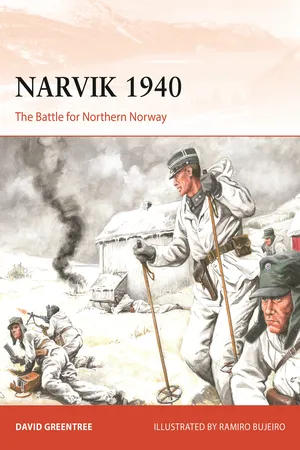
- 96 pages
- English
- ePUB (mobile friendly)
- Available on iOS & Android
eBook - ePub
About this book
Information
THE BATTLE OF NARVIK
THE GERMAN LANDING AND THE NAVAL BATTLES, 10–13 APRIL 1940
Wilhelm Heidkamp, slowly steaming through murky low cloud and snow showers, at 0415hrs on 9 April, suddenly encountered the Norwegian coastal defence ship Eidsvold near the entrance to the harbour. The Germans sent an envoy across to demand her surrender. Eidsvold’s captain Willoch radioed Askim to ask what he should do. He was told to refuse the German demand, and when he did the Germans were the first to fire. Dietl had told Bonte not to hesitate. Four torpedoes were launched and two hit Eidsvold, causing the ship to sink seconds later, killing 170 crew. The other two German destroyers of the flotilla, Bernd von Arnim and Georg Thiele, were approaching the quay through the maze of anchored ships and when they presented themselves were fired upon by the two 21cm and six 15cm guns of the coastal defence ship Norge. The two salvoes could only bracket the target. Bernd von Arnim disembarked soldiers of 2./Gebirgsjäger-Regiment 139 onto the quay from the starboard side while firing its guns from the other side. Torpedoes were launched from both destroyers when the Norwegian ship presented. The seventh hit, sinking the ship minutes later. Ninety-seven crewmen survived.

The railway would be an essential supply line for Dietl’s men. Sweden agreed to allow a train to go from Germany to the Norwegian border. The train would get to the border on 26 April. Clearing the Bjørnfjell Station of enemy soldiers was completely necessary, as the supplies had to be offloaded at the border. British aircraft had rendered the line to the town unusable by bombing portions of track. (Arkiv i Nordland, CC BY-SA 2.0)
Soldiers of 7. and 8./Gebirgsjäger-Regiment 139 were also landed from small motorboats and sloops. Dietl expected resistance from the garrison and once he met with the German consul on the pier, he headed to town in a Norwegian taxi with a soldier as his escort. He soon encountered Sundlo by the railway, who was considering what to do after being told he had 30 minutes to decide. Most of the residents appeared on the streets to see what was going on. After the war, Sundlo would write that the danger to the population was his main concern. He had orders from Fleischer to fight, and when he phoned Harstad to ask what to do, he was told by a staff officer that he had to decide himself. Sundlo, seeing MGs being positioned on higher ground to target his HQ, complied with the request. When Fleischer was notified of this he sacked Sundlo and replaced him with Major Omdal, ordering the battalion to march out of town and defend the railway line.
Major Omdal and 250 men slipped out of town. They could not get any skis or backpacks with supplies. When they got to Bjørnfjell on the Swedish border they pleaded with the Swedes for skis and supplies and they were given some. Omdal and his men would attempt to destroy the 180m-long railway bridge at Norddalsbrua. There would not be enough TNT to completely destroy the bridge, though damage to make it unusable to heavy engines would be achieved. Major Omdal was forced to surrender his force on 16 April when the Germans brought forward Major Schleebrugge’s 1./Gebirgsjäger-Regiment 139. The Germans had approached unseen to the east of the Norddalsbrua. The initial attack on Bjørnfjell Station was delayed. When the Germans brought forward a gun on a train to fire on the buildings of Bjørnfjell Station, the Norwegians had no answer. Most surrendered, though some escaped, including Omdal. By early May, the bridge had been strengthened enough to take an engine pushing two carriages to the Swedish border.
Bonte’s destroyers started to refuel from the Jan Wellem. He positioned three destroyers in Herjangsfjord, two in Ballangenfjord and the others with 25 merchantmen were in Narvik harbour. On the morning of 10 April, Diether von Roeder on patrol duty in Ofotfjord did not wait for relief and entered the harbour at 0400hrs. Some 30 minutes later, the British 2nd Destroyer Flotilla, commanded by Captain Warburton-Lee, started to fire torpedoes at the anchored German destroyers. If the path of Warburton-Lee’s ships had not been slightly off because of a navigation error, the German guard ship would have encountered them while steaming through Ofotfjord.
Korvettenkapitän Erdmenger, the captain of Wilhelm Heidkamp, reported that some shells landed near his ship and then a few seconds later a torpedo hit the stern. Two detonations followed; the second was the most powerful when ammunition exploded. The aft guns were hurled onto the forward part of the ship, smashing on the deck near the forecastle guns. The ship was flooded with smoke and then began to sink. The water got up to the aft funnel and then stopped. No enemy was seen. Exploding shells and the persistent echo the fjords produced made an impression of being fired on from Norwegian batteries located on high ground or being attacked by aircraft. Erdmenger saw a torpedo pass close to the bow and hit the railway pier. Many merchant ships were sinking or starting to burn. He noticed a serious fire on Diether von Roeder. A layer of oil hundreds of men were swimming through covered the ice-cold water. When his ship stopped sinking, Erdmenger got the men back on board and gathered on the forecastle. He raised the anchor and brought the ship alongside the Swedish steamer Oxelösund. He brought weapons on board the steamer to oppose an expected British landing. Once he realized only five destroyers had attempted the attack, he knew the size of the force was not going to be large enough to capture the town.
At 0430hrs, Hardy had fired three torpedoes from 1,500 yards. The first hit a tanker and the second Wilhelm Heidkamp, killing Kommodore Bonte and 80 others. Anton Schmitt, waiting to be refuelled by Jan Wellem, was hit by two torpedoes from two other destroyers and broke apart. The shock from the second explosion caused the engines of Hermann Künne, alongside the oiler, to seize up and the ship drifted towards the wreck of Anton Schmitt. Hans Ludemann, free from Jan Wellem, started a gunnery duel. Diether von Roeder was anchored; the destroyer’s guns also started a gunnery exchange with the British destroyers, and sustained numerous hits. Diether von Roeder’s captain could not get clear, because power to the windlass was interrupted. At 0505hrs he fired eight torpedoes towards the harbour entrance, though none hit. Four British destroyers would report torpedoes running underneath them. Lieutenant Heppel on Hardy surmised that this was because the degaussing equipment on the destroyers had stopped the magnetic pistols from working. The torpedoes, set at a depth of between 9ft and 13ft, ran slightly lower through the less salty waters of the fjords. The British destroyers’ draft of 12ft 6in and the fact that they were low on fuel also contributed.

Burning ships in the harbour at Narvik. The failure of the German torpedoes allowed Warburton-Lee to order all ships to go round again, this time at 20 knots at 0512hrs. At 0515hrs, the other German destroyers were sent signals of the British attack. The British could only use guns this time. Hostile, with a full complement of torpedoes, wanted to launch at Diether von Roeder. The destroyer was placed with the bow pointing out towards the harbour entrance and was too difficult a target. The British ships congregated outside the harbour. At 0544hrs, following a discussion with his officers, Warburton-Lee told his ships to attack once again. They did not enter the harbour, as blazing oil and sinking merchantmen blocked the way. Hostile fired four torpedoes, but none hit its targets. Hans Ludemann fired four torpedoes, but they were too low. At 0551hrs, Warburton-Lee ordered a withdrawal. (Arkiv i Nordland, CC BY-SA 2.0)
The repeated British attack runs gave time for the German destroyers from Herjangsfjord and Ballangenfjord to get underway. At 0553hrs, Bey’s destroyers from Herjangsfjord encountered the five British destroyers as they steamed out of harbour. Warburton-Lee was pursued by Bey for 20 miles when the two destroyers from Ballangenfjord could be seen to the front, facing broadside 4,000 yards distant. Hardy was soon a burning wreck, Warburton-Lee mortally wounded. Another destroyer lost its steering after numerous hits, and was accidentally rammed by Hostile and sank. Havock was badly damaged. The Germans broke off the pursuit because they had not completely refuelled. Damage to the two German destroyers, Georg Thiele and Bernd von Arnim, was not inconsiderable. The ammunition expended by the Germans was not replaced because the supply ships had not appeared. The Rauenfelds supply ship was lost when the surviving British destroyers intercepted her on the way out of the fjord. The Alster supply ship was lost near Bodø the same day, intercepted by British destroyers.

First and second naval battles of Narvik, 10–13 April 1940
Bey so...
Table of contents
- Cover
- Title Page
- Table of Contents
- Origins of the Campaign
- Chronology
- Opposing Commanders
- Opposing Forces
- Opposing Plans
- The Battle of Narvik
- Aftermath
- Bibliography
- eCopyright
Trusted by 375,005 students
Access to over 1.5 million titles for a fair monthly price.
Study more efficiently using our study tools.
Frequently asked questions
Yes, you can cancel anytime from the Subscription tab in your account settings on the Perlego website. Your subscription will stay active until the end of your current billing period. Learn how to cancel your subscription
No, books cannot be downloaded as external files, such as PDFs, for use outside of Perlego. However, you can download books within the Perlego app for offline reading on mobile or tablet. Learn how to download books offline
Perlego offers two plans: Essential and Complete
- Essential is ideal for learners and professionals who enjoy exploring a wide range of subjects. Access the Essential Library with 800,000+ trusted titles and best-sellers across business, personal growth, and the humanities. Includes unlimited reading time and Standard Read Aloud voice.
- Complete: Perfect for advanced learners and researchers needing full, unrestricted access. Unlock 1.5M+ books across hundreds of subjects, including academic and specialized titles. The Complete Plan also includes advanced features like Premium Read Aloud and Research Assistant.
We are an online textbook subscription service, where you can get access to an entire online library for less than the price of a single book per month. With over 1.5 million books across 990+ topics, we’ve got you covered! Learn about our mission
Look out for the read-aloud symbol on your next book to see if you can listen to it. The read-aloud tool reads text aloud for you, highlighting the text as it is being read. You can pause it, speed it up and slow it down. Learn more about Read Aloud
Yes! You can use the Perlego app on both iOS and Android devices to read anytime, anywhere — even offline. Perfect for commutes or when you’re on the go.
Please note we cannot support devices running on iOS 13 and Android 7 or earlier. Learn more about using the app
Please note we cannot support devices running on iOS 13 and Android 7 or earlier. Learn more about using the app
Yes, you can access Narvik 1940 by David Greentree,Ramiro Bujeiro in PDF and/or ePUB format, as well as other popular books in History & European History. We have over 1.5 million books available in our catalogue for you to explore.