An accessible illustrated introduction to the brutal conflict in the former Yugoslavia, one of the greatest yet least understood tragedies of the 20th century.
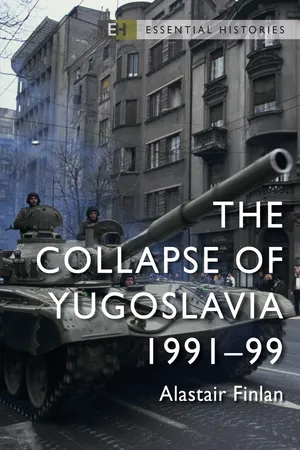
In 1991, an ethnically diverse and peaceful region of Europe descended into violence, lawlessness, bitter hatred and chaos, almost overnight to the bewilderment of international observers. Communities fractured along lines of ethnic and religious affiliation, and the ensuing fighting was deeply personal, resulting in horrific brutality, rape, torture and genocide, causing the deaths of thousands of people. Drawing on the latest research for this new edition, Alastair Finlan examines the internal upheavals of the former Yugoslavia and their international implications, including the failure of the Vance-Owen plan; the first use of NATO in a combat role and in peace enforcement; and the war in Kosovo, unsanctioned by the UN but prosecuted by NATO forces to prevent the ethnic cleansing of the region.
Updated and revised, with specially commissioned colour maps and all new images throughout, this is a concise overview of the tragic conflict in former Yugoslavia and its significant consequences.
- 144 pages
- English
- ePUB (mobile friendly)
- Available on iOS & Android
eBook - ePub
About this book
Information
THE FIGHTING
The destruction of Yugoslavia

Chaos and crime
A source of great debate among historians studying the collapse of Yugoslavia is the degree to which the fighting was planned by the major leaders. One of the most notable and persuasive accounts of this turbulent time, entitled The Serbian Project and its Adversaries: A Strategy of War Crimes by Professor James Gow claims that Slobodan Milosevic had devised a ‘project’ to push the region into war, so that the much stronger Serb forces could ultimately carve out a Greater Serbia in parts of Croatia and Bosnia-Herzegovina. On the face of it, Serbia’s spectacular gains in the early part of the fighting would support such a line of argument, but as the International Criminal Tribunal for the former Yugoslavia (ICTY) has found, it is very difficult to prove categorically that Milosevic’s hand was behind the instability. Nevertheless, regardless of the causes of the conflict, the fighting in Yugoslavia stands apart from traditional warfare as a result of the deeply personal nature of the violence. Victims in many cases knew their attackers, either from sharing the same town or having spent time at school together. Neighbours who had lived for years in peace suddenly found themselves drawn, willingly in some respects and unwillingly in others, towards ethnic affiliations. Unlike previous conflicts in recent history, like the Gulf War of 1991, the boundary between civilians and soldiers became rapidly blurred as the battlefield stretched across cities, towns and villages.
As the chaos spread and law and order broke down, criminals flourished and, indeed, the criminalisation of the fighting in Yugoslavia is one of the main historical features of the conflict. Gangs of bandits and outlaws terrorised people to the same extent as soldiers in uniform. Anyone with a gun could set up roadblocks throughout the region, acting purely on their own initiative. These decentralised and criminalised facets of the wars in the former Yugoslavia made it immensely difficult for outside authorities such as the United Nations to negotiate a lasting ceasefire on the ground. Too many interests were at stake, official and unofficial, in the crime zone of Yugoslavia. Once the civil authorities and law-enforcing capabilities of the nations of Croatia and Bosnia-Herzegovina had been traumatically undermined by the activities of the JNA, then chaos and crime flourished as it would in any country throughout the world in which policemen and centralised authority had disappeared. This is the indelible stain of responsibility that Milosevic will bear as the politician who used the military instruments of the state to repress his fellow Yugoslavs in the most callously indifferent manner.

JNA forces cleaning up in Erdut. Erdut was the base of the notorious Serbian paramilitary Arkan in 1991 and witnessed mass expulsions and murder of civilians. (Photo by Antoine GYORI – Corbis/Sygma via Getty Images)
The war in Croatia
Serb groups and figureheads
There were many interested parties in the fighting in Croatia, but the instigators of the violence were certainly the Serbs. The spread of hatred and violence in the region revolved around figureheads whose backgrounds and appearance bordered on the absurd. A central figure in the rallying of Croatian Serbs to war was Milan Babic, a rotund former dentist who, through his powerbase in Knin, urged Croatian Serbs to resist what he labelled the fascist Ustasha regime of the newly elected Franjo Tudjman. On 25 August 1990, Babic declared the creation of the Autonomous Province of the Serbian Krajina, which inevitably placed the Serbs on a collision course with the democratically elected government of President Tudjman. However, the Serb pocket in Croatia had a very good reason to believe that it could prevail: it benefited enormously from the covert help of the JNA, which from 1990 onwards started to redistribute weapons from territorial units based in Croatia to the Serb population. Consequently, those Croatian police who were loyal to President Tudjman often found themselves completely outgunned when trying to restore order in Serb-dominated areas. In addition, Milosevic, though denying to the international community any involvement in the fighting in Croatia, offered direct help politically and militarily to the Croatian Serbs, including air power either to intimidate the Croatian police or to simply bomb parts of Croatia. President Tudjman himself, although draped with the trappings of Croatian nationalism (particularly the famous chequerboard flag), tried hard to avert outright war with the Serbs. Ultimately, however, events on the ground spiralled out of control.
The fighting in Croatia intensified in late spring of 1991 in the region known as Eastern Slavonia on the border with Vojvodina, especially around the town of Vukovar. A key element in the intensification of violence carried out by Serbs in this part of Croatia was the use of extremist groups with strong links to Belgrade. The most notorious of these ‘agitators of violence’ were Arkan’s ‘Tigers’ and Seselj’s ‘Chetniks’. Arkan, or Zeljko Raznjatovic, was an internationally renowned bank robber (his ‘scores’ included robberies in Belgium, Germany, Holland and Sweden) who was known to have links with the Yugoslav secret police. Other aspects of his curriculum vitae included managing the fan club of Belgrade’s Red Star football club, known as the ‘Delije’, whose members became renowned for their thuggish and nationalistic behaviour. Arkan managed to combine the worst aspects of football hooliganism and tribalism with modern military weaponry. It was unsurprising that this fan club provided an excellent recruiting ground for the extraordinarily well-equipped Tigers, who rampaged with the utmost brutality through parts of Croatia and later Bosnia-Herzegovina under Arkan’s leadership.

Arkan’s ‘Tigers’ in 1995 – a well-armed gang of paramilitaries with a reputation for brutality and ruthlessness. Arkan was a well-known international criminal before the fighting broke out in the former Yugoslavia. (AFP via Getty Images)
In contrast to the ‘thug’ background of Arkan, Vojislav Seselj was a radical Serb intellectual with a PhD to boot, who was more than happy to fuel ethnic tensions with irresponsible media statements designed to create fear and unrest. His followers (who included groups like the White Eagles) were modelled closely on the World War II Chetniks, a Serb nationalist resistance movement, and wore traditional hats with Eagle badges on the front. Both groups and their leaders were primarily criminals intent on pillage and murder in order to create as much chaos as possible. In this respect, they succeeded, and their activities on the eastern borders of Croatia were characterised by these units sweeping through villages and towns. In the case of the attack on the town of Baranja, they openly fought in concert with the JNA, and this combination of strength meant that Eastern Slavonia quickly fell under Serb control. So, too, did other neighbouring districts with the overt support of the JNA, and the town Vukovar acquired an internationally recognised name due to the significant media coverage of the strangling siege until its surrender on 17 November 1991.
The siege of cities
The fighting spread quite quickly to include the regions around the Serb Krajina and famous Croatian cities. In the South, Montenegran troops loyal to the JNA caused international outrage by shelling the coastal city of Dubrovnik, which had been a popular tourist destination for Western Europeans. The siege of Dubrovnik was heavily covered by the international media, drawing attention yet again to the role of the Serbs and their allies in this conflict. Zagreb, too, was subject to regular bombings by the Yugoslav Air Force. In the Krajina, a new figure emerged in the JNA forces as a ruthlessly efficient commander – Colonel (later promoted to General) Ratko Mladic was a Bosnian Serb whose father had been killed by the Ustasha during World War II.
Mladic was a brash, larger-than-life character who undoubtedly possessed an astute military mind (when facing weaker opposition), but his name quickly became associated with ethnic cleansing in the areas under his control. Initially, due to the massive imbalance of arms, the Croatian Serbs and the JNA held the military advantage and exploited it to the full. However, Croatia managed to access arms from countries such as Hungary (mainly light weapons and anti-aircraft guns) before the UN embargo (UNSC Resolution 713 on 25 September 1991). Even after the embargo was imposed, Croatia managed to illegally acquire some weapons due to the geography of the country – a long western seaboard, ideal for smugglers. Its borders with countries to the north also had potential for unofficial arms transactions. Consequently, although the Serb pockets in the Krajina and Eastern Slavonia were well established by the start of 1992, the Serbs simply did not have the military capability to take all of Croatia. Nevertheless, the fighting and widespread ethnic cleansing had set the tone for the forthcoming war in Bosnia-Herzegovina, and relations between Serbs and Croats would never be the same again.

A Croatian armoured personnel carrier leading a convoy of vehicles engaged in a battle with JNA forces in 1991. (DAVID BRAUCHLI/AFP via Getty Images)
The United Nations in the former Yugoslavia
The role of the United Nations in the Balkans has generated immense criticism, due to its inability to quickly stop the fighting. Forty-seven United Nations Security Council Resolutions were passed between April 1992 and October 1993, but none managed to halt the violence decisively. For instance, the famous, or infamous, arms embargo (UNSCR 713) failed to stop the fighting due to the indigenous arms production capacities of the former Yugoslavia, and the ability of some nationalities to smuggle weapons across the borders. A more involved approach by the international community occurred on 21 February 1992, when the first deployments of UN forces were sanctioned by the Security Council with 14,000 troops despatched to Croatia and a controlling headquarters established in the capital of Bosnia-Herzegovina, Sarajevo, to set up United Nations Protected Areas (UNPAs). These UNPAs covered the Krajina, Eastern Slavonia and Western Slavonia, and were divided up into four areas called Sectors East, North, South and West.
The situation that faced the first UNPROFOR commander, the Canadian General Lewis MacKenzie, on arrival at Sarajevo just as war had broken out in Bosnia-Herzegovina, typified the fatally delayed response of the UN throughout the wars. The source of the problem was the ‘interpretation’ of the mandates under which UN forces were operating – in other words, taken as being a purely humanitarian role in which the soldiers in blue helmets could only try and encourage peace, not enforce it. Neither the international community nor the Secretary General Boutros Boutros-Ghali wanted to use forceful methods to halt the killing. Britain, France and the United States did not want to accept the political, economic and military costs of becoming involved in a full-scale war in South East Europe. In the latter case, the Secretary General was adamant about explicitly using non-military means to resolve the crisis. Boutros Boutros-Ghali and his special envoy to the region, Yasushi Akashi, were major contributors to this ‘soft’ approach, which perhaps reflected the minimal consensus within the Security Council towards the wars in the former Yugoslavia. Consequently, these factors and preferred methods, when combined with the application of the traditional notions of peacekeeping – consent and impartiality – proved to be nothing short of disastrous for the inhabitants of the Balkans and for the reputation of the United Nations as a whole.

The frustration of ordinary citizens shown during a visit of the UN Secretary General about the slow response of the international community to end the fighting in Sarajevo in 1992. (ENRIQUE FOLGOSA/AFP via Getty Images)
Theatre-based UNPROFOR commanders
As the fighting spread, so too did the UN commitment, swelling to over 30,000 personnel by 1994. Eventually, three UNPROFOR commands would be set up in Bosnia-Herzegovina, Croatia and Macedonia. Although an overarching UNPROFOR Force Commander was nominally in charge, the international media normally focused on the theatre-based UNPROFOR commander. In this respect, nations sent highly distinguished military leaders to the Balkans, but most were subsumed by the political nature of the task. General Philippe Morillon of France took over the UNPROFOR command in Bosnia-Herzegovina in September 1992, but had little success, and his tenure of command was notable for the assassination of the Deputy Prime Minister of Bosnia-Herzegovina, Hakija Turajlic, who was killed by a Bosnian Serb while surrounded by French soldiers in a French armoured personnel carrier in January 1993. His successor, the Belgian ...
Table of contents
- Cover
- Title Page
- CONTENTS
- INTRODUCTION
- BACKGROUND TO WAR
- WARRING SIDES
- OUTBREAK
- THE FIGHTING
- THE WORLD AROUND WAR
- HOW THE WAR ENDED
- CONCLUSION AND CONSEQUENCES
- CHRONOLOGY
- FURTHER READING
- LIST OF ABBREVIATIONS
- GLOSSARY OF NAMES
- eCopyright
Trusted by 375,005 students
Access to over 1.5 million titles for a fair monthly price.
Study more efficiently using our study tools.
Frequently asked questions
Yes, you can cancel anytime from the Subscription tab in your account settings on the Perlego website. Your subscription will stay active until the end of your current billing period. Learn how to cancel your subscription
No, books cannot be downloaded as external files, such as PDFs, for use outside of Perlego. However, you can download books within the Perlego app for offline reading on mobile or tablet. Learn how to download books offline
We are an online textbook subscription service, where you can get access to an entire online library for less than the price of a single book per month. With over 1.5 million books across 990+ topics, we’ve got you covered! Learn about our mission
Look out for the read-aloud symbol on your next book to see if you can listen to it. The read-aloud tool reads text aloud for you, highlighting the text as it is being read. You can pause it, speed it up and slow it down. Learn more about Read Aloud
Yes! You can use the Perlego app on both iOS and Android devices to read anytime, anywhere — even offline. Perfect for commutes or when you’re on the go.
Please note we cannot support devices running on iOS 13 and Android 7 or earlier. Learn more about using the app
Please note we cannot support devices running on iOS 13 and Android 7 or earlier. Learn more about using the app
Yes, you can access The Collapse of Yugoslavia by Alastair Finlan in PDF and/or ePUB format, as well as other popular books in History & 20th Century History. We have over 1.5 million books available in our catalogue for you to explore.