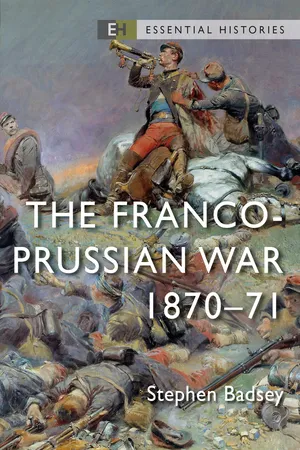
Illustrated with colour maps and images, this is an introduction to the Franco-Prussian War, a war that marked the beginning of the creation of modern Europe.
The Franco-Prussian War started in 1870 when Otto von Bismarck engineered a war with the French Second Empire under Napoleon III, as part of his plan to unite Prussia with the southern German states as a new Germany. Stephen Badsey examines the build-up, battles, and impact of the war, which was an overwhelming Prussian victory with massive consequences. The French Second Empire collapsed, Napoleon III became an exile in Britain, and King Wilhelm I was proclaimed Emperor of the new united Germany. In the peace settlement that followed, Germany gained the eastern French provinces of Alsace and Lorraine, areas that were to provide a bone of contention for years to come.
Updated for the new edition with revisions from the author and new images throughout, this is an accessible introduction to the largest and most important war fought in Europe between the age of Napoleon and the First World War.
- 144 pages
- English
- ePUB (mobile friendly)
- Available on iOS & Android
eBook - ePub
About this book
Information
THE FIGHTING
The invasion of France

Both sides expected the French to attack first, invading from France’s eastern provinces of Alsace and Lorraine across the common frontier into the Palatinate. Given that the assembled Federal Army would be much larger than any French Army that could take the field, this was France’s main chance for a victory; and France had, after all, both sought and declared war. The railway system in France was also superior to that of Prussia, in which the General Staff’s control over railways in wartime had not yet been fully established. A French invasion and an initial Prussian defeat could force Bavaria and the southern states into neutrality, and bring Austria or Italy into the war on the French side. Such an expansion of the war might also involve the British politically, ending it in the French favour.
In fact the French were completely unprepared to take any such action, and their only plans for war with Prussia were rudimentary. The Franco-Prussian War was later identified as the only case that century in which a country had declared war with no prior preparation or military action. But the Prussians did not know that, and Moltke had based his own plans on the urgent need to get as many troops to the frontier as fast as possible, even leaving the supply trains behind at first to increase the number of combat soldiers. His worst-case assessment was that the French might attack with a force of about 150,000 by 25 July, slicing through the unprepared Prussians; if they had not done so by 1 August he believed that he could win a defensive campaign, and if they still had not attacked by 4 August he would take the offensive. A lot of what happened in the first two months of the war stemmed from the reasonable Prussian belief that the French Army and its generals, belonging to the most powerful country in Europe, were at least as good as themselves. No-one on either side was prepared for just how badly the French were going to fare and even afterwards it remained hard to explain.
Three major military problems faced European generals at war in the mid-19th century. The first was the movement and supply of the vast new armies, both by rail and then on foot once they left their railheads. The forces mobilised on both sides in the Franco-Prussian War together constituted by far the largest armies in Europe that century. Not only was ammunition needed, but also thousands of horses for transport and haulage, and both horses and men required daily food and water. The second problem was how to communicate and exercise command over such large formations, both before and during the battle. The final problem was how to respond to the growing lethality of artillery and infantry firepower. Although they were known to be increasingly vulnerable, close troop formations were still needed to keep control and transmit orders, both when marching and on the battlefield.
The French had some experience of railways from 1859, but the lack of a proper General Staff or detailed peacetime preparation was a great handicap. Once away from the railheads, armies moved on foot as their ancestors had done, averaging about ten miles (16km) a day in 1870. Under Napoleon I the French Army had developed the technique of army corps moving separately across country for speed of manoeuvre and ease of supply, either through supply lines from depots or from the local countryside, or both. Given the limitations of 19th-century roads, the army corps moved side by side, only coming together for a major battle. The military aphorism was ‘separate to move, unite to fight’. Command of the new mass armies was seen as requiring essentially the same methods.
The issue of firepower had been addressed in the 1850s by the French ‘chasseur school’ of military thought, whose ideas spread throughout Europe. If weapons were three times as effective, then troops must advance in battle at three times the speed, at a fast trot or jog rather than walking, in more loose formations. This approach needed better recruits with higher levels of training, higher standards of fitness, and officers with a concern for the well-being of their men. Given that good recruits were not always available, other French generals, particularly with engineering experience, preferred taking up strong defensive positions and tempting the enemy to advance into a hail of fire. Defensive entrenchments in the form of ‘rifle pits’, holding up to 12 men, and the use of buildings as strongpoints, were not unusual. Regardless, the basis of French plans was that the war would be won by brilliant French generalship and by L’élan et le cran – flair and guts.
The approach of the Prussian General Staff under Moltke to the same problems was altogether different, including a belief that the nature of generalship had changed. The Prussian Army in 1870 introduced two new words into the military vocabulary: ‘mobilisation’, meaning the rapid assembly of a mass army, and ‘concentration’, its equally rapid transport to the frontiers ready to fight. Moltke envisaged a single continuous movement, from the order to mobilise through to the concentration of the armies, the first encounters with the enemy, and the decisive victory in battle. Moltke did not expect to be able to control these events, and the General Staff headquarters that he took with him as part of the Royal Headquarters was tiny: only 14 officers and 76 soldiers. Two of his often-quoted aphorisms were ‘mistakes made in the initial deployment cannot be corrected’, and ‘no plan of operations extends with certainty beyond the first encounter with the enemy’s main strength’. The basis of Prussian plans was that the war would be decided largely by greater numbers and Prussian staff training, and won by the side that made the fewest mistakes, while victory in battle would depend on superior Prussian discipline, and on an overwhelming ‘will to win’.
The Prussian emphasis on priority for fighting troops produced its own problems. Getting the balance right between troops and supplies had no obvious solution, and the armies while concentrating were extremely vulnerable to attack. Drawing on the Prussian tradition dating back to General Carl von Clausewitz (who died in 1831), Moltke argued that any such troubles would be resolved by defeating the enemy in battle. His preferred solution to the difficulty of attacking into increasing firepower was to make it the enemy’s problem. As the dispersed army corps encountered the French, so they would curl in like the closing fingers of a hand to surround them, forcing the enemy to fight their way through the encirclement, and destroying themselves in a ‘battle of annihilation’.
Unlike the wars of Napoleon I, which had been fought by armies with very similar weapons to each other, this was also a war in which weapons technology made a major difference to the way that both sides fought. In 1870 the famed Dreyse needle gun, with an effective range of 600m, was nearly obsolete. In 1868, as part of their reforms, the French Army was equipped with a rifle of the next generation, the excellent Chassepot breech-loader, with a range of 1,500m. Smokeless powder for both rifles and artillery was more than a decade in the future, and the clouds of smoke plus the need for close formations on the battlefield provided mass targets easily visible at the Chassepot’s maximum range.
If the French were a generation ahead in rifles, the Prussians had a similar advantage in artillery. After encountering the very good Austrian artillery in 1866, they had re-equipped with the latest Krupp-built steel rifled breech-loaders with percussion-fused shells that burst on impact. There were two main calibres of field artillery: the ‘4-pdr’ field gun (actually of 9lb or just under 80mm calibre) which equipped both the field artillery and horse artillery, and the ‘6-pdr’ field gun (15lb or 90mm calibre); the maximum range of the 6-pdr piece was 4,600m. In practice field guns on both sides seldom opened fire at above 3,000m, which was their effective range. The impressive Prussian train of siege artillery, of up to 210mm calibres with ranges of between 4,000m and 8,000m, was of a similar high quality. The French had not had the time or money to modernise their artillery. They still used muzzle-loading bronze cannon, chiefly the 1858 pattern rifled 4-pdr calibre field gun with an upper range of 3,300m, and the 1839 pattern 12-pdr smoothbore siege gun converted to rifling, with a notional upper range of 5,600m. As a further disadvantage, these had only time-fused shells that burst at restricted pre-set ranges. French factories did not produce sufficient percussion fuses until after the war’s start, and not until November 1870 could French artillery hold its own against the Prussians. The French artillery also included batteries of the Mitrailleuse, an early machine gun mounted on wheels and treated as the equivalent of a field gun that could fire 125 rounds a minute out to about 2,500m. Contrary to one common myth of the war this was a very effective weapon that the Prussians greatly respected.
The cavalry on both sides had serious problems: generals tended to underrate them, and they were badly used. For almost 20 years cavalry had been told that they were obsolete, since their horses could not survive the increases in firepower. But there was nothing that could replace cavalry in their two main functions of scouting for information, which with the new large armies was of increasingly greater importance, and making a mounted charge on the battlefield to scatter the enemy. Again after their experience in 1866 fighting superior Austrian cavalry, the Prussian cavalry were rather better than the French at scouting, but the difficulties in getting the information back was one reason why Moltke believed that detailed planning was impossible, and why the armies often marched blindly about the countryside.

A depiction of one of the several batteries of Prussian heavy artillery firing into Paris from a constructed emplacement during the siege. (Pictorial Press Ltd / Alamy Stock Photo)
These differences in weapons between the two sides meant that battles took the form either of Prussian infantry taking heavy casualties trying to close the gap between the range of the Chassepot rifle and the Dreyse, or of French infantry duelling at long range against Prussian artillery while the Prussian infantry hung back. In fact both sides’ infantry were more reluctant to move to close range than their commanders liked, although not for lack of courage. Cavalry was still used to charge in battle, chiefly to disrupt enemy fire by presenting a second target in order to save infantry in trouble, rather than with any hope of a decisive effect. Again, the Prussians were better at choosing their moment than the French, who often threw away their cavalry in hopeless charges. Although some French and all Prussian cavalry carried breech-loading carbines (shortened rifles), neither had adopted the dismounted tactics combined with the charge seen in the later stages of the American Civil War.
The Prussian mobilisation and concentration was dictated largely by the shape of their railway system. The General Staff plans, drawn up over the winter of 1869–70, provided for the three armies to assemble along the Rhine between Koblenz in the north and Karlsruhe in the south, intending to envelop the French from both sides if they attacked eastwards into the Palatinate. Prussian regiments were mostly regionally based, with each parish recruiting a battalion; on mobilisation reserves returning to their local depots brought the regiments up to war strength, and they then set off by train for their concentration areas. The process did not go perfectly, but it was effectively complete just 18 days after the mobilisation order. Including the southern allies and all the reserves and Landwehr, 1,183,000 men had been mobilised (equivalent to the population of a major European city), with everything from food and ammunition to military doctors and lawyers, and 462,000 had been concentrated on the frontier. By the war’s end, the Federal – by then Imperial – Army in France numbered 850,000 troops.
By late July no French attack had materialised apart from a few cavalry skirmishes, and the Prussian armies continued the move to their concentration areas: First Army (65,000 men) near Wadern, Second Army (174,000) near Neunkirchen, and Third Army (141,000) near Landau. King Wilhelm joined his Royal Headquarters at Mainz on 31 July. Moltke’s plan was for Second Army in the centre to advance towards Saarbrücken with First Army moving parallel to its north, and Third Army (which was intended to move first) advancing towards Strasbourg. The expectation was now that the French would meet Second Army’s thrust head-on, and that either First Army or Third Army (or both) would then envelop them from the side.
Meanwhile the French mobilisation, which had not been prepared or planned in the Prussian fashion, degenerated into chaos. Regiments were recruited from across France and reservists might live anywhere, meaning that formations would take about a month to reach full strength. But given the urgency of the situation, French plans combined mobilisation with concentration, so that regiments departed for their frontier concentration areas understrength, leaving the rest of their men and equipment to follow. About 2,000 separate contingents, each of 50–300 reservists, gathered together at towns throughout France, travelled first to their regimental depots, and then on to join their regiments. Stories became rife after the war of reservists living almost on the frontier with Germany journeying to their depots in southern France, Algeria or Corsica, and then back to their regiments on the frontier, only to arrive too late. Once more the French Army improvised; in addition to the Garde Mobile being used to augment the line infantry, formations known as Régiments de Marche were formed by combining battalions from different units.
The only plan that the French could implement had been drawn up in 1868, creating three armies based on the main rail routes which ran into Metz and Strasbourg. The Army of Alsace assembled at Strasbourg under Marshal MacMahon, the Army ...
Table of contents
- Cover
- Title Page
- CONTENTS
- INTRODUCTION
- BACKGROUND TO WAR
- WARRING SIDES
- OUTBREAK
- THE FIGHTING
- THE WORLD AROUND WAR
- HOW THE WAR ENDED
- CONCLUSIONS AND CONSEQUENCES
- CHRONOLOGY
- FURTHER READING
- eCopyright
Trusted by 375,005 students
Access to over 1.5 million titles for a fair monthly price.
Study more efficiently using our study tools.
Frequently asked questions
Yes, you can cancel anytime from the Subscription tab in your account settings on the Perlego website. Your subscription will stay active until the end of your current billing period. Learn how to cancel your subscription
No, books cannot be downloaded as external files, such as PDFs, for use outside of Perlego. However, you can download books within the Perlego app for offline reading on mobile or tablet. Learn how to download books offline
Perlego offers two plans: Essential and Complete
- Essential is ideal for learners and professionals who enjoy exploring a wide range of subjects. Access the Essential Library with 800,000+ trusted titles and best-sellers across business, personal growth, and the humanities. Includes unlimited reading time and Standard Read Aloud voice.
- Complete: Perfect for advanced learners and researchers needing full, unrestricted access. Unlock 1.5M+ books across hundreds of subjects, including academic and specialized titles. The Complete Plan also includes advanced features like Premium Read Aloud and Research Assistant.
We are an online textbook subscription service, where you can get access to an entire online library for less than the price of a single book per month. With over 1.5 million books across 990+ topics, we’ve got you covered! Learn about our mission
Look out for the read-aloud symbol on your next book to see if you can listen to it. The read-aloud tool reads text aloud for you, highlighting the text as it is being read. You can pause it, speed it up and slow it down. Learn more about Read Aloud
Yes! You can use the Perlego app on both iOS and Android devices to read anytime, anywhere — even offline. Perfect for commutes or when you’re on the go.
Please note we cannot support devices running on iOS 13 and Android 7 or earlier. Learn more about using the app
Please note we cannot support devices running on iOS 13 and Android 7 or earlier. Learn more about using the app
Yes, you can access The Franco-Prussian War by Stephen Badsey in PDF and/or ePUB format, as well as other popular books in History & 19th Century History. We have over 1.5 million books available in our catalogue for you to explore.