Following the American Declaration of Independence, communities from Boston to Savannah were forced to make a choice: to strike out for an independent republic, or remain true to the British Crown.
The American Revolutionary War was America's first civil war. As the conflict raged from Canada to the Caribbean and from India to Gibraltar, it was in American communities that the war was the most intimate, the most personal, and – accordingly – the most vicious.
In 1775, the inhabitants of British America included those born in North America and newly arrived immigrants; the established landed aristocracy and the indigent; the diverse nations of the Native Americans; and people of African descent, both enslaved and free. The coming of war forced every person to make the choice of whether to side with the Patriots or remain loyal to the British Crown. With so many cross-cutting imperatives, the individual decisions made splintered communities, sometimes even households, turning neighbour against neighbour in an escalating spiral of ostracism, embargo, exile, raid, reprisal and counter-reprisal. Accordingly, the war on the frontiers and on the margins of conflict was as underhanded and ugly as any of the 21st century's insurgencies.
In this study, the origins, fighting methods and combat effectiveness of the combatants fighting on both sides are assessed, notably in three significant clashes of the American Revolutionary War.
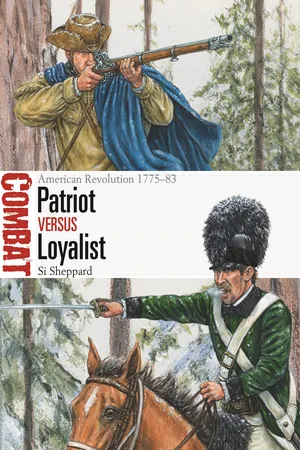
- 80 pages
- English
- ePUB (mobile friendly)
- Available on iOS & Android
eBook - ePub
About this book
Information
Oriskany
August 6, 1777
BACKGROUND TO BATTLE
The origins of British grand strategy guiding the 1777 campaign, which culminated in a defeat that constituted one of the critical turning points of the war, can be traced in large part to a fatal misunderstanding concerning the extent of Loyalist sentiment in the former colonies.
The essentials of the operational plan certainly appeared feasible on maps in London. One army under Major-General John Burgoyne would strike south down the Hudson River Valley in New York, while simultaneously a second army under Major-General William Howe would push north from New York City. The two forces would unite at Albany, severing New England from the rest of the fledgling Union. The divided Rebel territories could then be reduced in turn.
This narrative was immediately compromised when Howe instead embarked his army for an amphibious assault on the Patriot capital, Philadelphia. Burgoyne would therefore be on his own, in more ways than one, for the anticipated rising of Loyalists flocking to the Royal Standard on his route of march never happened. On the contrary, he found himself ever more isolated as he drove doggedly on toward Albany, the local Patriot militias responding like antibodies to his invasive presence in their communities, hanging on his flanks, exterminating his outriding forays at Bennington on August 16, and hounding him into surrender at Saratoga on October 17.
For decades prior to the outbreak of war, British authority in the Province of New York had been upheld on the personal recognizance of Sir William Johnson, Superintendent of Indian Affairs for the Northern Colonies. The personal relationship he established maintained peace between the colonists and the Six Nations of the Iroquois League (Haudenosaunee) under the imperial aegis. This responsibility was inherited by his nephew, Guy Johnson, in 1774, while his son, John, inherited his father’s baronetcy and lands. These men, along with Sir William’s son-in-law, Daniel Claus, the Deputy Secretary of Indian Affairs, struggled to uphold Crown authority before all were impelled to seek refuge in Canada, bringing with them their retainers and many First Nations allies. These regrouped at Fort Ontario and would be employed in the invasion of 1777, but not directly under Burgoyne. Instead, they would form up in a separate column under Lieutenant-Colonel Barry St. Leger. While Burgoyne took the main force directly south, St. Leger’s command would be transported west up the St. Lawrence River and via Lake Ontario to use Oswego as its jumping-off point for the march inland. The intent was for this detachment to draw off Patriot forces mobilizing to confront Burgoyne.

A patrician of the landed gentry, Major General Philip Schuyler had the difficult task of coordinating the defense of New York against the Burgoyne expedition. When Fort Ticonderoga fell at the onset of that campaign, Schuyler was replaced in command by Major General Horatio Gates, who had accused Schuyler of dereliction of duty. Schuyler demanded a court martial in order to clear his name and was acquitted, but subsequently resigned from the Continental Army. He remained a member of the Second Continental Congress, however, and his high profile made him the target of a British kidnapping plot. Loyalists led by Captain John Meyers broke into Schuyler’s mansion, The Pastures, 2 miles south of Albany on July 29, 1781. Schuyler’s bodyguards and servants held off the intruders long enough for him to race upstairs and arm himself. As he explained to Washington, “those in the quarter exposed to my fire retired on the first discharge, those that had got in the Saloon, leading to my bed room, retreated with Great precipitation, on hearing me call ‘come on my lads surround the house, And Secure the Villains who are plundering’” (Founders Online). Having fallen for this bluff, Meyers’ men withdrew, taking with them two prisoners and as much of Schuyler’s silverware as they could stuff into their pockets. (Library of Congress)
St. Leger set out on July 19 with a mixed force including 100-strong detachments from both the 8th and 34th regiments of Foot, 80 Anspach Jäger, 40 artillerymen, 200 Canadian pioneers, and approximately 350 Loyalists. At the core of the Loyalist contribution was a unit raised by Lieutenant Colonel Sir John Johnson, the King’s Royal Regiment of New York (KRR, unofficially dubbed the Royal Yorkers, Johnson’s Greens, or the Royal Greens). Johnson led in person, his key subordinate being his brother-in-law, Captain Stephen Watts. Other prominent Loyalists accompanying the expedition included Colonel Daniel Claus, Superintendent of the Loyalist First Nations in Canada, and Major John Butler, who with his son, Captain Walter Butler, had raised the posse of Loyalist volunteers that would constitute the nucleus of Butler’s Rangers when that unit was formally recognized later in the year.
Departing Oswego on July 25, St. Leger linked up with contingents from those four of the six nations making up the Iroquois League that allied with the British – the Mohawk, Seneca, Onondaga, and Cayuga – for this conflict broke the Great Peace (Kayenarhekowa) which had bound their confederacy together for generations, sparking a civil war within the greater civil war now raging between rival white factions. The total number of warriors joining the British cause swelled to as many as 1,000 under chiefs such as Thayendanegea (Joseph Brant), Gyantwachia (Cornplanter), Sayenqueraghta (Old Smoke), and Thaonawyuthe (Blacksnake).
The Americans, who had been stretched in holding off a British counter-invasion in 1776 after the Patriot retreat from Montreal, were aware another onslaught out of Canada was inevitable. In March 1777, Major General Philip Schuyler, Patriot commander of the Northern Department, ordered 28-year-old Colonel Peter Gansevoort to take command of the Continental Army’s 3rd New York Regiment at Fort Stanwix and make it the breakwater in the defense of the Mohawk Valley. The fort stood on the Oneida Carry, a vital portage road for boats and canoes between the Mohawk River and Wood Creek. The 600 Regulars, laboring to refurbish the fort while coming under ever-increasing pressure from Loyalist and First Nations raiders, were reinforced by another 150 Continental Army troops of the 9th Massachusetts Regiment on July 19. St. Leger arrived beneath the fort with his main force on August 2 and, after Gansevoort refused a summons to surrender the garrison, commenced siege operations. To better impose a tighter cordon, St. Leger split his command, the British troops encamping north of the fort, the Loyalists and First Nations allies to its south.

Joseph Brant (also known as Thayendanegea) was truly a man of two cultures, growing up where the Iroquois and British worlds intersected. As a 12-year-old boy he was a witness to the conference convened at Fort Johnson on June 21, 1755, by Sir William Johnson at which Johnson called on the Iroquois chiefs and clan mothers to ally with the British at the onset of the Seven Years’ War. Brant himself would enlist when he came of age, while his sister, Molly, became Johnson’s common-law wife. In 1775, Brant withdrew from Patriot authority, first to Canada, then to London with Guy Johnson in order to solicit more direct royal support for First Nations rights. Having been introduced to King George III, he returned to America with the British invasion force that occupied New York City, then made his way north to Six Nations territory, where he raised a company of irregulars dubbed Brant’s Volunteers. Interestingly, the majority of these men initially were white Loyalists; only later, as Brant’s reputation as a war chief grew, was he able to attract large numbers of warriors from the Iroquois tribes. Brant had numerous opportunities to enhance his credentials in battle, leading from the front at Oriskany (1777); Cobleskill, Wyoming Valley, German Flatts, and Cherry Valley (all 1778); Minisink (1779); Klock’s Field (1780); and Lochry’s Defeat (1781), among a host of other raids and skirmishes. In the aftermath of the war, he led his people into exile and resettlement in Canada. (Art Images via Getty Images)
With all remaining Regular troops of the Continental Army in the Northern Department being mustered to confront the main British invasion force under Burgoyne, Schuyler would be forced to rely heavily on regional militias to support Gansevoort at Fort Stanwix. This would mean a process of negotiation with, not assumed authority over, military leadership in the local communities. Typically, Schuyler twice ordered Tryon County militia Brigadier General Nicholas Herkimer to reinforce Gansevoort, only for Herkimer to insist he could not spare any men. It took a direct appeal from New York Governor George Clinton before Herkimer finally ordered the Tryon County militia mustered at Fort Dayton on August 2. The 800-plus volunteers were organized into four separate regiments, each of about 200 men, and set out on August 4 on the roughly 30-mile trek west to Fort Stanwix. In the vanguard was the Canajoharie District 1st Regiment, under Colonel Ebenezer Cox. Next in line was the Palatine District 2nd Regiment, under Colonel Jacob Klock; then came the Kingston–German Flatts District 4th Regiment under Colonel Isaac Paris and Colonel Peter Bellinger. These were followed by five companies of Colonel Frederick Visscher’s Mohawk District 3rd Regiment, then an ox-drawn convoy of 15 wagons bearing provisions and baggage, and finally the rest of Visscher’s companies, which were serving as the rearguard.
Herkimer had wanted to wait for reinforcements to come in from the Schenectady and Albany militias, but the local committeemen insisted he march out immediately, even accusing Herkimer of being afraid to advance. In any event, initiative from the neighboring communities would prove lacking. On August 4, Continental Army Colonel Goose Van Schaick wrote to Schuyler from Schenectady complaining that he had ordered half of the militias from Schoharie and Schenectady counties to march immediately to German Flatts only for his orders to be countermanded by the Schoharie committee on the grounds that “none of their Militia can be spared. I have this day been trying to prevail on the militia of this place, but find to my great surprise that not a man will go with me” (quoted in Clinton II.169–70).
Herkimer, meanwhile, was having trouble asserting his authority over his subordinates, who wanted to continue the march along the easier ground north of the Mohawk River. Herkimer had to insist the better...
Table of contents
- Cover
- Title Page
- Table of Contents
- Introduction
- The Opposing Sides
- Westchester County
- Oriskany
- Kings Mountain
- Analysis
- Aftermath
- Select Bibliography
- eCopyright
Trusted by 375,005 students
Access to over 1.5 million titles for a fair monthly price.
Study more efficiently using our study tools.
Frequently asked questions
Yes, you can cancel anytime from the Subscription tab in your account settings on the Perlego website. Your subscription will stay active until the end of your current billing period. Learn how to cancel your subscription
No, books cannot be downloaded as external files, such as PDFs, for use outside of Perlego. However, you can download books within the Perlego app for offline reading on mobile or tablet. Learn how to download books offline
Perlego offers two plans: Essential and Complete
- Essential is ideal for learners and professionals who enjoy exploring a wide range of subjects. Access the Essential Library with 800,000+ trusted titles and best-sellers across business, personal growth, and the humanities. Includes unlimited reading time and Standard Read Aloud voice.
- Complete: Perfect for advanced learners and researchers needing full, unrestricted access. Unlock 1.5M+ books across hundreds of subjects, including academic and specialized titles. The Complete Plan also includes advanced features like Premium Read Aloud and Research Assistant.
We are an online textbook subscription service, where you can get access to an entire online library for less than the price of a single book per month. With over 1.5 million books across 990+ topics, we’ve got you covered! Learn about our mission
Look out for the read-aloud symbol on your next book to see if you can listen to it. The read-aloud tool reads text aloud for you, highlighting the text as it is being read. You can pause it, speed it up and slow it down. Learn more about Read Aloud
Yes! You can use the Perlego app on both iOS and Android devices to read anytime, anywhere — even offline. Perfect for commutes or when you’re on the go.
Please note we cannot support devices running on iOS 13 and Android 7 or earlier. Learn more about using the app
Please note we cannot support devices running on iOS 13 and Android 7 or earlier. Learn more about using the app
Yes, you can access Patriot vs Loyalist by Si Sheppard,Adam Hook in PDF and/or ePUB format, as well as other popular books in History & Early American History. We have over 1.5 million books available in our catalogue for you to explore.