Throughout the first year of the war in the Pacific during World War II the USAAF was relatively ineffective against ships.
Indeed, warships in particular proved to be too elusive for conventional medium-level bombing. High-level attacks wasted bombs, and torpedo attacks required extensive training. But as 1942 closed, the Fifth Air Force developed new weapons and new tactics that were not just effective, they were deadly. A maintenance officer assigned to a B-25 unit found a way to fill the bombardier's position with four 0.50-cal machine guns and strap an additional four 0.50s to the sides of the bomber, firing forward. Additionally, skip-bombing was developed. This called for mast-top height approaches flying the length of the target ship. If the bombs missed the target, they exploded in the water close enough to crush the sides. The technique worked perfectly when paired with "strafe" B-25s.
Over the first two months of 1943, squadrons perfected these tactics. Then, in early March, Japan tried to reinforce their garrison in Lae, New Guinea, with a 16-ship convoy – eight transports guarded by eight destroyers. The Fifth Air Force pounced on the convoy in the Bismarck Sea. By March 5 all eight transports and four destroyers had been sunk
This volume examines the mechanics of skip-bombing combined with a strafing B-25, assessing the strengths and weaknesses of the combatants (B-25 versus destroyer), and revealing the results of the attacks and the reasons why these USAAF tactics were so successful.
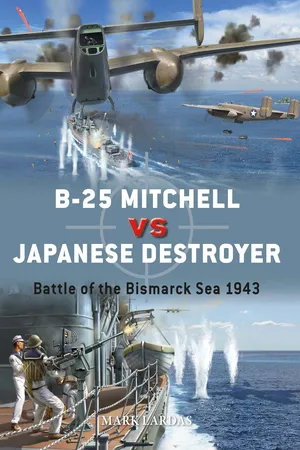
eBook - ePub
B-25 Mitchell vs Japanese Destroyer
Battle of the Bismarck Sea 1943
- 80 pages
- English
- ePUB (mobile friendly)
- Available on iOS & Android
eBook - ePub
About this book
Information
TECHNICAL SPECIFICATIONS
B-25 MITCHELL
The B-25 was a semi-monocoque aircraft using aluminum for both the structural elements and the skin. It was a mid-wing aircraft with retractable tricycle landing gear, a horizontal stabilizer set at the top of the fuselage, and twin rudders. Monocoque construction is one where all structural loads are supported by the aircraft’s skin. In semi-monocoque construction, while the skin supplies some of the strength, the framing provides most of the aircraft’s structural strength. It offers structural redundancy, allowing the skin and frames to share the load.
The primary structural material used in the B-25 was aluminum. Weighing one-third of an equivalent volume of steel, aluminum is corrosion-resistant and easy to manufacture, making it an ideal structural and covering material for aircraft. It was also stronger and easier to work with than the wood and fabric used in previous generations of aircraft.
The B-25 used aircraft construction techniques typical of the period. These included transverse frames on the wings and fuselage, and fuselage frames that were linked together with metal stringers, while the wings used full cantilever construction. The mid-wing had a center section anchored to the fuselage, with the inner wing panels running to the engine mounting. The outer wings bolted onto the center wing section. The skin was attached to the frames with aluminum rivets. Removable panels were secured using Dzus fasteners. The aircraft was not intended to be pressurized, so its profile was that of a rounded rectangle, maximizing usable internal volume.

This standard B-25C, assigned to the Fifth Air Force’s 38th BG in November 1942, reveals how lightly armed these aircraft were when they initially arrived in New Guinea. It has a flexibly mounted 0.50-cal. machine gun for the bombardier, and a fixed weapon of the same caliber in the lower right side of the nose. (NARA)
The fuselage had three main structural components: forward, middle, and tail. The forward section contained the nose, with the bombardier’s station or nose guns and the flightdeck where the pilot, co-pilot, and navigator worked. In later versions (B-25H onward), it also contained the dorsal turret. The middle section held the bomb-bay and a passage linking the forward and rear fuselage. The rear section comprised everything aft of the bomb-bay. In the B-25C/Ds that fought at Bismarck Sea, it also contained both turrets. In later versions, the waist and tail guns were located there.
The aircraft’s main landing gear retracted into the engine nacelles, while the nose leg and wheel were housed in a compartment below the flightdeck. Tricycle gear offered two advantages over conventional tailwheel gear during take-off and landing. The former gave the pilot better visibility, especially on take-off, and made the aircraft less susceptible to nose-overs. On landing, it reduced the possibility of ground looping, while also offering better crosswind performance during the final approach.
These advantages compensated for the complexity of adding a retractable nose gear. Except for aircraft already in production (such as the Lockheed Hudson), all American multi-engined military aircraft procured after 1940 used tricycle landing gear. B-25s had a tail skid to protect the rear fuselage should the pilot over-rotate the aircraft on take-off.
The B-25 was a hauler. It could carry nearly 50 percent of its empty weight in payload – fuel, bombs, and ammunition. While long-range missions reduced bombload due to balancing fuel against bombs carried, the aircraft’s ability to carry so much weight made it extremely versatile. This attribute also permitted the type of field modifications that led to the development of strafer versions of the B-25.
B-25C MITCHELL STRAFER COCKPIT

1. Altimeter correction card
2. Pilot’s clock
3. Static pressure selector valve
4. Pilot direction indicator
5. Free air temperature indicator
6. Altimeter (behind control column)
7. Radio compass
8. Directional gyro
9. Airspeed indicator
10. Turn-and-bank indicator
11. Accelerometer
12. Turn-and-bank needle valve
13. Flight attitude indicator
14. Rate-of-climb indicator
15. Nose wheel turn indicator lights
16. Magnetic compass
17. Compass correction card
18. Section (vacuum) gauge
19. Remote-reading compass
20. Autopilot oil pressure gauge
21. Autopilot directional gyro unit
22. Autopilot turn-and-bank gyro unit
23. Manifold pressure gauge
24. Oil pressure gauge
25. Main tanks fuel level indicator
26. Auxiliary...
Table of contents
- Cover
- Title Page
- Table of Contents
- Introduction
- Chronology
- Design and Development
- Technical Specifications
- The Strategic Situation
- The Combatants
- Combat
- Statistics and Analysis
- Aftermath
- Further Reading
- eCopyright
Trusted by 375,005 students
Access to over 1.5 million titles for a fair monthly price.
Study more efficiently using our study tools.
Frequently asked questions
Yes, you can cancel anytime from the Subscription tab in your account settings on the Perlego website. Your subscription will stay active until the end of your current billing period. Learn how to cancel your subscription
No, books cannot be downloaded as external files, such as PDFs, for use outside of Perlego. However, you can download books within the Perlego app for offline reading on mobile or tablet. Learn how to download books offline
Perlego offers two plans: Essential and Complete
- Essential is ideal for learners and professionals who enjoy exploring a wide range of subjects. Access the Essential Library with 800,000+ trusted titles and best-sellers across business, personal growth, and the humanities. Includes unlimited reading time and Standard Read Aloud voice.
- Complete: Perfect for advanced learners and researchers needing full, unrestricted access. Unlock 1.5M+ books across hundreds of subjects, including academic and specialized titles. The Complete Plan also includes advanced features like Premium Read Aloud and Research Assistant.
We are an online textbook subscription service, where you can get access to an entire online library for less than the price of a single book per month. With over 1.5 million books across 990+ topics, we’ve got you covered! Learn about our mission
Look out for the read-aloud symbol on your next book to see if you can listen to it. The read-aloud tool reads text aloud for you, highlighting the text as it is being read. You can pause it, speed it up and slow it down. Learn more about Read Aloud
Yes! You can use the Perlego app on both iOS and Android devices to read anytime, anywhere — even offline. Perfect for commutes or when you’re on the go.
Please note we cannot support devices running on iOS 13 and Android 7 or earlier. Learn more about using the app
Please note we cannot support devices running on iOS 13 and Android 7 or earlier. Learn more about using the app
Yes, you can access B-25 Mitchell vs Japanese Destroyer by Mark Lardas,Jim Laurier in PDF and/or ePUB format, as well as other popular books in History & 20th Century History. We have over 1.5 million books available in our catalogue for you to explore.