Conceived during 1941 in case Germany occupied Britain, when US bombers would then have insufficient range to retaliate, the B-36 was to be primarily a '10,000-mile bomber' with heavy defensive armament, six engines and a performance that would prevent interception by fighters.
Although rapid developments in jet engine and high-speed airframe technology quickly made it obsolescent, the B-36 took part in many important nuclear test programmes. The aircraft also provided the US nuclear deterrent until the faster B-52 became available in 1955. It was one of the first aircraft to use substantial amounts of magnesium in its structure, leading to the bomber's 'Magnesium Overcast' nickname.
It earned many superlatives due to the size and complexity of its structure, which used 27 miles of wiring, had a wingspan longer than the Wright brothers' first flight, equivalent engine power to 400 cars, the same internal capacity as three five-room houses and 27,000 gallons of internal fuel – enough to propel a car around the world 18 times. Much was made of the fact that the wing was deep enough to allow engineers to enter it and maintain the engines in flight. B-36s continued in the bomber and reconnaissance role until their retirement in February 1959 following 11 years in SAC. Convair employees were invited to suggest names for the giant aircraft, eliciting suggestions such as 'King Kong Bomber', 'Condor', 'Texan' and 'Unbelievable', but the most popular was 'Peacemaker'. Oddly, objections from religious groups deterred the USAF from ever adopting it officially.
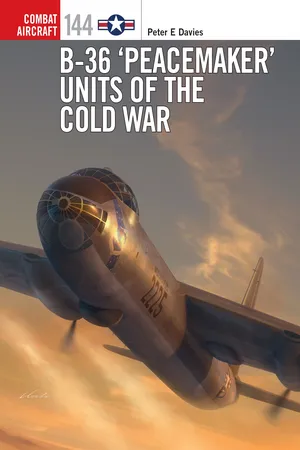
This fully illustrated volume includes first-hand accounts, original photographs and up to 30 profile artworks depicting in detail the complexity of this superlative aircraft.
- 96 pages
- English
- ePUB (mobile friendly)
- Available on iOS & Android
eBook - ePub
B-36 ‘Peacemaker’ Units of the Cold War
About this book
Information
CHAPTER ONE
BIGGER AND BOLDER
The largest bomber ever to have served with the US Air Force (USAF) still rates numerous superlatives decades after the last example flew. With an unmatched 86,000-lb bomb load, an unrefuelled range greater than the B-2A Spirit’s and a 230-ft wingspan, the Convair B-36 earned its unofficial name ‘Peacemaker’ by maintaining America’s nuclear deterrent throughout a long Cold War period, during which Soviet defences gradually developed the means to resist its power.

Accompanied by a C-87 transport version of Consolidated’s legendary B-24 Liberator bomber, XB-36 prototype 42-13570 makes an early test flight. Both machines are having to fly nose-high in order to remain in formation with the slower photo-aircraft. The ‘buzz number’ BM-570 was painted on the nose and below the left wing of 42-13570 at a later date (Terry Panopalis Collection)
On 8 September 1945, the first XB-36 emerged from the massive Fort Worth, Texas, Government Aircraft Plant 4, the home of the Consolidated Vultee Aircraft Corporation as it became in 1943, abbreviated thereafter to Convair from 1954. The proximity of Lake Worth was originally an incentive to use this as a main manufacturing plant, rather than the company’s San Diego, California, headquarters, as its newly completed PBY Catalina flying boats could be flown from there. Fear of Japanese attacks on the US west coast also prompted a move into safer territory in Texas.
The huge bomber’s development had begun in 1941, but it was delayed by America’s entry into World War 2 following the Japanese attack on Pearl Harbor, and the subsequent need to use Plant 4’s cavernous interior to build 2743 B-24 Liberator bombers, together with B-32 Dominators, PBY Catalinas and C-87 Liberator Express transport aircraft.
It was the shock of the Pearl Harbor raid on 7 December 1941 that persuaded the US War Department to expedite the development of a bomber with far greater range and payload than the B-17 Flying Fortress or the B-24 Liberator. The aircraft’s origins coincided with the building of Plant 4, begun in April 1941 on the understanding that the factory could be suitable for the manufacture of an intercontinental bomber with a range of 10,000 miles, a wingspan of 195 ft and an unprecedented weight of 200,000 lbs – four times that of a loaded B-24.
Although the decision to delay its development was understandable in a wartime situation where mass production of established types like the B-24 and higher-risk innovations like the Boeing B-29 Superfortress was vital, the B-36 might have been ready to attack Japan from Hawaii in 1944 had it been prioritised in 1941.
The idea of a massive intercontinental bomber also emerged as the ‘Amerika bomber’, conceived in 1940 to fulfil Adolf Hitler’s vision of bombing New York and 20 other targets in the USA if America was drawn into World War 2. The four-engined Messerschmitt Me 264 and the six-engined Junkers Ju 390, with a 165-ft wingspan, were intended to make the 7200-mile round trip from Europe via the Azores with light bomb loads. They reached prototype form only.
In Britain, the Bristol Aeroplane Company made preliminary designs in 1937 for a large bomber with wings spanning 230 ft – the same as the B-36, but with a 15-ft longer fuselage. With eight paired 2650 hp Centaurus engines driving contra-rotating 16-ft diameter propellers, the Type 167 would have had a 5500-mile range at 250 mph. By 1948 the design had evolved into the Brabazon 100-seat airliner – a commercial failure which also reached prototype form only, but completed successful flight trials. In April 1949, the Brabazon’s designated test pilot, Bill Pegg, visited Convair for familiarisation training on the XB-36.
Six-engined giant bomber designs were also pursued in the Soviet Union from the early 1930s with the ANT-16, its wings spanning 177 ft, and the aircraft’s even larger eight-engined derivative, the ANT-20 Maxim Gorky. It boasted a 206 ft 8 in wingspan. Japan’s six-engined G10N1 had the same wingspan, and it was designed to reach America.
A much earlier project to build a six-engined, long-range bomber (and the only six-engined American aircraft constructed and flown prior to the B-36) actually originated in the USA as a response to the Zeppelin-Staaken R.VI biplanes that had operated over the Western Front from 1917. Walter Barling’s 1923 XNBL-1 triplane experimental night bomber, built by Wittemann-Lewis, had a wing span of 120 ft. Its six 400 hp Liberty engines gave it a cruising speed of only 60 mph and a service ceiling of a mere 7700 ft. Carrying bombs reduced the aircraft’s fuel load so much that its range was only 170 miles.

The XB-36’s nose, seen here in June 1947, included a smaller ‘greenhouse’ area with its bomb-aiming window placed centrally. Crew access was via a ladder in the nose-gear well (Terry Panopalis Collection)
Franklin D Roosevelt, president of a neutral USA while Nazi armies rapidly overran Europe from September 1939, regarded American military air power as ‘utterly inadequate’ compared with the advanced might of Germany. He resolved to support the Allied cause in Europe without direct military involvement, and large numbers of fighters and bombers were seen as the only feasible response to such apparently unstoppable aggression. As America slowly recovered from the Great Depression, Roosevelt advocated many new factories to build military equipment.
In June 1941 the Führer launched his invasion of the Soviet Union, and although the Royal Air Force had held off the Luftwaffe in the Battle of Britain the previous year, the German threat remained if the USSR was defeated. If Britain also fell, the Americans would be unable to base bombers in England in order to prevent Hitler from grabbing the resources of Soviet Russia. Operating bombers from the USA would then become the only option, and no existing aircraft could meet that requirement. However, Britain stood strong following America’s entry into World War 2, and England duly became a ‘terrestrial aircraft carrier’ for a massive USAAF offensive against German-occupied Europe from the summer of 1942.
The mile-long production facility of Plant 4 at ‘Cowtown’, Texas, was devoted to B-24 mass production for that purpose, which in turn meant that the intercontinental bomber project had to wait. Once the Eighth Air Force’s British airfields were secured, there was no need to prioritise funding for another complex new bomber since the B-29 was already being developed in great secrecy. However, an intensive high-priority research programme was instigated for the B-36 as a long-term, vital strategic asset, overseen by I M ‘Mac’ Laddon, executive vice-president and chief engineer at the Consolidated Aircraft Corporation.
BOMBER LOGIC
The use of strategic bombers during World War 2 seemed to prove the theories of Col Billy Mitchell and Gen Giulio Douhet expressed in the 1920s that ‘the bomber will always get through’, albeit at considerable cost. The most advanced strategic bomber of the conflict was the B-29, which commenced operations in June 1944. With its 3000-mile range and atomic bomb capability (which brought the Pacific War to a terrifying end), the Superfortress seemed to be proof of the strategic bomber’s primacy as a decisive weapon.

YB-36 42-13571 initially had the single-wheel main landing gear that was subsequently replaced both on the XB-36 and on this aircraft by multi-wheel units. Evolved during the winter of 1946-47, it had a completely revised flightdeck to accommodate a nose gun turret (Author’s Collection)
In March 1946, Strategic Air Command (SAC) was created to ensure peace in a world where only the USA would carry the ‘big stick’ of a nuclear deterrent. Soviet premier Joseph Stalin made no secret of his desire to expand his empire, and the USSR soon copied the B-29 as the Tupolev Tu-4, giving the Soviet bloc potential nuclear capability. It enabled them to attack any target in Europe or fly one-way missions to the USA.
When it became clear in September 1949 that the USSR also had atomic weapons, the introduction of a more capable, longer-ranging successor to the B-29 became the basis for the creation and massive expansion of SAC’s bomber force. By the end of 1949 that force employed 71,500 personnel, owned almost 1000 aircraft and was still expanding rapidly. A year earlier, it had only six crews with training in nuclear delivery and a major problem in retaining relevant manpower, but by the end of 1948 there were 70 crews with atomic weapons training and an intensive recruitment drive was in full swing.
In its ambitious initial 1941 request for a ‘very heavy’ bomber, the US Army Air Corps (USAAC) specified a range of 12,000 miles at 25,000 ft. It would cruise at 275 mph, but reach a maximum of 450 mph and an absolute ceiling of 45,000 ft. As air-to-air refuelling was still thought impractical, and was never seriously considered for the B-36, the fuel requirements for such long range immediately dictated a massive airframe. By January 1948 attitudes to aerial refuelling had changed. Gen George Kenney, commander of SAC, stated, ‘I don’t know any project that is more important than the refuelling project right now’. SAC bombers like the B-29 and B-50 (essentially an improved Superfortress) were adapted to use it, but the B-36 remained self-sufficient for fuel.
The aircraft’s expanded size also enabled carriage of the enormous 43,000-lb ‘earthquake’ bomb to blast underground bunkers, as well as the very heavy early nuclear devices such as the Mk 3 ‘Fat Man’ bomb. Initially though, the new intercontinental bomber was conceived as a carrier for 10,000 lbs of conventional ordnance.
Before 1940, the largest bomber projects had been the 35-ton XB-15 (first flown in October 1937) and the XB-19 (first flown in June 1941). Both were one-offs and both were powered by four 1000 hp piston engines. Essentially experimental aircraft with a 212-ft wingspan, they were used to establish the feasibility of heavy bombers with a range of 5000 miles. Their speed, range, engine power and bomb capacity were well below the US War Department’s real targets and series production was not intended, although some of the XB-19’s systems were used in the B-36.
Instead, Boeing and Consolidated were requested in April 1941 to submit proposals based on their respective Model 384 and six-engined Model 385, together with the 164-ft wingspan Model 35 with four pusher-tractor engines, although none of these projects appeared to be very promising at the time. Boeing, fully occupied with B-17 production, devoted little attention to what they considered an unfeasible project.
In order to ease the designers’ tasks, the parameters were revised, reducing the combat radius by 1000 miles to...
Table of contents
- Cover
- Title Page
- Table of Contents
- Chapter One: Bigger and Bolder
- Chapter Two: Birth of a Heavyweight
- Chapter Three: Test and Development
- Chapter Four: Service Entry
- Chapter Five: Doomsday Bomber
- Chapter Six: Global Reach
- Chapter Seven: Many Crew, Many Tasks
- Chapter Eight: Massive Changes
- Appendices
- Colour Plates Commentary
- eCopyright
Trusted by 375,005 students
Access to over 1.5 million titles for a fair monthly price.
Study more efficiently using our study tools.
Frequently asked questions
Yes, you can cancel anytime from the Subscription tab in your account settings on the Perlego website. Your subscription will stay active until the end of your current billing period. Learn how to cancel your subscription
No, books cannot be downloaded as external files, such as PDFs, for use outside of Perlego. However, you can download books within the Perlego app for offline reading on mobile or tablet. Learn how to download books offline
Perlego offers two plans: Essential and Complete
- Essential is ideal for learners and professionals who enjoy exploring a wide range of subjects. Access the Essential Library with 800,000+ trusted titles and best-sellers across business, personal growth, and the humanities. Includes unlimited reading time and Standard Read Aloud voice.
- Complete: Perfect for advanced learners and researchers needing full, unrestricted access. Unlock 1.5M+ books across hundreds of subjects, including academic and specialized titles. The Complete Plan also includes advanced features like Premium Read Aloud and Research Assistant.
We are an online textbook subscription service, where you can get access to an entire online library for less than the price of a single book per month. With over 1.5 million books across 990+ topics, we’ve got you covered! Learn about our mission
Look out for the read-aloud symbol on your next book to see if you can listen to it. The read-aloud tool reads text aloud for you, highlighting the text as it is being read. You can pause it, speed it up and slow it down. Learn more about Read Aloud
Yes! You can use the Perlego app on both iOS and Android devices to read anytime, anywhere — even offline. Perfect for commutes or when you’re on the go.
Please note we cannot support devices running on iOS 13 and Android 7 or earlier. Learn more about using the app
Please note we cannot support devices running on iOS 13 and Android 7 or earlier. Learn more about using the app
Yes, you can access B-36 ‘Peacemaker’ Units of the Cold War by Peter E. Davies,Gareth Hector,Jim Laurier in PDF and/or ePUB format, as well as other popular books in History & 20th Century History. We have over 1.5 million books available in our catalogue for you to explore.