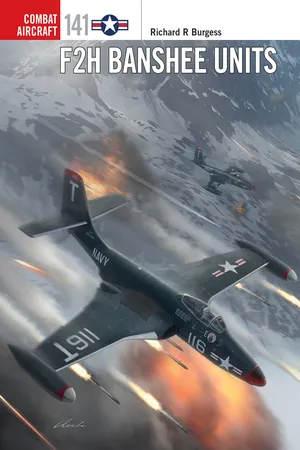
A fully illustrated study of the extraordinarily successful early-generation jet, the F2H Banshee, a frontline aircraft that served with 27 US Navy and US Marine Corps squadrons and three Royal Canadian Navy (RCN) squadrons.
The F2H Banshee was an extraordinarily successful early-generation jet that outlasted both contemporary and more modern fighter types on the decks of the US Navy's aircraft carriers in the 1950s. It served in a variety of roles and was a frontline aircraft for more than a decade in an era when jet fighters came and went with relatively short service careers.
This book examines the entire service life of the F2H in the service of the US Navy, US Marine Corps and the RCN. Initially created as a replacement aircraft for McDonnell's pioneering FH1 Phantom, the F2H served in the Korean War as a strike fighter, close air support aircraft, B29 escort, and photoreconnaissance aircraft, including the latter's forays over the Soviet Union and China. Post service in Korea, the Banshee served as a carrier based nuclear strike aircraft, followed by its service as a defensive fighter for antisubmarine aircraft carriers.
Filled with first-hand accounts and rare colour photographs, this is the engrossing story of the F2H Banshee, exploring its variety of roles in service and detailing the technology development that improved the aircraft's capabilities over time.
- 96 pages
- English
- ePUB (mobile friendly)
- Available on iOS & Android
eBook - ePub
F2H Banshee Units
About this book
Information
CHAPTER ONE
FIRST GENERATION JETS
The Banshee’s story began with its McDonnell predecessor, the FH-1 (previously FD-1) Phantom, which was the US Navy’s first operational carrier-based jet fighter. The Phantom was a single-seat, twin-engined design with visually obvious pedigree to the Banshee that succeeded it. The aircraft originated from a US Navy Bureau of Aeronautics request in 1942 to McDonnell Aircraft Corporation for a carrier-based jet fighter. McDonnell was selected in part because the major aircraft companies of the day were heavily engaged in wartime production of piston-engined fighters like the F6F Hellcat and F4U Corsair.

VMF-122 F2H-2 BuNo 123266 in flight. VMF-122 was not only the first US Marine Corps squadron to be equipped with the Banshee, it was also the first to deploy with the aircraft on board a carrier – it was assigned to CVG-4 embarked in Oriskany for the vessel’s Mediterranean cruise of 1951. VMF-122 had flown FH-1 Phantoms and F2H-1s prior to upgrading to the F2H-2 (Peter Davies Collection)
McDonnell submitted the Phantom design in January 1943, and within a week had an order from the US Navy for one prototype. The design reflected the influence of the company’s XP-67 Moonbat twin piston-engined fighter. The initial straight-wing layout of the FD-1 included six wing-mounted engines of notional size, but the eventual design settled on two larger engines installed in the wing-root fillets to maximise fuel capacity in the fuselage and to facilitate the wing-fold. The pilot sat forward of the wing’s leading edge, and the armament of four 0.50-cal machine guns was installed in the upper half of the nose.
Construction of the XFD-1 proceeded well, but the initial flight was hampered by delays in delivery of the Westinghouse WE-19XB-2B engines. The XFD-1 prototype, with only one engine installed, achieved flight for the first time on 2 January 1945 during a brief hop over the runway at Lambert Field in St Louis, Missouri. The second engine was installed shortly thereafter and the test programme began in earnest on 26 January. Although flight-testing was subsequently delayed by engine and aerodynamic problems and a fatal mishap, the aircraft proved its carrier suitability during trials on 19 July 1946 on board USS Franklin D. Roosevelt (CVB-42), when Lt Cdr James Davidson made the US Navy’s first pure jet carrier takeoffs and landings. This was fortuitous for manufacturer and customer alike, as the Phantom had been ordered into production some 16 months earlier, on 7 March 1945.

F2H-1s assigned to VF-171 line up for launch from a Midway-class aircraft carrier in an undated photograph. VF-171 was the first fleet Banshee squadron and, along with sister squadron VF-172, took the jet on its first deployment, from 9 September 1950 to the Mediterranean Sea with CVG-17 on board Coral Sea. Note the F2H-1’s lack of provision for tip tanks (Peter Davies Collection)
The FH-1 (as the Phantom was re-designated when the ‘D’ manufacturer designation was returned to Douglas designs) featured a slightly longer fuselage, an enlarged vertical stabiliser and a greater fuel capacity provided by a conformal ventral tank. The first production FH-1 was delivered in January 1947, and McDonnell completed deliveries of 60 aircraft to the US Navy and US Marine Corps in May 1948.
The first fleet squadron to receive the FH-1 was VF-17A, which gave up its F8F Bearcats and duly became the world’s first operational carrier-based jet fighter squadron. On 1 May 1948, the squadron’s 16 Phantoms were craned on board USS Saipan (CVL-48) for extensive carrier qualifications, including deck launches and catapult shots. After 200 landings without incident, the squadron debarked on 3 May, although one Phantom was lost during a mid-air collision during recovery at Naval Air Station (NAS) Quonset Point, Rhode Island.
Records are unclear as to whether the FH-1 made any substantial deployments during its short career, although one source states that VF-17A ‘Phantom Fighters’ (later re-designated VF-171 on 11 August 1948) embarked in USS Coral Sea (CVB-41) with CVAG-17 from 7 June through to 11 August 1948, during which time the carrier sailed in the South Atlantic and the Mediterranean. VF-171 deployed again with CVG-17 (re-designated from CVAG-17 on 1 September 1948) on board USS Midway (CVB-41) to the Mediterranean from 4 January to 5 March 1949.
VF-1L – later part of Air Development Squadron Three (VX-3) – and VF-172 also received the FH-1, as did Marine Fighter Squadron (VMF) 122. After its brief fleet service, the Phantom served in the Naval Air Reserve for jet introduction training until July 1953.
ENTER THE BANSHEE
In the accelerating competition between the first generation of jet fighters, the FH-1 Phantom lagged behind from the start. McDonnell responded to a US Navy Bureau of Aeronautics request for a successor design to the aircraft, and on 2 March 1945 it requested that the company develop and build three XF2D-1s (later XF2H-1s).
The XF2H-1 was powered by two Westinghouse J34-WE-22 turbojets each generating 3000 lbs of thrust. The lengthened fuselage allowed room for more fuel than the FH-1. The nose was redesigned to house four 20 mm M3 cannon firing from its underside to avoid flash-blinding the pilot. The XF2H-1 first flew from Lambert Field on 11 January 1947, with company test pilot Robert M Eldholm at the controls. The aircraft’s flight test programme and carrier trials were successful, but some improvements were needed. These were duly incorporated into the first Banshee production model, the F2H-1.
The F2H-1 differed from the XF2H-1 in that it featured a slightly longer fuselage to allow greater internal fuel tankage and the elimination of dihedral in the horizontal stabiliser. The wing was thinner, with less of a dihedral than the XF2H-1. No tip tanks could be installed, but internal tankage allowed for a 600-mile-radius mission. No external stores could be carried. Ejection seats were installed on the F2H-1 after the tenth production aircraft – in August 1949, the Banshee had the distinction of being the first aircraft from which a pilot had to make an emergency ejection. The engines were later replaced by J34-WE-30s, which each produced 3150 lbs of thrust.
The first F2H-1 was bailed by the US Navy to McDonnell and used to test afterburners developed for the company’s XF-88A and an extended trailing edge for the wing under development for the F2H-3.
On 29 May 1947, the US Navy ordered 56 F2H-1s, which McDonnell delivered in the Bureau Number (BuNo) blocks 122530-122539 and 122990-123015. In August 1948, the company delivered the fleet’s first F2H-1s to Air Development Squadron (VX) 3 at NAS Atlantic City, New Jersey, for a service evaluation. The Banshees replaced the FH-1 Phantoms in VF-171 (which became the ‘Aces’) at Naval Auxiliary Air Station (NAAS) Cecil Field, Florida, in March 1949, and led to the transfer to reserve units of the rest of the fleet’s FH-1s.
The Banshee entered service at a time critical to the future of carrier aviation. The USAF, fielding the Convair B-36 Peacemaker long-range bomber, challenged the need for aircraft carriers in the nation’s arsenal by claiming that its new strategic bomber could fly higher than contemporary jet fighters and, therefore, could not be challenged by interceptors. The Secretary of Defense, Louis Johnson, subsequently cancelled development of the first supercarrier, USS United States (CVA-58). The Banshee was selected by concerned US Navy admirals to demonstrate the vulnerability of the B-36 and, in August 1949, a production example was flown to 52,000 ft. It set an unofficial altitude record for a jet as a result, and, crucially, exceeded the operational ceiling of the B-36.
F2H-2
The F2H-1 had only a brief fleet career, for it was rapidly superseded by the F2H-2. The latter would have the largest production run of any Banshee version.
While the overall length of the F2H-2 was the same as the F2H-1, the fuselage forward of the wing was 14 inches longer on the former. The internal fuel load was also increased, the uprated J34-WE-34 engine replaced the -30 and a small, range-only fire-control radar was installed in the upper nose. The wingtips were modified with connections to accommodate a 200-gallon fuel tank affixed to each wingtip. Eight under-fuselage and wing racks were fitted to allow the Banshee to haul two 500-lb bombs or some combination of eight 250-lb bombs, or 5-in. High-Velocity Aircraft Rockets (HVARs) or Anti-Tank Aircraft Rockets (ATARs). The wing was strengthened to handle the increased load. These improvements came at a cost, as the F2H-2’s performance suffered slightly compared to the F2H-1.
Production of the F2H-2 – which first flew on 18 August 1949 – would total 333 aircraft, including 27 that would be delivered as F2H-2Bs (see later). The F2H-2/2B BuNo blocks were 123204-123299, 123314-123382, 124940-124955, 124964-125071, 125500-125505 and 125649-125670. In 1949, deliveries of the F2H-2 proceeded to squadrons in the Atlantic Fleet (VF-171, VF-172 and VF-11), while Pacific Fleet squadrons received F9F Panthers, which were committed to the war in Korea from July 1950. Later, as Atlantic Fleet squadrons deployed to Task Force (TF) 77 off Korea, the “Banjo”, as the Banshee had been affectionately nicknamed in the fleet, joined the fray.
While the F9F Panthers initially bore the jet fighter burden of the air war over Korea at the beginning of the conflict, Banshee squadrons made several deployments to the Atlantic Ocean and Mediterranean Sea before they would see service in the skies over Korea. The first F2H-2 fighter squadron deployments were to the US Sixth Fleet in the Mediterranean Sea when VF-171 and VF-172 (the US Navy’s first Banshee squadrons) embarked their jets in Coral Sea as part of CVG-17, the carrier departing its homeport of Norfolk, Virginia, on 9 September 1950 and returning from cruise on 1 February 1951.
VF-171 and VF-172 had begun work-ups for deployment in the Banshee in 1949. Both squadrons had previously flown the FH-1 Phantom, so the ...
Table of contents
- Cover
- Title Page
- Table of Contents
- Introduction
- Chapter One: First Generation Jets
- Chapter Two: War Deployments
- Chapter Three: Photo-Banshee
- Chapter Four: Nightfighters and Nukes
- Chapter Five: The ‘Big Banjo’
- Chapter Six: Canadian Operations and Retirement
- Appendices
- Colour Plates Commentary
- Bibliography
- eCopyright
Trusted by 375,005 students
Access to over 1.5 million titles for a fair monthly price.
Study more efficiently using our study tools.
Frequently asked questions
Yes, you can cancel anytime from the Subscription tab in your account settings on the Perlego website. Your subscription will stay active until the end of your current billing period. Learn how to cancel your subscription
No, books cannot be downloaded as external files, such as PDFs, for use outside of Perlego. However, you can download books within the Perlego app for offline reading on mobile or tablet. Learn how to download books offline
Perlego offers two plans: Essential and Complete
- Essential is ideal for learners and professionals who enjoy exploring a wide range of subjects. Access the Essential Library with 800,000+ trusted titles and best-sellers across business, personal growth, and the humanities. Includes unlimited reading time and Standard Read Aloud voice.
- Complete: Perfect for advanced learners and researchers needing full, unrestricted access. Unlock 1.5M+ books across hundreds of subjects, including academic and specialized titles. The Complete Plan also includes advanced features like Premium Read Aloud and Research Assistant.
We are an online textbook subscription service, where you can get access to an entire online library for less than the price of a single book per month. With over 1.5 million books across 990+ topics, we’ve got you covered! Learn about our mission
Look out for the read-aloud symbol on your next book to see if you can listen to it. The read-aloud tool reads text aloud for you, highlighting the text as it is being read. You can pause it, speed it up and slow it down. Learn more about Read Aloud
Yes! You can use the Perlego app on both iOS and Android devices to read anytime, anywhere — even offline. Perfect for commutes or when you’re on the go.
Please note we cannot support devices running on iOS 13 and Android 7 or earlier. Learn more about using the app
Please note we cannot support devices running on iOS 13 and Android 7 or earlier. Learn more about using the app
Yes, you can access F2H Banshee Units by Rick Burgess,Jim Laurier,Gareth Hector in PDF and/or ePUB format, as well as other popular books in History & Military & Maritime History. We have over 1.5 million books available in our catalogue for you to explore.