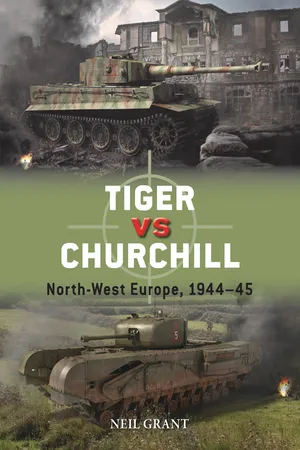
This fully illustrated study assesses the origins, development, and combat record of the legendary Tiger and Churchill Tanks during World War II.
The Tiger and the Churchill are two of the most recognizable heavily armoured tanks of World War II. Both were designed hastily in the early years of the war, and both witnessed inauspicious debuts in battle in August 1942 (the Churchill in the disaster at Dieppe, the Tiger near Leningrad). Despite their heavy weight, both tanks, which were intended to serve in breakthrough operations, had surprisingly good tactical mobility. Yet there were key differences between them too, chiefly in the effectiveness of their main armament.
This fascinating and detailed work explores the design and development of these famous tanks and its influence on their head-to-head encounters, the effectiveness of the support services each tank relied upon, and the skills and experiences of the crews that fought in them. The specific battlefield conditions of Normandy in June and July 1944 are also examined, exploring the effect they had on the duels between these two heavyweight AFVs.
- 80 pages
- English
- ePUB (mobile friendly)
- Available on iOS & Android
eBook - ePub
About this book
Information
DESIGN AND DEVELOPMENT
THE A22 CHURCHILL
Before World War II, the British Army distinguished three types of tanks. Light tanks were used for scouting and ‘imperial policing’, though they were being replaced by armoured cars. Cruiser tanks were intended for independent ‘cavalry’ action. They were relatively fast, to outflank and cut off enemy units and exploit breakthroughs, but lightly armoured. Finally, Infantry tanks were relatively slow but well armoured infantry support machines.
The first infantry tank was the two-man machine-gun armed A11 Matilda, followed in 1939 by the four-man 26-ton Matilda II, armed with a 2-pdr anti-tank gun. A third Infantry Tank, the Valentine, did not fit into a logical development sequence, since it was privately developed by Vickers and ordered in July 1939 as the only tank available for immediate production. In September 1939, the army issued a General Staff specification for a fourth infantry tank, the A20.
This reflected fears of World War I-style battlefields re-emerging. It envisaged a vehicle with a long track run to cross wide trenches, ideally with a secondary set of tracks recessed between the main ones for deep mud. A requirement to carry an unditching beam prevented a turret being fitted, so the armament – a pair of 2-pdrs, each with a coaxial Besa machine gun – was carried in World War I-style side sponsons, along with a third Besa in the nose. 80mm armour was specified, proof against the standard German 37mm anti-tank gun.

The A20 prototype, fitted with the 2-pdr turret from an A12 Matilda II. The side slots ahead of the turret-mounted additional Besa machine guns. Many design elements, such as the high track run, carried over into the Churchill. (Tank Museum, Bovington)
The Mechanisation Board revised the specification to remove the secondary tracks and unditching beam, putting one 2-pdr into a turret – initially that from the existing A12 Matilda II as a stopgap – and the other in the hull front, though it still included machine-gun mounts in each side. Armour was reduced to 60mm to keep weight down to 32 tons, less than the existing Matilda II’s 78mm. A 300hp Meadows DAV flat-12 engine was planned, despite concerns it would be underpowered for the weight, since it was the only one immediately available.
Shipbuilders Harland & Wolff began detailed design work in October 1939, and 100 were ordered in February 1940 without waiting for prototypes. Two mild-steel pilot models were delivered in June 1940, but proved severely underpowered and unreliable, while weight increased to 43 tons, too much for existing bridging equipment. Moreover, the fall of France and the obvious lessons of blitzkrieg rendered the A20 specification irrelevant – the army no longer expected trench warfare in the foreseeable future, and the order was cancelled.

A Churchill Mk I of 9 RTR on Salisbury Plain in January 1942, with 3in. howitzer in the hull. The three slots in the cast turret were for the main gun, coaxial MG and sight. Oddly, the coaxial on Mk I and II tanks was on the opposite side of the main gun compared to later marks. (© Imperial War Museum, H 16962)

A Mk II Churchill on a railway flatcar in July 1941. The side air intake louvres (here the early rounded downward-pointing type) would be unbolted and stowed on the rear deck for travel to reduce vehicle width. (© Imperial War Museum, H 11712)
In its place, the army issued specification A22, for a smaller 35-ton vehicle with a more powerful engine and within the 40-ton bridging limit. Vauxhall Motors were appointed as project leaders despite having no previous experience of tank production. Given the dire situation, with fears of imminent invasion, time was short. The Prime Minister wanted 500 of the new vehicle available by 31 March 1941 – only nine months away. Vauxhall completed the design very quickly, and though smaller than the A20 it carried forward many elements of that design, including the long track run, along with 102mm of armour. It mounted a 2-pdr and 7.92mm coaxial Besa in a cast turret, and a 3in. howitzer in the hull front, like the earlier French Char B infantry tank.
The howitzer would fire smoke rounds and high-explosive rounds against infantry positions, against which the small solid 2-pdr armour-piercing (AP) rounds were ineffective. However, its placement low in the hull between the protruding track horns limited traverse and elevation, and thus both range and usefulness of the weapon. Worse, it was loaded and aimed by a single crewman working in a very cramped position, reducing rate of fire. As only a few hundred howitzers were available, it was quickly replaced by a second Besa.
The desperate need to replace tanks lost in France meant that the A22 – technically ‘Infantry Tank Mk IV’ but named ‘Churchill’ after the Prime Minister, who took personal interest in it – was pushed straight into production. The first pilot model began trials in December 1940 and tanks started reaching regiments by June 1941. This was impressive, but only achieved by skipping the usual building and testing of prototypes to identify problems.
Unsurprisingly, early production vehicles were plagued by mechanical problems. Vauxhall were unusually frank about this, admitting the faults in the user’s handbook but noting they would normally have been identified and resolved during development if not for the urgent need for tanks.
The defects were eventually resolved, but large numbers of vehicles had already been produced. An extensive factory re-work programme was conducted during 1942 with two factories halting new vehicle production to upgrade 700 of the first 1,000 vehicles produced to reasonable standards of reliability; the first 300 were not thought worth updating. Even so, the Churchill was only regarded as a stopgap until better designs arrived.
As tanks were regularly transported by rail, the Churchill’s maximum width was set by the narrow British railway loading gauge. This was not merely the distance between rails, but also clearances between track and platforms and height and width limits in tunnels. Since British railway infrastructure was generally older than its continental equivalents, this limited the Churchill to a maximum of 9ft 6in., much tighter than the equivalent German loading gauge of 10ft 6in., even though the track itself was the same.

A Churchill Mk III. Note the larger welded 6-pdr turret, newer squarer upward-facing air intakes and track guards to reduce dust. (© Imperial War Museum, KID 810)
The high track run inherited from the A20 also meant the turret ring sat between the tracks to keep the centre of gravity low, rather than above them. These factors restricted the Churchill’s turret ring to only 54in. (1,350mm), limiting the weapons the turret could mount.
As a result, the Churchill could not be upgraded to carry the powerful 17-pdr, while the Sherman – a smaller vehicle overall, but with a turret ring above its tracks like the Tiger instead of between them – could be developed ...
Table of contents
- Cover
- Title Page
- Table of Contents
- Introduction
- Chronology
- Design and Development
- The Strategic Situation
- Technical Specifications
- The Combatants
- Combat
- Statistics and Analysis
- Conclusion
- Bibliography
- eCopyright
Trusted by 375,005 students
Access to over 1.5 million titles for a fair monthly price.
Study more efficiently using our study tools.
Frequently asked questions
Yes, you can cancel anytime from the Subscription tab in your account settings on the Perlego website. Your subscription will stay active until the end of your current billing period. Learn how to cancel your subscription
No, books cannot be downloaded as external files, such as PDFs, for use outside of Perlego. However, you can download books within the Perlego app for offline reading on mobile or tablet. Learn how to download books offline
We are an online textbook subscription service, where you can get access to an entire online library for less than the price of a single book per month. With over 1.5 million books across 990+ topics, we’ve got you covered! Learn about our mission
Look out for the read-aloud symbol on your next book to see if you can listen to it. The read-aloud tool reads text aloud for you, highlighting the text as it is being read. You can pause it, speed it up and slow it down. Learn more about Read Aloud
Yes! You can use the Perlego app on both iOS and Android devices to read anytime, anywhere — even offline. Perfect for commutes or when you’re on the go.
Please note we cannot support devices running on iOS 13 and Android 7 or earlier. Learn more about using the app
Please note we cannot support devices running on iOS 13 and Android 7 or earlier. Learn more about using the app
Yes, you can access Tiger vs Churchill by Neil Grant,Richard Chasemore in PDF and/or ePUB format, as well as other popular books in History & German History. We have over 1.5 million books available in our catalogue for you to explore.