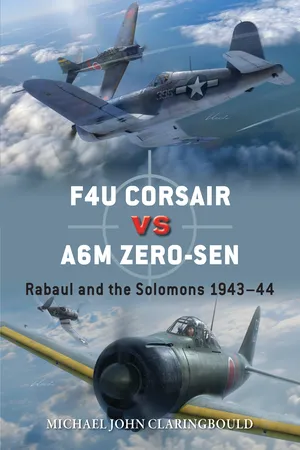
The aerial clashes between the iconic Corsair and Zero-sen translated into a contest of speed and altitude for the former, versus the latter's outstanding agility and range.
Whilst the F4U Corsair eventually proved to be a superior fighter in Pacific operations, its introduction into combat in this theatre initially demonstrated its weaknesses. Indeed, the 'Saint Valentine's Day Massacre' debacle showcased exemplary Zero-sen fighter tactics, and American losses were of sufficient magnitude that further daylight missions toward Bougainville were discontinued until Allied fighter tactics could be improved. As a result, for the next two months the Corsair's combat results were much subdued. Indeed, the F4U only became a superb fighter when both its pilots and their commanders worked out how to deploy the gull-wing design effectively. Optimum circumstances for effective engagement did not always occur, and the Zero-sen remained effective against the Corsair until February 1944 in the South Pacific, after which all IJNAF fighter units vacated Rabaul.
This book closely examines these two different fighters in the Solomons/Rabaul theatre, and the unique geographic conditions which shaped their deployment and effectiveness. It contains rare photographs and digital artwork that accurately showcases and aligns combats of both types in-theatre with unprecedented accuracy.
Both sides vastly over-claimed. With full access to IJNAF and US Navy/US Marine Corps records, these numbers are presented accurately.
eBook - ePub
F4U Corsair versus A6M Zero-sen
Rabaul and the Solomons 1943–44
- 80 pages
- English
- ePUB (mobile friendly)
- Available on iOS & Android
eBook - ePub
F4U Corsair versus A6M Zero-sen
Rabaul and the Solomons 1943–44
About this book
Information
COMBAT
The best way to analyze the Corsair versus Zero-sen struggle in the Solomons is to examine large-scale combats whereby the two belligerents were pitted against each other almost exclusively. Fortunately, numerous such examples are available for comparison.
As previously noted, on October 26, 1942, VMF-124 became the first US Marine Corps unit to receive Corsairs when it was still under training in California. Three months later, on January 24, aircraft transporter USS Kitty Hawk (APV-1) unloaded the first eight “birdcage” F4U-1s at Espiritu Santo. Here, VMF-124 CO Maj William Gise and his pilots were reunited with their mounts. With the unit’s engineers having sailed directly onwards for Guadalcanal, the pilots had to prepare their Corsairs for flight themselves. This included removing thick, sticky Cosmoline inhibitor which had protected the airframes during the sea voyage, and then conducting extensive test flights, including at high altitude.

Maj William Gise, CO of VMF-124, was photographed outside his tent at Fighter 2 on Guadalcanal. Gise was flying one of four “birdcage” F4U-1s that were lost in combat on May 13, 1943, his squadron engaging 42 Zero-sens from the 204th and 582nd Kokutai, led by Lt Zenjiro Miyano and Lt(jg) Gi’ichi Noguchi, respectively. (Author’s Collection)
On the afternoon of February 12, the first F4U-1s to arrive at Guadalcanal flew into Fighter 2 airfield. The initial batch of 17 Corsairs were followed by seven more later that day. Just a few hours after landing, two Corsairs from this second group provided an escort for a PBY sent to rescue downed US Marine Corps Wildcat pilots Lt Jefferson DeBlanc and SSgt James Feliton. With the first Corsair combat patrol completed, the following day 11 aircraft from VMF-124 escorted nine US Navy PB4Y-1 Liberators tasked with bombing Japanese shipping off southern Bougainville in the Buin–Shortland area. A handful of Zero-sens in the Buin airfield circuit looked them over from a distance but did not approach.
The February 14 mission was essentially a repeat of the previous day’s operation, although this time it marked the first Corsair-versus-Zero-sen combat. The F4Us were again escorting PB4Y Liberators on a shipping strike off southern Bougainville. The mission duly became known as the “Saint Valentine’s Day Massacre” due to the high number of American aircraft that were lost.

This photograph was released for publicity purposes in the USA in mid-February 1943 to showcase the arrival of the first Corsairs at Guadalcanal. These aircraft are from VMF-124, and they have their squadron numbers stenciled in black on the fuselage and forward cowl. These were later repainted in white to increase visibility. The closest F4U-1, appropriately marked with the number “1,” was the mount of squadron CO, Maj William Gise. (Author’s Collection)
A 252nd Kokutai Zero-sen patrol led by FPO2c Tamotsu Okabayashi that was already airborne over southern Bougainville was the first to spot the incoming American formation, and soon additional A6Ms were scrambling from Ballale airfield. The approaching American pilots watched the dust rise from Buin airfield as 13 more Zero-sens from the 204th Kokutai scrambled, with Lt Zenjiro Miyano leading the fighters aloft. Finally, 11 A6M2-N “Rufe” floatplane fighters from the 802nd Kokutai were also scrambled from their Shortland Islands base, thus bringing the strength of the IJNAF force to 41.
A furious dogfight developed around noon after the Liberators dropped their bombs and withdrew southeast with their escorts. A PB4Y and three P-38 Lightnings were lost in the resultant melee, as were two Corsairs flown by 1Lts Gordon Lyon Jr and Harold Stewart of VMF-124. When Stewart re-joined his element leader, 1Lt Lloyd Pearson, after combat at about 20,000ft, gasoline vapor was spraying from several bullet holes in Stewart’s wing. The streaming fuel ran the Corsair dry about ten minutes later, whereupon Stewart nosed down to ditch. Following Zero-sens were quick to spot the downed fighter, and they descended to strafe Stewart in his yellow dinghy minutes after the clean ditching. He was never seen again.
From this seminal engagement it is difficult to match belligerents as both Zero-sen units claimed Corsairs. In turn, VMF-124 was credited with three Zero-sens and a “Pete” floatplane shot down, while the PB4Y gunners claimed nine A6Ms and Lightning pilot Capt Bill Griffith one Zero-sen. However, against 14 American claims, the only IJNAF loss was 252nd Kokutai pilot FPO2c Yoshio Yoshida, who collided with Lyon’s Corsair during the dogfight. The remaining Zero-sen pilots from the 252nd Kokutai fired a combined total of 5,126 7.7mm and 1,369 20mm rounds, thus reflecting the intense nature of the combat. Although generous shipping claims were made by the Liberator crews, only the 6,500-ton merchantman Hitachi Maru was sunk.
This first Corsair-versus-Zero-sen combat had seen the Americans fare badly, with the loss of nine US aircraft showcasing the effectiveness of Japanese fighter tactics and underlining the potency of both the Zero-sen and the “Rufe” floatplane fighter. American losses were of sufficient magnitude that further daylight bombing missions against Bougainville were paused until fighter escort tactics could be reassessed.
A post-mortem of the mission concluded that ideally five fighters should cover each bomber, although at this stage of the war such a generous ratio was unavailable to the Cactus Air Force (the name by which Allied air power on Guadalcanal was known from August 1942). Instead, long-range missions to Bougainville with fighter escort were briefly put on hold. This in turn meant that March and April saw only sporadic aerial combat for Corsair pilots, who had limited involvement in opposing the IJNAF’s Operation I-Go strike on Guadalcanal on April 7.

Admiral Isoroku Yamamoto, Commander in Chief of the Combined Fleet, watches a recently camouflaged Zero-sen depart from Lakunai as part of the Operation I-Go strike force against Port Moresby on April 12, 1943. The 204th, 251st, 253rd, and 582nd Kokutai all participated in the I-Go sweeps of Guadalcanal, operating alongside aircraft from the carriers Hiyo, Junyo, and Zuikaku. (Tony Holmes Collection)
By mid-May, VMF-124 had been joined in-theater by VMF-112, which had replaced its F4F-4s with F4U-1s whilst remaining in the frontline on Guadalcanal. The 13th of that month proved to be an auspicious day for two Corsair pilots when, during the first dogfight to defend the Russell Islands, VMF-112’s Capt Archie Donahue was awarded four confirmed Zero-sen victories and one probable in the unit’s first aerial combat with the Corsair. 2Lt Ken Walsh of VMF-124 was credited with three more “Zekes,” which he added to two previous A6M kills and a “Val” destroyed on April 1 to become the first F4U ace.
The many US participants in the action off the Russell Islands on May 13 claimed 18 aerial victories in total – seven to VMF-112, eight to VMF-124, and three to USAAF Lightning pilots. A total of 42 Zero-sens from the 204th and 582nd Kokutai engaged US fighters that day in a battle that raged from medium to high altitude. Both units were led by particularly experienced and aggressive leaders in the form of Lt Zenjiro Miyano and Lt(jg) Gi’ichi Noguchi.
Miyano’s 204th Kokutai pilots had departed Rabaul at 0700 hrs to refuel and stage through Buin, where they joined their counterparts from the 582nd. Mid-morning, Guadalcanal’s radar operators had warned that a single “bogey” had been detected approaching “The Slot” towards the Russell Islands, followed closely by two fighter formations. The single intruder was a 702nd Kokutai “Betty” flown by FCPO Koji Maeda, who had been tasked with reconnoitring the new airfields at Banika and Yandina. However, he turned for home when he spotted American fighters ahead. Among the latter were seven F4U-1s from VMF-112.
The Zero-sen pilots were experienced, and they used all their skills in a series of aerial maneuvers that resulted in them downing six American fighters in exchange for three A6Ms destroyed – a far cry from the 18 credited to US pilots. For VMF-112 in particular, the unit’s combat debut with the F4U resulted in a series of “misadventures.” 2Lt Otto Seifert’s fighter was last seen diving steeply trailing white smoke five miles northwest of the Russell Islands, and no trace of the aircraft, or its pilot, has ever been found. A 20mm shell exploded in Capt Blaine Baesler’s cockpit, shattering both his goggles and hydraulic lines in the floor. Nonetheless, a squinting Baesler successfully force-landed on the Russell Islands.
Another Zero-sen holed the starboard stabilizer of Capt Archie Donahue’s F4U-1 with two 20mm rounds, while 2Lt Julian Wilcox had half his starboard aileron and lower rudder mount shot away. This rendered the rudder inoperative and left the pilot with minimal pitch control. Other rounds wrecked the accessories junction and outboard starboard gun. Despite also suffering a painful shrapnel wound to his right shoulder, Wilcox managed to land safely in his badly damaged fighter.

VMF-124’s 1Lt Howard Finn first flew “18” when it arrived in-theater in February 1943, although the fighter is seen here following its transfer to VMF-213 two months later. The Corsair, christened BUBBLES by its new pilot, was photographed leading four other “birdcage” F4U-1s on a mission to Munda in mid-1943. (Author’s Collection)
VMF-124 also suffered losses. 2Lt William Cannon could not lower his undercarriage after his fighter’s hydraulics were shot up, so he ditched offshore Tulagi and was quickly rescued. 2Lt Benjamin Dale was wounded in the foot by shrapnel, and he too was plucked from the water after he bailed out. The unit’s gravest misfortune was the loss of its CO, Maj William Gise, who was posted Missing in Action. Lightning pilot 1Lt James Gill also failed to return.
Both sides over-claimed on May 13, the IJNAF excessively so. The 582nd Kokutai was credited with nine definites (mostly F4Us, with a handful of USAAF fighters) and the 204th Kokutai about the same. Ordnance expenditure was also high, with 4,250 7.7mm rounds being fired by the 582nd Kokutai and 4,386 rounds by the 204th Kokutai.
Three Zero-sen pilots were lost – FPO2c Shogo Sasaki of the 582nd Kokutai and FCPO Hayato Nozue and FPO2c Yuhi Kariya of the 204th Kokutai. Separately, a 582nd Kokutai Zero-sen force-landed and five more were slightly damaged. The paucity of actual losses suffered by the IJNAF makes it difficult to properly apportion three confirmed US victories between 18 claims, especially with the status of two aces riding on the outcome.
Back at Guadalcanal, the day’s combat was remembered by many, not for the excitement, but more for when two P-40Fs were mistakenly shot up by over-enthusiastic VMF-112 Corsairs. After landing, the incensed USAAF victims raced over to VMF-112’s camp to confront the ...
Table of contents
- Cover
- Title Page
- Table of Contents
- Introduction
- Chronology
- Design and Development
- Technical Specifications
- The Strategic Situation
- The Combatants
- Combat
- Statistics and Analysis
- Aftermath
- Further Reading
- eCopyright
Trusted by 375,005 students
Access to over 1.5 million titles for a fair monthly price.
Study more efficiently using our study tools.
Frequently asked questions
Yes, you can cancel anytime from the Subscription tab in your account settings on the Perlego website. Your subscription will stay active until the end of your current billing period. Learn how to cancel your subscription
No, books cannot be downloaded as external files, such as PDFs, for use outside of Perlego. However, you can download books within the Perlego app for offline reading on mobile or tablet. Learn how to download books offline
Perlego offers two plans: Essential and Complete
- Essential is ideal for learners and professionals who enjoy exploring a wide range of subjects. Access the Essential Library with 800,000+ trusted titles and best-sellers across business, personal growth, and the humanities. Includes unlimited reading time and Standard Read Aloud voice.
- Complete: Perfect for advanced learners and researchers needing full, unrestricted access. Unlock 1.5M+ books across hundreds of subjects, including academic and specialized titles. The Complete Plan also includes advanced features like Premium Read Aloud and Research Assistant.
We are an online textbook subscription service, where you can get access to an entire online library for less than the price of a single book per month. With over 1.5 million books across 990+ topics, we’ve got you covered! Learn about our mission
Look out for the read-aloud symbol on your next book to see if you can listen to it. The read-aloud tool reads text aloud for you, highlighting the text as it is being read. You can pause it, speed it up and slow it down. Learn more about Read Aloud
Yes! You can use the Perlego app on both iOS and Android devices to read anytime, anywhere — even offline. Perfect for commutes or when you’re on the go.
Please note we cannot support devices running on iOS 13 and Android 7 or earlier. Learn more about using the app
Please note we cannot support devices running on iOS 13 and Android 7 or earlier. Learn more about using the app
Yes, you can access F4U Corsair versus A6M Zero-sen by Michael John Claringbould,Jim Laurier,Gareth Hector in PDF and/or ePUB format, as well as other popular books in History & 20th Century History. We have over 1.5 million books available in our catalogue for you to explore.