The Bolsheviks' seizure of power in Russia in late 1917 was swiftly followed by the establishment of the Cheka, the secret police of the new Soviet state.
The Cheka was central to the Bolsheviks' elimination of political dissent during the Russian Civil War (1917–22). In 1922 the Soviet state-security organs became the GPU and then the OGPU (1923–34) before coalescing into the NKVD.
After it played a central role in the Great Terror (1936–38), which saw the widespread repression of many different groups and the imprisonment and execution of prominent figures, the NKVD had its heyday during the Great Patriotic War (1941–45). During the conflict the organization deployed full military divisions, frontier troop units and internal security forces and ran the hated GULAG forced-labour camp system. By 1946, the power of the NKVD was so great that even Stalin saw it as a threat and it was broken up into multiple organizations, notably the MVD and the MGB – the forerunners of the KGB.
In this book, the history and organization of these feared organizations are assessed, accompanied by photographs and colour artwork depicting their evolving appearance.
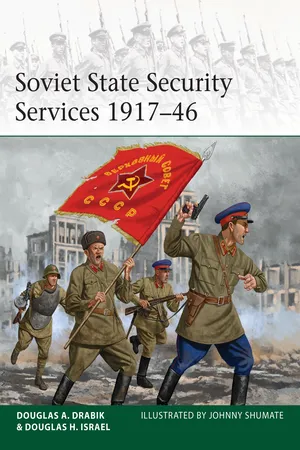
eBook - ePub
Soviet State Security Services 1917–46
- 64 pages
- English
- ePUB (mobile friendly)
- Available on iOS & Android
eBook - ePub
Soviet State Security Services 1917–46
About this book
Information
THE NKVD
Reorganization and leadership changes
Menzhinsky died on 10 May 1934 after a long, debilitating illness. Long before this, Yagoda, his first deputy, had taken over the quotidian management of the OGPU. Two months to the day after Menzhinsky died, the OGPU was subsumed into a newly reorganized, all-union NKVD and Yagoda was named People’s Commissar of Internal Affairs. Previously the NKVD had responsibility for police, border security functions, railroad security, firefighting and prison guards within the RSFSR only; state security was handled in all the republics of the USSR by the OGPU. Now the OGPU was reorganized as the GUGB (Glavnoye Upravleniye Gosurdarstvennoy Bezopasnosti; ‘Main Directorate for State Security’) within the NKVD, other main directorates being called the GURKM (Glavnoye Upravleniye Raboce-krest’yanskoi Militisyi; ‘Main Directorate of Workers’ and Peasants’ Militia’ or ordinary police), the GUPVO (Glavnoye Upravleniye Pogranicnoi i Vnytrennei Okhrany; ‘Main Directorate of Border and Internal Guards’), the GULAG (Glavnoye Upravleniye Lagerey; ‘Main Directorate for Camps’), the Convoy Guards or GTU (Glavnoye Transpotnoie Upravleniye; ‘Main Directorate for Transport’) and others covering railways, firefighting and economic affairs. During World War II the GUPVI (Glavnoye Upravleniye Voyennoplennikh i Internirovannikh; ‘Main Directorate of POWs and Interned Persons’) was added, although these imprisoned groups are usually spoken of as GULAG prisoners.
In September 1936, Yagoda was succeeded by Nikolai Ivanovich Yezhov; Lavrentiy Pavlovich Beria became GUGB chief in September 1939 and then overall head of the NKVD that November. In February 1941, the GUGB was again separated from the NKVD and became a separate NKGB (Naródnyi Komissariát Gosudarstvennoy Bezopasnosti; ‘People’s Commissariat of State Security’), while the OO (Osobye Otdely; ‘Special Departments’) responsible for military counterintelligence were now detached from the NKVD and were administered separately by the Red Army and Red Navy. Vsevolod Nikolayevich Merkulov, an acolyte of Beria, became People’s Commissar of the NKGB.
The NKGB was returned to administrative control of the NKVD in July 1941, shortly after the beginning of Operation Barbarossa, the Axis invasion of the USSR. At this time, Merkulov was made deputy People’s Commissar of the NKVD, and was once again subordinate to Beria.
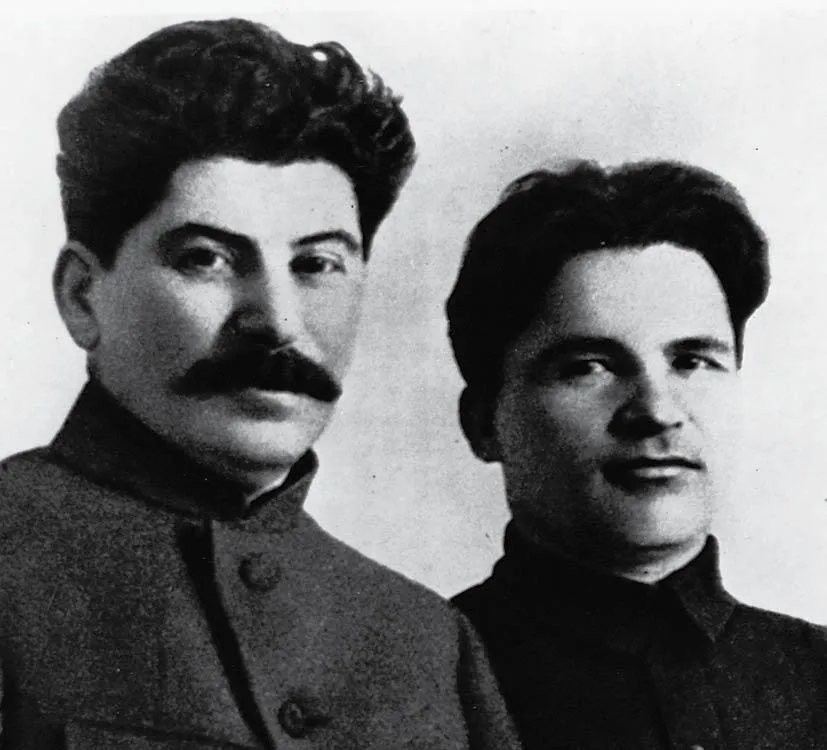
Kirov with Stalin. (Library of Congress/Corbis/VCG via Getty Images)
Two changes occurred in 1943: the NKGB was again re-established as a separate commissariat with Merkulov as head, with major directorates controlling Foreign Intelligence, Counterintelligence, Transport Security, Sabotage and Special Tasks, Codes and Cyphers, Government Protection and Kremlin Protection Services. At the same time, Military Counterintelligence was taken away from Red Army and Red Navy control and reorganized into SMERSH (Smert Shpionam; ‘Death to Spies’). SMERSH was in actuality controlled by the NKO (Naródnyi Komissariát Oborony; ‘People’s Commissariat of Defence’), although it was usually considered part of the NKVD/NKGB, with most of its personnel being drawn from these two commissariats. Responsibilities were broad in counter-intelligence but among other duties, SMERSH was responsible for rooting out traitors and defeatists in the Red Army, for the neutralization of hostile groups in the combat zone such as the Polish Home Army or Ukrainian Partisan Army, and for the ‘filtration’ of liberated Russian POWs and scrutiny of Soviet civilians in liberated territories who had been trapped behind enemy lines. In 1946 SMERSH was returned to NKVD control just before all the people’s commissariats were reorganized as ministries.
The Kirov assassination
On 1 December 1934, Sergei Mironovich Kirov, the Leningrad Party boss, was assassinated at the Smolny Institute by Leonid Vasilevich Nikolayev, a disaffected Party member who had been purged from the Party, with revenge for this action the apparent motive. Kirov was a close intimate of Stalin and had been personally appointed as Leningrad first Party secretary by Stalin to replace Grigori Yevseyevich Zinoviev, who had been prominent in the ‘Left Opposition’ to Stalin after Lenin’s death. Zinoviev was close to Lev Kamenev, another Left Oppositionist, and had at times pondered collusion with Trotsky – Stalin’s arch-nemesis and hated enemy – to oust Stalin from his position as General Secretary of the Communist Party. The fact that their opposition in general and any possible collusion with Trotsky was entirely ineffectual did not diminish Stalin’s appreciation of them as a great threat to his position.
Within hours of the assassination of Kirov, an anti-terrorism law was drafted by Stalin and signed by his Politburo. The law provided for expedited trials of suspected terrorists in camera without legal representation for – or even presence of – the accused, without right of appeal and with sentences to be carried out without delay. The investigation into Kirov’s murder disclosed that some of Nikolayev’s acquaintances had worked for Zinoviev and that some defendants had criticized Stalin’s collectivization program. The investigation quickly revealed a ‘Zinovievite Centre’ and resulted in two trials, the second of which implicated Kamenev. The Zinovievites, and now Kamenev, were soon conflated with ‘White Guards, wreckers, spies and saboteurs’.
The investigation also revealed extreme laxity on the part of the NKVD itself in protecting Kirov, and confirmed in Stalin’s mind that the NKVD was at least asleep on the job, if not in some ways sympathetic to and complicit in the affair. It was not forgotten that Kamenev had implicated Yagoda as being sympathetic to the Left Oppositionists’ cause in a 1932 conversation with Bukharin, of which Stalin was aware. Yagoda’s investigation of the Kirov affair succeeded only in proving that Zinoviev and Kamenev were responsible for creating a moral atmosphere in which the assassination could occur, but not their direct involvement, and did not implicate Trotsky in the plot. As a result of this, Zinoviev and Kamenev received prison sentences and were expelled from the Party, but their blood was not yet spilled. Yagoda remained in post, but was suspected of inadequate revolutionary vigilance at the least.

Nikolai Ivanovich Yezhov in 1938. Yezhov understood that Stalin sought direct connections between the Left Opposition (Zinoviev and Kamenev), Trotsky and the Right Opposition (Bukharin, Mikhail Tomsky and Aleksey Rykov). In a May 1935 thesis titled ‘From Factional Activity to Open Counterrevolution’, Yezhov established an equivalence between any factional opposition and terrorism against the State. (Hulton-Deutsch/Hulton-Deutsch Collection/Corbis via Getty Images)

Leon Trotsky. It cannot be overemphasized that by 1935, Trotskyism had become a metaphor for any opposition to Stalin, real or imagined, past or present, and whether the individual had renounced their prior beliefs or not. In Stalinist logic, a struggle against Stalin was a struggle against the whole Soviet system; a counter-revolutionary struggle to reimpose capitalism itself. To do this, opponents were willing to work with the Imperialist bloc, including Fascists, hence the insistence during the Purge and its show trials on having defendants be unmasked as foreign spies. Only in the Byzantine world of the Marxist–Leninist dialectic could Trotskyism be equated with a desire to reimpose capitalism while working with the Gestapo. (Bettmann/Getty Images)
The Great Terror gathers momentum
Stalin’s paranoia was further fuelled by the unmasking of a ‘Kremlin plot’ that uncovered Kremlin employees who had been former aristocrats or other class enemies. Protection of the Kremlin had previously been the responsibility of the Defence Commissariat, but now devolved to the NKVD, not to Yagoda but instead to a rising star favoured by Stalin, Nikolai Yezhov, who was now tasked with oversight and investigation of the Central Executive Committee and of the Kremlin staff.
As a result of the Kremlin plot, Avel Safronovich Enukidze, a longstanding Stalin associate, was expelled from the Party. This set a precedent as he was the first old Bolshevik to be expelled without ever having joined any opposition group; he was accused of having protected anti-Soviet elements within the Kremlin itself and for the time being was demoted, though subsequently executed on 30 October 1937.
Subsequent to the ‘verification’ campaign ...
Table of contents
- Cover
- Title Page
- Contents
- Forerunners
- The Cheka
- The GPU and OGPU
- The NKVD
- Aftermath
- Bibliography
- eCopyright
Trusted by 375,005 students
Access to over 1.5 million titles for a fair monthly price.
Study more efficiently using our study tools.
Frequently asked questions
Yes, you can cancel anytime from the Subscription tab in your account settings on the Perlego website. Your subscription will stay active until the end of your current billing period. Learn how to cancel your subscription
No, books cannot be downloaded as external files, such as PDFs, for use outside of Perlego. However, you can download books within the Perlego app for offline reading on mobile or tablet. Learn how to download books offline
Perlego offers two plans: Essential and Complete
- Essential is ideal for learners and professionals who enjoy exploring a wide range of subjects. Access the Essential Library with 800,000+ trusted titles and best-sellers across business, personal growth, and the humanities. Includes unlimited reading time and Standard Read Aloud voice.
- Complete: Perfect for advanced learners and researchers needing full, unrestricted access. Unlock 1.5M+ books across hundreds of subjects, including academic and specialized titles. The Complete Plan also includes advanced features like Premium Read Aloud and Research Assistant.
We are an online textbook subscription service, where you can get access to an entire online library for less than the price of a single book per month. With over 1.5 million books across 990+ topics, we’ve got you covered! Learn about our mission
Look out for the read-aloud symbol on your next book to see if you can listen to it. The read-aloud tool reads text aloud for you, highlighting the text as it is being read. You can pause it, speed it up and slow it down. Learn more about Read Aloud
Yes! You can use the Perlego app on both iOS and Android devices to read anytime, anywhere — even offline. Perfect for commutes or when you’re on the go.
Please note we cannot support devices running on iOS 13 and Android 7 or earlier. Learn more about using the app
Please note we cannot support devices running on iOS 13 and Android 7 or earlier. Learn more about using the app
Yes, you can access Soviet State Security Services 1917–46 by Douglas A. Drabik,Douglas H. Israel,Johnny Shumate in PDF and/or ePUB format, as well as other popular books in History & Military & Maritime History. We have over 1.5 million books available in our catalogue for you to explore.