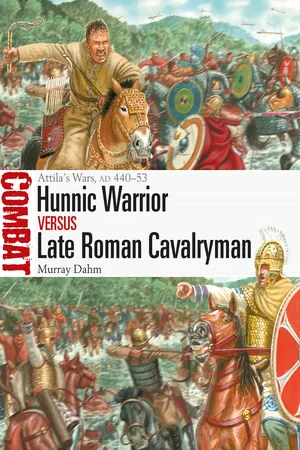
Roman and Hunnic fighting men are assessed and compared in this fully illustrated study of Attila's bid to conquer Europe in the 5th century AD.
The Huns burst on to the page of western European history in the 4th century AD. Fighting mostly on horseback, the Huns employed sophisticated tactics that harnessed the formidable power of their bows; they also gained a reputation for their fighting prowess at close quarters. Facing the Huns, the Roman Army fielded a variety of cavalry types, from heavily armed and armoured clibanarii and cataphractii to horse archers and missile cavalry. Many of these troops were recruited from client peoples or cultures, including the Huns themselves.
After carving out a polyglot empire in eastern and central Europe, the Huns repeatedly invaded Roman territory, besieging the city of Naissus in 443. With Constantinople itself threatened, the Romans agreed to pay a huge indemnity. In 447, Attila re-entered Roman territory, confronting the Romans at the battle of the Utus in Bulgaria. The Huns besieged Constantinople, but were unable to take the city. In 451, after Hunnic forces invaded the Western Roman Empire, an army led by the Roman general Aetius pursed the invaders, bringing the Huns to battle at the Catalaunian Plains.
Featuring specially commissioned artwork and maps, this study examines the origins, fighting methods and reputation of the two sides' cavalry forces, with particular reference to the siege of Naissus, the battle of the Utus and the climactic encounter at the Catalaunian Plains.
eBook - PDF
Hunnic Warrior vs Late Roman Cavalryman
Attila's Wars, AD 440–53
- 81 pages
- English
- PDF
- Available on iOS & Android
eBook - PDF
About this book
Information
Table of contents
- Cover
- Contents
- Introduction
- The Opposing Sides
- Naissus: AD 443
- The Utus River: AD 447
- The Catalaunian Plains: 20 June AD 451
- Analysis
- Aftermath
- Bibliography
- Index
- Imprint
Trusted by 375,005 students
Access to over 1.5 million titles for a fair monthly price.
Study more efficiently using our study tools.
Frequently asked questions
Yes, you can cancel anytime from the Subscription tab in your account settings on the Perlego website. Your subscription will stay active until the end of your current billing period. Learn how to cancel your subscription
No, books cannot be downloaded as external files, such as PDFs, for use outside of Perlego. However, you can download books within the Perlego app for offline reading on mobile or tablet. Learn how to download books offline
Perlego offers two plans: Essential and Complete
- Essential is ideal for learners and professionals who enjoy exploring a wide range of subjects. Access the Essential Library with 800,000+ trusted titles and best-sellers across business, personal growth, and the humanities. Includes unlimited reading time and Standard Read Aloud voice.
- Complete: Perfect for advanced learners and researchers needing full, unrestricted access. Unlock 1.5M+ books across hundreds of subjects, including academic and specialized titles. The Complete Plan also includes advanced features like Premium Read Aloud and Research Assistant.
We are an online textbook subscription service, where you can get access to an entire online library for less than the price of a single book per month. With over 1.5 million books across 990+ topics, we’ve got you covered! Learn about our mission
Look out for the read-aloud symbol on your next book to see if you can listen to it. The read-aloud tool reads text aloud for you, highlighting the text as it is being read. You can pause it, speed it up and slow it down. Learn more about Read Aloud
Yes! You can use the Perlego app on both iOS and Android devices to read anytime, anywhere — even offline. Perfect for commutes or when you’re on the go.
Please note we cannot support devices running on iOS 13 and Android 7 or earlier. Learn more about using the app
Please note we cannot support devices running on iOS 13 and Android 7 or earlier. Learn more about using the app
Yes, you can access Hunnic Warrior vs Late Roman Cavalryman by Murray Dahm,Giuseppe Rava in PDF and/or ePUB format, as well as other popular books in History & European History. We have over 1.5 million books available in our catalogue for you to explore.