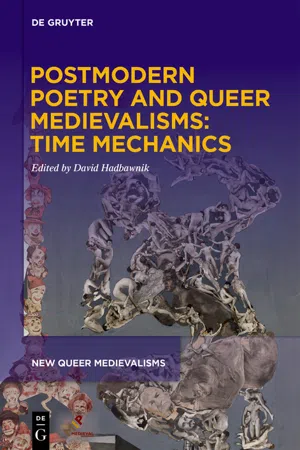
This volume builds on recent scholarship on contemporary poetry in relation to medieval literature, focusing on postmodern poets who work with the medieval in a variety of ways. Such recent projects invert or "queer" the usual transactional nature of engagements with older forms of literature, in which readers are asked to exchange some small measure of bewilderment at archaic language or forms for a sense of having experienced a medieval text. The poets under consideration in this volume demand that readers grapple with the ways in which we are still "medieval" – in other words, the ways in which the questions posed by their medieval source material still reverberate and hold relevance for today's world. They do so by challenging the primacy of present over past, toppling the categories of old and new, and suggesting new interpretive frameworks for contemporary and medieval poetry alike.
- 218 pages
- English
- ePUB (mobile friendly)
- Available on iOS & Android
eBook - ePub
Postmodern Poetry and Queer Medievalisms: Time Mechanics
About this book
Information
The Time Mechanic and the Theater: Translation, Performativity, and Performance in the Old English of Karen Coonrod’s Judith, W.H. Auden, and Thomas Meyer
Daniel C. Remein
Translation in the Orbit of Performance
I would like to begin with reference to an experimental theatrical production based on the Old English poem Judith, as given in a partial workshop performance at the MIT Center for Art, Science, and Technology in March of 2019. The piece, titled Judith, is a “Music/Text/Chamber/Hybrid/Opera” with a libretto by Karin Coonrod and a score by Paul Vasile. The piece adapts the Old English poem Judith—itself an adaptation of the Deuterocanonical/Apocryphal Biblical book into Old English poetry—into the unstable space of experimental theatrical performance. Performed with a small number of both professional and accomplished amateur singers and instrumentalists in an unadorned auditorium, the production renders the poem in a highly anti-absorptive, stylized manner that heterogeneously incorporates translated and untranslated passages of Old English poetry as sung voice and digitally projected text.1
The Old English Judith is already a text anxious about translation and preoccupied by gender and sexuality. As Haruko Momma explains, “it is interesting that Judith’s complexity comes from its apparent simplification of the Latin source material.”2 The Old English poem effaces its source-text’s investment in religious difference by restructuring the narrative and omitting reference to Jewish dietary laws, the Temple cult, and circumcision—omissions that are “rounded off” by dilating on scenes of feast and battle, and which invoke less the ancient Near East than the world of Beowulf.3 Along with these “domesticating” translative moves, as Mary Dockray-Miller points out, by not eliminating the character of Judith’s maid along with other characters from the source-text, the poem portrays a “cooperative community of women.”4 The Old English text thus accedes to a certain mode of translating gender and sexuality (from Latin Christian texts about the ancient Jewish world into the Old English literary world) in a way that we might mark as queer:
Judith is not described as a wife or widow (or even, technically, virgin) because her sexuality is not limited to a heterosexuality defined by her relationship with a man. Judith demonstrates a sexuality and satisfaction of desire that goes beyond the paradigm of two lovers, heterosexual or homosexual, to encompass different generations and a multiplicity of bonds, with men, with women, with mothers, with children, whether or not related by blood.5
Registering this queerness in the structure of her production in a manner that may also invoke an axis of Trans*-ness, Coonrod’s libretto accounts for the third-person narrator of the Old English poem by inventing a “Bard” to perform the diagesis, whom Coonrod describes as “a kind of Tiresias ‘they’ character, a man and woman, ancient and modern”6 (performed in this instance by Srinivasan Raghuraman, an MIT graduate student in the Theory of Computation also trained in Carnatic Vocal music).
At the climactic moment of the narrative, in which Judith delivers a prayer before beheading Holofernes, she sings in Old English while a translation of the text is projected on the back wall. Following this moment, a prolonged, slow-paced scene unfolds in which translation and source-text occupy the space of avant-garde theatrical performance—as voice and text—as the Bard narrates the beheading (itself not pantomimed), “speak-singing” in a high-pitched chant while both the Old English text and a Present-Day English translation of the text are projected on the back wall (the former in a font very closely resembling the miniscule of an Old English poetic codex).7 Throughout this sequence, the chorus hums gravely and distressingly.
Along with the specific latencies of the Old English text that this performance throws into relief (a topic for another essay), it is also remarkable in that it places, as text, the translation of Old English poetry quite literally within the formal space of embodied dramatic performance—and within a space we might call “avant-garde” or “experimental.” This performance thus provokes questions worth asking about the relationship between translation and performance in the queer medievalisms of modern and contemporary poetry. How might historical conventions of dramatic performance—whether in the context of a source-text or a translation—shape the practice and function of translating medieval texts within queer modern poetics? How might the historical, concrete possibility of a formalized use of either source-text or translation as a performance script condition its translation? How might the inescapably performative trajectories of texts not explicitly marked for formalized performance nonetheless pull translation into the dynamics queried above? This essay cannot provide answers to all these questions, either as general theory or as particulars of literary history. In an attempt to generate the kind of critical terrain in which to phrase such questions, what follows will turn to twentieth-century poet W. H. Auden’s poem known as “The Watershed” and contemporary poet Thomas Meyer’s translation of Ælfric’s Colloquy on the Occupations from his 1979 book Staves Calends Legends. First, however, I will briefly consider where the questions posed above might intersect with the translation poetics of mid-twentieth-century poet Jack Spicer (whose figure of the “time mechanic” provides the context for this collection), and the place of performativity in foundational queer theory.
Translation, Performance, Spectral Sexuality
In a famous discussion of the basic problems of translation that appears in his book After Lorca, post-war twentieth-century poet Jack Spicer exhorts that “a poet is a time mechanic not an embalmer.”8 I would like to pause on this maxim, allowing Spicer’s “time mechanic” to calibrate, if somewhat indirectly, these questions about translation and performance in the queer medievalisms of modern and contemporary poetics. A central figure in the gay coterie of the so-called “Berkeley Renaissance” (along with Robin Blaser and Robert Duncan), the later San Francisco Renaissance, and the loose grouping of the “New American Poetry” from the post-war period, Spicer was also a student of the Middle Ages under philologist Arthur G. Brodeur and historian Ernst Kantorowicz (having completed all his coursework, but never a thesis, for a PhD at Berkeley).9
Spicer’s work is at home in the fundamentally disclosive turn away from symbolist thought (and the reinterpretations of the legacy of Romanticism) that Charles Altieri long-ago identified as a hallmark of a broad spectrum of American post-war poetries.10 But it is also consistently auto-marginalizing and oppositional to both adjacent avant-gardes and even his own compa...
Table of contents
- Title Page
- Copyright
- Contents
- Introduction: The Opening of the Field
- “A Real Fictional Depth”: Transtexuality & Transformation in Robert Glück’s Margery Kempe
- A Basket of Fire and the Laughter of God: Anne Sexton’s Queer Theopoetics
- feeld Notes: Jos Charles’s Chaucerian “anteseedynts”
- The Time Mechanic and the Theater: Translation, Performativity, and Performance in the Old English of Karen Coonrod’s Judith, W.H. Auden, and Thomas Meyer
- Translation for the End Times: Peter O’Leary’s The Sampo
- The Harlot and the Gygelot: Translation, Intertextuality, and Theft in Medbh McGuckian’s “The Good Wife Taught her Daughter”
- Queer Time, Queer Forms: Noir Medievalism and Patience Agbabi’s Telling Tales
- Speak Like a Child: Caroline Bergvall’s Medievalist Trilogy
- Index
Trusted by 375,005 students
Access to over 1.5 million titles for a fair monthly price.
Study more efficiently using our study tools.
Frequently asked questions
Yes, you can cancel anytime from the Subscription tab in your account settings on the Perlego website. Your subscription will stay active until the end of your current billing period. Learn how to cancel your subscription
No, books cannot be downloaded as external files, such as PDFs, for use outside of Perlego. However, you can download books within the Perlego app for offline reading on mobile or tablet. Learn how to download books offline
Perlego offers two plans: Essential and Complete
- Essential is ideal for learners and professionals who enjoy exploring a wide range of subjects. Access the Essential Library with 800,000+ trusted titles and best-sellers across business, personal growth, and the humanities. Includes unlimited reading time and Standard Read Aloud voice.
- Complete: Perfect for advanced learners and researchers needing full, unrestricted access. Unlock 1.5M+ books across hundreds of subjects, including academic and specialized titles. The Complete Plan also includes advanced features like Premium Read Aloud and Research Assistant.
We are an online textbook subscription service, where you can get access to an entire online library for less than the price of a single book per month. With over 1.5 million books across 990+ topics, we’ve got you covered! Learn about our mission
Look out for the read-aloud symbol on your next book to see if you can listen to it. The read-aloud tool reads text aloud for you, highlighting the text as it is being read. You can pause it, speed it up and slow it down. Learn more about Read Aloud
Yes! You can use the Perlego app on both iOS and Android devices to read anytime, anywhere — even offline. Perfect for commutes or when you’re on the go.
Please note we cannot support devices running on iOS 13 and Android 7 or earlier. Learn more about using the app
Please note we cannot support devices running on iOS 13 and Android 7 or earlier. Learn more about using the app
Yes, you can access Postmodern Poetry and Queer Medievalisms: Time Mechanics by David Hadbawnik in PDF and/or ePUB format, as well as other popular books in Literature & World History. We have over 1.5 million books available in our catalogue for you to explore.