eBook - ePub
Conceptions of Time in Greek and Roman Antiquity
- 252 pages
- English
- ePUB (mobile friendly)
- Available on iOS & Android
eBook - ePub
Conceptions of Time in Greek and Roman Antiquity
About this book
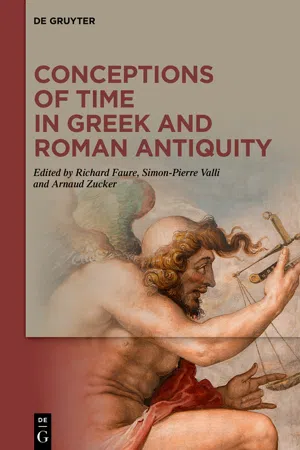
This collection of articles is an important milestone in the history of the study of time conceptions in Greek and Roman Antiquity. It spans from Homer to Neoplatonism. Conceptions of time are considered from different points of view and sources. Reflections on time were both central and various throughout the history of ancient philosophy. Time was a topic, but also material for poets, historians and doctors. Importantly, the contributions also explore implicit conceptions and how language influences our thought categories.
Information
Subtopic
Ancient LanguagesIndex
LiteratureLa compréhension du passé chez les premiers historiens grecs : Étude sur les emplois de πάλαι et d’ἀρχή
Emmanuel Golfin
Université Toulouse - Jean-Jaurès, PLH, France
Abstract
Understanding the past in the first Greek historians: Study of the uses of πάλαι and ἀρχή. Comparing the ways Herodotus, Thucydides and Xenophon use words of the family of ἀρχή and πάλαι makes possible an understanding of their conceptions of past in historical narration. Herodotus, who favours ἀρχή, seeks to delve into the origins as deep as possible, while Thucydides prefers πάλαι and examines the remote past from the present’s viewpoint. Despite his primary use of ἀρχή, Xenophon is not concerned with the origins. These lexical differences have several consequences: refusal of the hellenocentrism; invention of a global, if not universal history by Herodotus; starting point of a linear and progressive view of time in Thucydides; conception of a past whose limit is recent, from the point of view of a present in crisis in Xenophon. The limitations of the sources constrain the historians to pay special attention to the myths. When including the latter in their works, all of them apply a rational filter (albeit different). Herodotus is aware that anything can arrive on the long run and is welcoming for the myths. In Thucydides the myths come as a confirmation of what he found out about the relationship among cities. Finally, Xenophon shows that myths are rhetorically exploited for ideological purposes.
Pour savoir comment les anciens Grecs se représentaient le temps, on peut recourir à bien des matériaux que nous fournissent les textes ou l’archéologie, à propos de l’organisation d’une journée dans une cité, d’un mois ou d’une année, avec les circonstances qui rythment une existence, les divers âges des femmes et des hommes, certains événements marquants, les fêtes. Il peut sembler également pertinent de s’intéresser aux historiens dont le travail a pour but de mettre en forme un savoir qui a le temps sinon pour objet, du moins pour cadre. Pour un historien, le temps est à la fois un matériau, un flux à mettre en forme et le résultat de son travail, car, à travers tel ou tel sujet d’étude, il en donne une image et une compréhension.
Il peut être particulièrement fécond de regarder de près les textes des historiens grecs dans la mesure où ils ont accompli les premiers la tâche non seulement de recueillir des faits, de les lier entre eux pour en faire un récit cohérent, mais aussi de les intégrer dans une chronologie, c’est-à-dire de positionner les événements dans un ordre temporel, de découper le temps en périodes, d’établir des concordances entre plusieurs calendriers, afin de dater des faits concernant des cités ou des peuples différents.
De plus, en dehors de toute considération sur la validité de son contenu, dont il ne saurait être question ici, le texte historique contient un discours sur le temps – qui n’est pas forcément théorisé, mais que nous pouvons interroger.
Autre élément intéressant : les premières œuvres historiques que nous avons conservées intactes sont celles de trois historiens de l’époque classique qui se suivent d’une génération à une autre : Hérodote, Thucydide et Xénophon1. Par-delà l’originalité de chaque auteur, il est possible d’examiner si en trois générations la conception et la construction du temps changent. Le temps ancien – passé – et le temps présent sont-ils conçus avec des constantes, des évolutions, voire sous l’angle d’un perfectionnement ?
Pour avoir une première réponse à la question complexe de la conception du temps chez les historiens antiques, nous étudierons la manière dont ils élaborent et (re)créent le passé. Ce thème permettra d’entrevoir comment les historiens anciens organisent le temps dans son amplitude la plus grande, si et comment ils explorent le temps long, plus difficile à mettre en forme qu’un présent restitué au jour le jour, lorsqu’on le vit. L’appréhension du passé implique une distance, un écart, un important décalage entre le temps de l’écriture et le temps des faits.
La pertinence d’une comparaison entre Hérodote et Thucydide tient à ce que, même si leur sujet d’étude est différent, ils abordent de nombreux thèmes communs, au point de l’un et l’autre se compléter ou se contredire2. Quant à la confrontation entre Thucydide et Xénophon, elle se justifie pleinement, dans la mesure où Xénophon continue ouvertement l’œuvre de Thucydide.
Un relevé détaillé des préférences que chaque historien manifeste pour formuler le passé fera ainsi apparaître des choix qui, s’ils ne s’avèrent pas quantitativement décisifs, indiqueront néanmoins des tendances marquées. Ces choix permettront ensuite d’examiner comment chaque historien considère le passé dans un écart plus ou moins ample avec le présent, s’il s’agit pour lui de l’explorer et de quelle manière, enfin de mesurer quel rapport chaque auteur établit entre histoire et mythe, avec lequel le passé a des frontières poreuses.
1 À la recherche du passé ancien : les récits rétrospectifs
Bien qu’Hérodote, Thucydide ou le Xénophon des Helléniques soient considérés comme des historiens3, l’essentiel de leur travail relève plutôt d’une chronique du temps présent ou du passé proche. Hérodote est né pendant les guerres médiques et il a vécu peu après, il en a connu les conséquences. Même ce qui les a précédées, à partir de la constitution de l’empire perse par le roi Cyrus (550 – 549 av. J.-C.), relève d’une histoire somme toute assez récente pour lui. Ses parents ou ses grands-parents en ont été les contemporains. Thucydide a participé comme stratège à la guerre du Péloponnèse. Xénophon a lui aussi connu cette guerre. Il a pris part à l’expédition des mercenaires grecs destinée à aider Cyrus le Jeune dans sa lutte contre son frère Artaxerxès II et a été élu stratège co...
Table of contents
- Title Page
- Copyright
- Contents
- Introduction: From theoretical to practical time in antiquity
- The debate on the question of “tense” and “aspect” in the Stoics’ linguistic theory
- Chance, relativity, and Empedocles’ cycle(s) of time
- Lucretius’ theory of temporality: Aetas in de Rerum Natura
- Le temps des crises chez Galien
- Temporality and ekphrastic narrative in the Aeneid
- La compréhension du passé chez les premiers historiens grecs : Étude sur les emplois de πάλαι et d’ἀρχή
- The transformation of the saeculum and its rhetoric in the construction and rejection of roman imperial power
- Index locorum
- Index nominum
- Index rerum
Trusted by 375,005 students
Access to over 1.5 million titles for a fair monthly price.
Study more efficiently using our study tools.
Frequently asked questions
Yes, you can cancel anytime from the Subscription tab in your account settings on the Perlego website. Your subscription will stay active until the end of your current billing period. Learn how to cancel your subscription
No, books cannot be downloaded as external files, such as PDFs, for use outside of Perlego. However, you can download books within the Perlego app for offline reading on mobile or tablet. Learn how to download books offline
Perlego offers two plans: Essential and Complete
- Essential is ideal for learners and professionals who enjoy exploring a wide range of subjects. Access the Essential Library with 800,000+ trusted titles and best-sellers across business, personal growth, and the humanities. Includes unlimited reading time and Standard Read Aloud voice.
- Complete: Perfect for advanced learners and researchers needing full, unrestricted access. Unlock 1.5M+ books across hundreds of subjects, including academic and specialized titles. The Complete Plan also includes advanced features like Premium Read Aloud and Research Assistant.
We are an online textbook subscription service, where you can get access to an entire online library for less than the price of a single book per month. With over 1.5 million books across 990+ topics, we’ve got you covered! Learn about our mission
Look out for the read-aloud symbol on your next book to see if you can listen to it. The read-aloud tool reads text aloud for you, highlighting the text as it is being read. You can pause it, speed it up and slow it down. Learn more about Read Aloud
Yes! You can use the Perlego app on both iOS and Android devices to read anytime, anywhere — even offline. Perfect for commutes or when you’re on the go.
Please note we cannot support devices running on iOS 13 and Android 7 or earlier. Learn more about using the app
Please note we cannot support devices running on iOS 13 and Android 7 or earlier. Learn more about using the app
Yes, you can access Conceptions of Time in Greek and Roman Antiquity by Richard Faure, Simon-Pierre Valli, Arnaud Zucker, Richard Faure,Simon-Pierre Valli,Arnaud Zucker in PDF and/or ePUB format, as well as other popular books in Literature & Ancient Languages. We have over 1.5 million books available in our catalogue for you to explore.