Die Studien zur Geschichte und Kultur des Vorderen Orients erscheinen als Supplement der Zeitschrift Der Islam, gegründet 1910 von Carl Heinrich Becker, einem der Väter der modernen Islamwissenschaft. Ganz im Sinne Beckers ist das Ziel der Studien die Erforschung der vergangenen Gesellschaften des Vorderen Orients, ihrer Glaubenssysteme und der zugrundeliegenden sozialen und ökonomischen Verhältnisse, von der Iberischen Halbinsel bis nach Zentralasien, von den ukrainischen Steppen zum Hochland des Jemen.
Über die grundlegende philologische Arbeit an der literarischen Überlieferung hinaus nutzen die Studien die archivalischen, sowie materiellen und archäologischen Überlieferungen als Quelle für die gesamte Bandbreite der historisch arbeitenden Geistes- und Sozialwissenschaften.
Beginnend mit Band 28 setzt SME die Reihe Studien zur Geschichte und Kultur des islamischen Orients / Studies in the History and Culture of the Islamic Orient (STIO) fort.
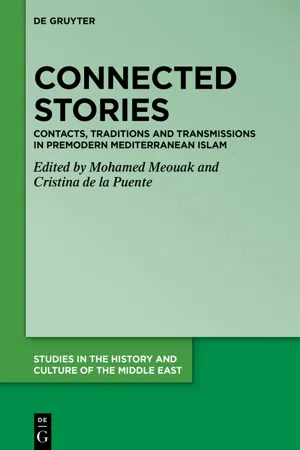
eBook - ePub
Connected Stories
Contacts, Traditions and Transmissions in Premodern Mediterranean Islam
- 322 pages
- English
- ePUB (mobile friendly)
- Available on iOS & Android
eBook - ePub
Connected Stories
Contacts, Traditions and Transmissions in Premodern Mediterranean Islam
About this book
Information
Subtopic
European Medieval HistoryIndex
HistoryPart I: Linguistic Stories
Sociolinguistic Infrastructures
Prerequisites of Translation Movements Involving Latin and Arabic in the Medieval Period
Daniel G. König
1 Introduction
The following contribution systematically compares two medieval “translationTranslation movements” involving the languages Latin and Arabic.
During the first translationTranslation movement, a handful of Latin texts was ArabicizedArabicization in the Christian and the courtly milieus of late Umayyad al-AndalusAndalus, al-. Translation activities began approximately in the middle of the 9th century and petered out by the middle of the 11th century.1 They did not stand at the beginning of a systematic study of Latin and the development of Latin studies in the Arabic-Islamic sphere: Latin–Arabic translationTranslation was not taken up again until much later, this time by very different agents: between RomeRome and the Middle EastMiddle East, Christians of various denominations attached to the Roman ChurchChurch transferred a huge corpus of medieval and early modern Latin-Christian texts into Arabic between the 15th and the 19th centuries. Muslim Arab scholars, in turn, only began to produce Arabic translations of a large corpus of ancient and a very much smaller number of medieval and early modern Latin texts after the introduction of a system of secular academic education to the Arab world at the beginning of the 20th century.2
During the second translationTranslation movement, hundreds of texts were translated from Arabic to Latin in various European and Mediterranean locations. Translation began in the 11th century at the latest, but only gained momentum at the beginning of the 12th century. It tied in with the millennia-long diffusion of ancient Greek texts in the wider Mediterranean sphere—the late antique LatinizationLatinization of a limited number of Greek works at the hands of BoethiusBoethius (d. c. 524) and CassiodorCassiodor (d. c. 580–585),3 the Greek–Syriac–Arabic translationTranslation movement of the 5th to 10th centuries,4 as well as the systematic translationTranslation of Greek texts into Latin that also began in the 12th century.5 Arabic–Latin translations continued to be produced until the early 16th century. This translationTranslation movement provided one, if not the basis for the emergence of Arabic studies in Christian Europe. TranslationTranslation activities were taken up by European Arabists who produced a limited number of Latin translations of Arabic texts until the 19th century, when Latin ceased to be used as a language of academic endeavours.6 The medieval Arabic–Latin translationTranslation movement became a battlefield for two ferocious debates. One opposed Graecophile humanists and Arabists in Christian Europe of the 14th to 16th century and revolved around the question, whether scientific texts produced by the ancient Greeks were superior in quality to their medieval Arabic–Latin translations and Arabic writings in general.7 The other debate involved and continues to involve those who accept and those who refuse to accept that influences from the Islamic(ate) sphere contributed to the early modern rise of the sciences in Europe.8
Although they involve the same languages, the two translationTranslation movements subject to comparison in this article are obviously highly unequal in terms of duration, scope, and their mid- to long-term legacy.9 The aim of this article is to understand why they differed so much. To this end, the article systematically compares the sociolinguistic prerequisites of both movements. Building on deliberations by Cyrille AilletAillet, Cyrille, Matthias MaserMaser, Matthias, Dimitri GutasGutas, Dimitri, Dag Nikolaus HasseHasse, Dag Nikolaus, and others,10 its objective is to understand why they began, why they took place in a particular period, in particular places, and in a particular manner, and—last but not least—how and why they ended. The article will analyse each translationTranslation movement individually and end with a comparative conclusion. Analysis and comparison build on a set of parameters. These include (1) the relation between geopolitical shifts, the emergence and/or availability of specific forms of “intellectualized bilingualism”, and the beginnings of translationTranslation activity; (2) the scope and duration of the translationTranslation movement as circumscribed by the availability and thematic breadth of appropriate texts, the motivations to translate, and the supporting institutions of patronagePatronage; finally (3) the resulting degree of institutionalization in the spheres of language learning, teaching, and translationTranslation in relation to the end and the respective legacy of translationTranslation activity.
2 From Latin to Arabic in Umayyad al-AndalusAndalus, al- (9th–11th Cent.)
Latin–Arabic translationTranslation in Umayyad al-AndalusAndalus, al- involved two sets of texts: Christian texts including the Psalter, the Gospels, the Pauline epistles, and the ecclesiastical canons of the Visigothic era on the one hand, historiographical texts, specifically an enlarged version of OrosiusOrosius’ (d. c. 417) late antique “Histories against the Pagans” (Historiarum adversus paganos libri septem) and, possibly, a list of Frankish kings on the other hand. Translations were generally produced in the environs of Cordoba“Cordoba”, both in a “Mozarab” Christian milieu and in circles attached to the Umayyad court.11
2.1 Geopolitical Preconditions and the Emergence of Romance-Arabic Bilingualism
The beginning of translationTranslation activity in the middle of the 9th century ultimately resulted from the geopolitical shift brought about by the Muslim invasion of the Iberian PeninsulaIberian Peninsula in 711. The invasion extended the recently established contact zone of Latin and Arabic, which had come into being in North AfricaNorth Africa at the end of the 7th century. This contact zone had brought together Arabic speakers from the Middle EastMiddle East as well as speakers of what we may either call “vulgar” Latin or a Romance idiom derived from Latin.12 The latter included Romanized North African city-dwellers and Romanized Berbers accustomed to communicating in a Latinate idiom. Since both groups had already lived under Muslim rule for several decades, we can assume that some of their members were able to communicate with the Muslim elites in Arabic. If we accept these preconditions,13 it seems plausible that North African linguistic mediators facilitated acts of collaboration and administrative interaction between Arabic speakers and Iberian speakers of Romance during the period of invasion.
Initially, communication between the different speaker groups must have been confined to the exchange of rather basic and thus easily explicable information.14 Communication on more complex ...
Table of contents
- Title Page
- Copyright
- Contents
- List of contributors
- Connected Stories. Introduction
- Part I: Linguistic Stories
- Part II: Intellectual Stories
- Part III: Material Stories
- Part IV: Spiritual Stories
Trusted by 375,005 students
Access to over 1.5 million titles for a fair monthly price.
Study more efficiently using our study tools.
Frequently asked questions
Yes, you can cancel anytime from the Subscription tab in your account settings on the Perlego website. Your subscription will stay active until the end of your current billing period. Learn how to cancel your subscription
No, books cannot be downloaded as external files, such as PDFs, for use outside of Perlego. However, you can download books within the Perlego app for offline reading on mobile or tablet. Learn how to download books offline
Perlego offers two plans: Essential and Complete
- Essential is ideal for learners and professionals who enjoy exploring a wide range of subjects. Access the Essential Library with 800,000+ trusted titles and best-sellers across business, personal growth, and the humanities. Includes unlimited reading time and Standard Read Aloud voice.
- Complete: Perfect for advanced learners and researchers needing full, unrestricted access. Unlock 1.5M+ books across hundreds of subjects, including academic and specialized titles. The Complete Plan also includes advanced features like Premium Read Aloud and Research Assistant.
We are an online textbook subscription service, where you can get access to an entire online library for less than the price of a single book per month. With over 1.5 million books across 990+ topics, we’ve got you covered! Learn about our mission
Look out for the read-aloud symbol on your next book to see if you can listen to it. The read-aloud tool reads text aloud for you, highlighting the text as it is being read. You can pause it, speed it up and slow it down. Learn more about Read Aloud
Yes! You can use the Perlego app on both iOS and Android devices to read anytime, anywhere — even offline. Perfect for commutes or when you’re on the go.
Please note we cannot support devices running on iOS 13 and Android 7 or earlier. Learn more about using the app
Please note we cannot support devices running on iOS 13 and Android 7 or earlier. Learn more about using the app
Yes, you can access Connected Stories by Mohamed Meouak, Cristina Puente, Mohamed Meouak,Cristina Puente in PDF and/or ePUB format, as well as other popular books in History & European Medieval History. We have over 1.5 million books available in our catalogue for you to explore.