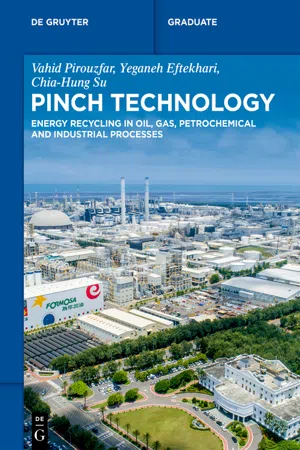
Pinch Technology explains the principles of process integration, the use of pinch technology as well as energy recycling in oil, gas, petrochemical and industrial processes. It gives an complete overview of all relevant and similar references in the fi eld of energy recovery in oil, gas and petrochemicals.
eBook - ePub
Pinch Technology
Energy Recycling in Oil, Gas, Petrochemical and Industrial Processes
- 103 pages
- English
- ePUB (mobile friendly)
- Available on iOS & Android
eBook - ePub
Pinch Technology
Energy Recycling in Oil, Gas, Petrochemical and Industrial Processes
About this book
Information
Chapter 1 Overview on the History of Integration and Fundamental Concept
1.1 Overview on the History of Pinch Technology
Reducing the energy consumption and industrial unit expenses is the factor that has been always studied and researched in process optimization issues. Generally, the results are showing that by applying changes and providing suitable operational conditions by an accurate process control and monitoring, using standard methods and engineering design could help achieve this purpose.
In this regard, many concepts have been spread and process integration is relatively a new concept and widely used today in industries, in order to examine a particular part of process design.
1.1.1 Process Integration
A chemical and industrial process consists of a set of related units and many different streams. Process integration is a general way to design and run a process, and actually, it emphasizes on integrity of the process, which includes several parts.
Due to the evolution that occurred in process integration during recent decade, the International Energy Agency has presented a definition of process integration as follows:
In fact, process integration is the application of methods and algorithms which are based on system and through a comprehensive approach, it can lead to new design, modification and integration of industrial processes. These methods might be mathematical, thermodynamic and economic models and algorithms, that the Artificial intelligence, pinch analysis and mathematical programing are also some examples of them.
In other words, the main purpose of process integration is an integrated system analysis in such a way that the interaction of components in system is examined comprehensively in order to improve the design aims or utilization [1].
Process integration includes the following items:
- Optimization of energy consumption
- Optimization of external heat sources system and utilities
- Improving the process and operational conditions of equipment such as distillation towers and reactors
- Reducing operational and capital costs
- Optimization of hydrogen consumption
- Reducing greenhouse gas emissions
- Optimization of sequential separation processes and discontinuous processes
- Reducing the rate of water consumption and effluent production
Heat recovery system is one of the basic parts of process units and has a decisive and key role to play in energy consumption of units, determining heat cost and promoting heat recovery in chemical processes. This system includes heat exchanger network, cold utilities and hot utilities.
Therefore, using process integration methods in refinery units such as petrochemical units has been developed and expanded. In this regard, many new methods have been invented, and the most important ones are pinch analysis and mathematical programming method.
1.1.2 Mathematical Programming Method
For so long, the energy supplying system of the process heat network was performed traditionally. In this method, the process core is firstly designed by constant flow rates and temperatures, and the mass and energy balances of system take place. After that the design of heat recovery system would be completed. At the end, other system requirements will be covered by the use of external heat sources.
Due to the high energy consumption and operational costs in classical methods, researchers by presenting mathematical methods have provided solutions in order to optimize energy and operating costs of industrial units.
In 1969, Kesler and Parker proposed a linear programming based on a simultaneous algorithm. In this method, which aims to minimize the total costs of process heat network, each stream splits into multiple and smaller streams that are equal and have specific heating load. Then the smaller hot flows will be connected to the cold flows. To expand more, networks that include all substreams must be built.
In 1973, sequential algorithms method and tree searching algorithm have been presented by Lapidus, which eventually created a tree diagram to design a heat network. But t...
Table of contents
- Title Page
- Copyright
- Contents
- About the Authors
- Chapter 1 Overview on the History of Integration and Fundamental Concept
- Chapter 2 Composite Curve
- Chapter 3 Cascade Diagram
- Chapter 4 Heat Exchanger Network Design with Maximum Energy Recovery
- Chapter 5 Heat Exchanger Network Design with Minimum Heat Transfer Unit
- Chapter 6 Estimating the Number of Shells and Heat Transfer Area of Heat Exchanger Network
- Chapter 7 Estimating the Cost of Heat Exchanger Network
- Chapter 8 Furnaces, Heat Engines, Heat Pumps and Distillation Tower
- Index
Trusted by 375,005 students
Access to over 1.5 million titles for a fair monthly price.
Study more efficiently using our study tools.
Frequently asked questions
Yes, you can cancel anytime from the Subscription tab in your account settings on the Perlego website. Your subscription will stay active until the end of your current billing period. Learn how to cancel your subscription
No, books cannot be downloaded as external files, such as PDFs, for use outside of Perlego. However, you can download books within the Perlego app for offline reading on mobile or tablet. Learn how to download books offline
Perlego offers two plans: Essential and Complete
- Essential is ideal for learners and professionals who enjoy exploring a wide range of subjects. Access the Essential Library with 800,000+ trusted titles and best-sellers across business, personal growth, and the humanities. Includes unlimited reading time and Standard Read Aloud voice.
- Complete: Perfect for advanced learners and researchers needing full, unrestricted access. Unlock 1.5M+ books across hundreds of subjects, including academic and specialized titles. The Complete Plan also includes advanced features like Premium Read Aloud and Research Assistant.
We are an online textbook subscription service, where you can get access to an entire online library for less than the price of a single book per month. With over 1.5 million books across 990+ topics, we’ve got you covered! Learn about our mission
Look out for the read-aloud symbol on your next book to see if you can listen to it. The read-aloud tool reads text aloud for you, highlighting the text as it is being read. You can pause it, speed it up and slow it down. Learn more about Read Aloud
Yes! You can use the Perlego app on both iOS and Android devices to read anytime, anywhere — even offline. Perfect for commutes or when you’re on the go.
Please note we cannot support devices running on iOS 13 and Android 7 or earlier. Learn more about using the app
Please note we cannot support devices running on iOS 13 and Android 7 or earlier. Learn more about using the app
Yes, you can access Pinch Technology by Vahid Pirouzfar,Yeganeh Eftekhari,Chia-Hung Su in PDF and/or ePUB format, as well as other popular books in Technology & Engineering & Science General. We have over 1.5 million books available in our catalogue for you to explore.