The major themes in this volume are the rise of Winnipeg to world curling prominence in the nineteenth century and the persistence of that prominence in the twentieth.
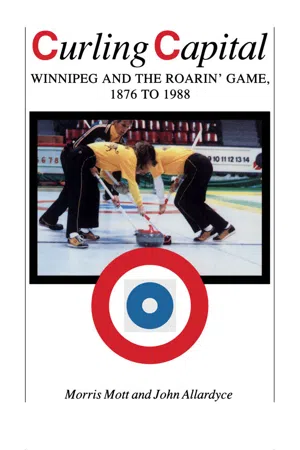
- 171 pages
- English
- ePUB (mobile friendly)
- Available on iOS & Android
eBook - ePub
Curling Capital
About this book
Information
1
Becoming a Curlers’ Mecca, 1876 to 1903
Although curling was played occasionally in Winnipeg before the 1870s, in that decade the sport was firmly established in the city. It was introduced by people of British-Protestant, especially Scottish, background who valued the sport and felt obligated to promote it. By early in the twentieth century their bonspiel and their curlers had acquired an unrivalled international reputation.
THE OBJECTIVE IN CURLING is to score more points than the other team. One gains points by throwing stones that stop closer to a target than stones thrown by the opponent, and that remain closer to the target despite the opponent’s efforts to move them. Some or all of these goals have been incorporated into games played for thousands of years in many parts of the world. Therefore it would not be accurate to say that the Scots “invented” curling.
Nevertheless, it is true that the Lowland Scots developed curling as we know it. The Scots began curling at least four hundred years ago. Until early in the nineteenth century they played according to local rules that prescribed varying numbers of players per team and shots per player, and suggested or required rinks of assorted lengths, and stones of diverse shapes and sizes. Then, as improved means of transportation made it possible for curlers to compete against distant opponents, uniformity of rules became desirable. This was largely accomplished through the formation in 1838 of the Grand Caledonian Curling Club. This club, which became the Royal Caledonian Curling Club in 1843 after Prince Albert agreed to become patron, was not so much a club as it was an association of clubs. It adopted or promoted the most important rules that have marked the sport to the present day: only circular stones are used; a team, or “rink,” consists of four players; each player has two shots per end; the sheet of ice, or “rink,” on which the game occurs is forty-six yards long from “foot-score to footscore” (hack to hack).1
The Scots not only developed the sport of curling, but they also introduced it to other parts of the world, including British North America. By the time the RCCC was formed in the late 1830s, British North Americans had been curling for decades. The first to play the sport in the New World may have been the Scottish soldiers in the British Army, which occupied Quebec over the winter of 1759-60. Curling certainly had been introduced by the late eighteenth century, and the first club on the continent was established in 1807 in Montreal. By 1867, a host of clubs had been formed in the four British colonies that united in that year to form the Dominion of Canada. Clubs were especially numerous and active in Upper Canada, or what is now eastern, southern and western Ontario.
Especially after the formation of the RCCC. British North Americans attempted to adopt rules and equipment employed in Scotland. However, in some parts of what is now central Canada, granite was not available locally, and to import rocks from Scotland was either impossible or too expensive. Therefore “rocks” might be made of wood or iron, and rules might be adjusted to accommodate the altered equipment. Wooden rocks were commonplace in Upper Canada. They often featured an iron handle, as well as an iron band wrapped around the circumference to prevent splitting. Meanwhile, in Lower Canada, or Quebec, rocks were more often fashioned from iron than from wood. Normally iron rocks were heavier than granites and much heavier than woods. When used indoors, or even when used outside on mild days, the irons had a tendency to dig into the ice, particularly when left stationary for a few minutes. Curlers who threw take-outs with irons were often frustrated because the rock that was hit might not move. The irons did have one positive quality, however. In very cold weather they did not break as easily as granites did.2
While some Scots were establishing curling in the settled communities of what are now central and eastern Canada, others were attempting to do so in the West, where the main economic activities were still associated with the fur trade. In November 1839, men from the Hudson’s Bay Company curled with “flat stones” (no handles) on the east side of the Rocky Mountains, probably in what is now the United States.3 Quite likely other traders curled after a fashion at different times thereafter, with equipment made from material close at hand.
Meanwhile, inhabitants of the Red River Settlement also took up curling. The Settlement incorporated approximately the area that became known as Greater Winnipeg. It had been established in 1811-12 by Lord Selkirk and the Hudson’s Bay Company, and one of its main purposes was to provide cheap food for the northern traders. It contained about 2,000 people in 1824, about 6,700 in 1856, and close to 12,000 by 1870. Among the earliest and most tenacious settlers were the relatively small number of Scots who built homes over the years, especially in the parishes of St. John’s, St. Paul’s (Middlechurch), and St. Andrew’s. It is not known when the settlers first curled, and it is unlikely they played often.4 However, it seems certain that they did curl from time to time with wooden rocks on keen patches of ice on rivers and ponds.
This conclusion is suggested especially in a letter from “Templeton,” published on March 28,1860, in the newly founded Settlement newspaper, the Nor’Wester. In his letter Templeton described the game of curling as it was played in Scotland, and mentioned that some gentlemen who presumably lived in, or very close to, the tiny village of Winnipeg, located at the middle of the Settlement, planned to form the Royal Fort Garry Curling Club “as soon as possible.” These Winnipeggers wanted to arrange games with curlers from the “lower district,” which evidently meant St. Andrew’s parish.5 It seems that the Royal Fort Garry Club was never established, but both Templeton’s letter and other documents indicate that several people in the Settlement were familiar with curling and participated in it occasionally before Red River became part of the Dominion of Canada in 1870.6
It was not until 1876, however, that curling became well established in the city that soon became the leading centre for the sport. In 1870 the Dominion of Canada had acquired the West from the Hudson’s Bay Company and divided it into the small Province of Manitoba and the huge North West Territory. The small village of Winnipeg had been chosen the seat of government for both. Sporadically over the next few years individuals from Winnipeg tried to form a curling club, and they succeeded on November 9,1876, when the Manitoba Curling Club was established.
The Manitoba Curling Club is usually referred to as the first curling club in the West, but it may not have been. In the winter of 1873-74 construction workers at the federal penitentiary at Stony Mountain had curled with iron rocks in a lumber shed they had converted into a one-sheet rink. Whether they formed a club is not known, but if so, the club was inactive by the late 1870s. The Manitoba Curling Club was really the first club in western Canada to achieve a degree of permanence. It originally had about twenty members. They purchased land from A.G.B. Bannatyne on the western edge of town near the present site of Victoria and Albert School and constructed a rink. In this rink, on December 11, in the afternoon because there were no lights, eight members of the new organization participated in the first club match.7
Fewer that twenty-seven years after these unimpressive beginnings, Rev. John Kerr was saying that Winnipeg was the world’s leading curling city. To him and to several other curling observers by this time, it was obvious that Winnipeg and Winnipeggers were remarkable.8 How and why had they become so?
The Manitoba Curling Club that was formed in 1876 quickly became a reasonably healthy organization. However, it was an “iron” club, and some of its members preferred granite stones. In 1881 they broke away to form a new club named, appropriately, the Granite Curling Club. For three seasons the two entities shared the same facilities, but more and more curlers switched to granites, and late in 1883 the iron club folded.9 From that point forward iron rocks were rarely seen, and by the 1890s the only curlers who did not use granites were the youngsters who often learned the game with wooden blocks or jam pails.10
The Granite Club was the only curling club in Winnipeg from 1883 to 1887. In the latter year a majority of members decided to take advantage of the opportunity to move to a better rink than the one they were renting. A minority, some of whom were shareholders in the building the Granite Club was using, disagreed with the choice and they formed a new club, the Thistle Curling Club.11 Like the Granite, the Thistle is still a thriving club today.
Meanwhile, between 1879 and 1888, a number of clubs were formed in smaller prairie towns and cities such as Emerson, Portage la Prairie, Brandon, Gladstone and others beyond the Manitoba boundary as far west as Calgary.12 Curlers in these centres, like those in Winnipeg, often started with iron or wooden “stones,” but soon discarded them in favour of granites.13 By the 1890s granites were used almost always.
In these pioneer years almost all curlers in Winnipeg and in the smaller western places were Protestants of British origin or descent: Anglicans, Methodists, Presbyterians or Congregationalists who were English, Irish and especially Scots. Occasionally they were emigrants from the United States, but normally they were from Great Britain or eastern Canada and in particular Ontario. They were members of the British-Protestant community that in the 1870s and 1880s was rapidly becoming the most numerous and most powerful group in Manitoba. By the late 1880s they represented almost two-thirds of the population and had made the province a “British and Canadian” one, to quote the late W.L. Morton. They had made the exportation of grain rather than furs the cornerstone of the economy, and had established their institutions, values and ways of doing things as the dominant ones.14
These people enjoyed a remarkable variety of sports and other recreations, and they transferred virtually all of them to Winnipeg and to the West. However, they tended to look for “higher” motives than mere enjoyment for participating in sports or other pastimes. They had been influenced by th...
Table of contents
- Cover
- Half Title Page
- Title Page
- Copyright Page
- Dedication
- Contents
- List of Photographs
- Acknowledgements
- Introduction
- 1 Becoming a Curlers’ Mecca, 1876 to 1903
- 2 “Greatest Curling City in the World,” 1903 to 1928
- 3 Confirmation of Superiority, 1928 to 1957
- 4 Still a Special Place, 1957 to 1988
- Conclusion: A Hall of Fame
- Notes
- Glossary
- Index
Trusted by 375,005 students
Access to over 1.5 million titles for a fair monthly price.
Study more efficiently using our study tools.
Frequently asked questions
Yes, you can cancel anytime from the Subscription tab in your account settings on the Perlego website. Your subscription will stay active until the end of your current billing period. Learn how to cancel your subscription
No, books cannot be downloaded as external files, such as PDFs, for use outside of Perlego. However, you can download books within the Perlego app for offline reading on mobile or tablet. Learn how to download books offline
Perlego offers two plans: Essential and Complete
- Essential is ideal for learners and professionals who enjoy exploring a wide range of subjects. Access the Essential Library with 800,000+ trusted titles and best-sellers across business, personal growth, and the humanities. Includes unlimited reading time and Standard Read Aloud voice.
- Complete: Perfect for advanced learners and researchers needing full, unrestricted access. Unlock 1.5M+ books across hundreds of subjects, including academic and specialized titles. The Complete Plan also includes advanced features like Premium Read Aloud and Research Assistant.
We are an online textbook subscription service, where you can get access to an entire online library for less than the price of a single book per month. With over 1.5 million books across 990+ topics, we’ve got you covered! Learn about our mission
Look out for the read-aloud symbol on your next book to see if you can listen to it. The read-aloud tool reads text aloud for you, highlighting the text as it is being read. You can pause it, speed it up and slow it down. Learn more about Read Aloud
Yes! You can use the Perlego app on both iOS and Android devices to read anytime, anywhere — even offline. Perfect for commutes or when you’re on the go.
Please note we cannot support devices running on iOS 13 and Android 7 or earlier. Learn more about using the app
Please note we cannot support devices running on iOS 13 and Android 7 or earlier. Learn more about using the app
Yes, you can access Curling Capital by Morris Mott,John Allardyce in PDF and/or ePUB format, as well as other popular books in History & North American History. We have over 1.5 million books available in our catalogue for you to explore.