![]()
Chapter 1:
Considering Disaster Management
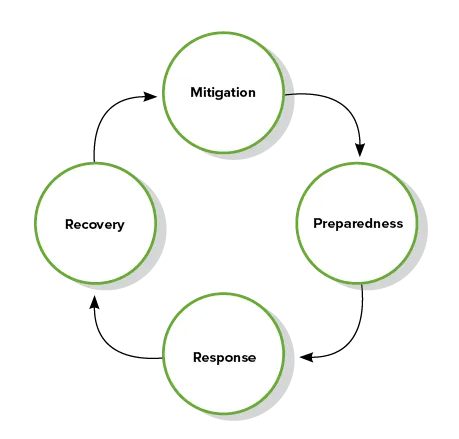
Disaster management follows a cycle. At the most basic level, the disaster-management cycle consists of four basic parts. This book focuses on one of the most important but often neglected parts—recovery. Why does recovery tend to be neglected? Many reasons exist, but the primary reason is that we often live under the impression that “It will never happen here.” Our goal is to spend as little time in the recovery portion of the cycle as possible. When we are in recovery, by definition, life is not normal. Returning to normal operations helps everyone—it is better for our business, better for our mental health, and better for the community that we serve.
- Preparation involves the development and testing of emergency-action plans. Preparedness is a continuing commitment, which requires monetary investment. Organizations should not view preparedness as being done once the plan is written. Instead, they should test the plan, reevaluating whether the plan needs revisions. Other examples include stockpiling food and water.
- Response occurs when an emergency or disaster begins. It requires us to take action to protect lives and property. During a response, our investments in planning and training are put to the test. This is game day or “go time.” Organizations that have invested in their mitigation and preparedness efforts will have responses that are effective and efficient. Such planning limits damage and loss of life and allows us to move past the emergency in a more expeditious manner.
- Recovery comes after the immediate threat to life and property has ended and involves picking up the pieces and attempting to return to normal. Recovery can be a long road—and for some communities, it may take years to fully recover. Recovery often contains short- and long-term efforts. For example, establishing a shelter to meet the needs of displaced individuals is a short-term recovery goal; whereas, rebuilding homes destroyed by the disaster is a long-term recovery goal. Each recovery effort seeks to bring stability to the impacted community.
- Mitigation efforts seek to reduce potential harm or loss from emergencies or disasters. Mitigation activities are completed before a response and involve conducting activities to lower risk. For instance, a city may enact building codes to reduce the impact of high winds or floods on buildings. By enacting these codes, the city is seeking to reduce the potential losses that may be incurred from a disaster. Another example is purchasing insurance.
The disaster-management cycle is especially important for small businesses, which often feel the tangible impact of a disaster just as a family would. Small businesses account for 99 percent of all companies and employ 50 percent of all private-sector employees (US Department of Homeland Security, Earthquake Country Alliance, and Federal Alliance for Safe Homes, n.d.). Communities across the United States depend on small businesses for everyday needs, including for early child care and education.
Effects on Early Childhood Programs
Many early childhood programs are small businesses. According to the Committee for Economic Development of The Conference Board (CED), 768,521 child-care establishments were operating in the country in 2019, with approximately 90 percent being classified as family child-care programs or one-person operations (CED, 2019; Stevens, 2017). While certainly large in quantity, when compared to child-care centers, family child-care providers generated approximately 25 percent of total revenue for the entire early childhood sector. While workforce numbers are difficult to quantify, several groups estimate at least 12 million children under the age of six are in a child-care arrangement.
Sadly, the US Federal Emergency Management Agency (FEMA) estimates that between 40 and 60 percent of small businesses do not reopen after a disaster. Resuming operations as soon as possible is vital, as there is a direct correlation between the time it takes to reopen and the likelihood of continued operations. Doing so allows you to resume your cash flow, and importantly, let your customers know you are back open. Being unable to reopen after an emergency can have dire consequences. Nearly 90 percent of small businesses that do not reopen within five days of a disaster will fail within a year (FEMA and Federal Alliance for Safe Homes, n.d.a). Additionally, nearly 75 percent of businesses without emergency preparedness and continuity planning will fail within three years of a disaster (FEMA and Federal Alliance for Safe Homes, n.d.b). While this is tragic for any one business, the loss of an early childhood program in a community can be downright disastrous.
These statistics are important and help paint a clear picture for policymakers and professional emergency-management organizations. These facts and figures show the importance of child care as a business. We also need to consider the impact that a lack of child-care services has on a community.
While we all face the possibility of experiencing disasters, only 49 percent of child-care administrators in both residential and child-care centers report being able to properly care for children during and after disasters. Of those, 37 percent of administrators in child-care centers report being able to provide care to children for longer than twenty-four hours during and after an emergency (Leser, Looper-Coats, and Roszak, 2019).
If child care is not available, parents are unable to work. In communities suffering from the disaster, rebuilding and recovery efforts can be delayed without adequate child care. Little research has been done about the economic impacts of post-disaster closure of early childhood programs. However, a study looking at typical breakdowns in child care—children being sick, child-care programs temporarily closing, issues with transportation, and other routine events—found that lack of access to child care costs $8.3 billion in lost wages each year (Glynn and Corley, 2016). One can only speculate that this figure would severely increase in the event of a prolonged absence of early childhood programs within a community.
Furthermore, vulnerable populations, such as children, older adults, people with disabilities, and those living in poverty, are the most likely to experiencing adverse effects in a post-disaster environment. This is important as early childhood programs begin to think about the clients that they serve and the staff that they employ. Families that were barely making it prior to the emergency or disaster will likely need assistance in the post-disaster environment. This is a special consideration that must be taken into account. Consider how you may best help these clients, such as supporting them through cash donations, tangible goods (food, water, or clothing), tuition relief, or even transportation. Depending on the clientele you serve, this could include a substantial portion of your clients, especially if your program traditionally serves families below the poverty thresholds (such as Head Start programs).
The severe damage suffered by Puerto Rico after Hurricane Maria in 2017 helps to provide a snapshot. After the hurricane, 99.7 percent of families with children younger than the age of eighteen were without electricity for an average of 103 days, and 85 percent of such families lost water service for an average of 55 days. A report by Instituto Desarrollo Juventud (2018) examined the impacts of Hurricane Maria on a representative sample of families with children eighteen years and younger in Puerto Rico. Findings consistently showed that poorer families (with incomes less than $15,000) fared much worse from the aftermath of the hurricane compared to families with higher incomes. These outcomes were seen in all categories (food security, utilities, employment, transportation, medical services). In this study, nearly a third of families reported that it was probable or very probable that they would migrate because of the hurricane.
The Puerto Rican experience was not unique: findings in the USVI after Hurricane Irma, which hit both the USVI and Puerto Rico two weeks before Maria, were similar. The USVI Kids Count report found that the poverty levels for families in the USVI with children increased from 27 percent to 32 percent, and more households received Supplemental Nutrition Assistance Program (SNAP) benefits in September 2018 than during the two years prior to the hurricanes. Similarly, in the 2016–2017 school year, only fifteen families received emergency or crisis intervention that provided essential needs such as food, clothing, and shelter; that number increased to 300 families that received those services in the 2017–2018 school year, after the hurricanes (Community Foundation of the Virgin Islands, 2018; Michael et al., 2019).
The Head Start program administered by the USVI Department of Human Services in Puerto Rico is the most comprehensive childhood program in the territory. Head Start can provide services to 894 eligible children each year in its fifteen centers with forty-five classrooms across the three main islands of St. Croix, St. John, and St. Thomas. Due to damage from Hurricanes Irma and Maria, classrooms had to be consolidated. The Head Start centers in St. John and St. Thomas remain closed, as well as the two centers in St. Croix. Many more centers were less seriously damaged and able to reopen, but still operate with unrepaired damages.
Enrollment at Head Start across the territory decreased more than 50 percent from the beginning of the school year to the end. For private child care (not to be confused with Head Start), the USVI Department of Human Services reported that twenty-seven child-care centers in the St. Thomas–St. John district closed, along with twelve centers on St. Croix. The territory’s private child-care centers lost more than half their capacity in available space and number of children enrolled due to damage to the facilities and families moving off the islands.
Migration is a phenomenon that occurs after every disaster. For example, massive migration was seen after Hurricane Katrina struck the Gulf Coast of the United States in 2005. In fact, all fifty states, the District of Columbia, and Puerto Rico received families affected by the hurricane’s devastation (Ericson, Tse, and Wilgoren, 2005).More recently, USVI and Puerto Rico experienced this phenomenon as well.
The diaspora of families and children away from the impacted area is something that early childhood programs should take into account when developing their recovery plans. Staying in close contact with your clients and families during recovery is an important consideration and can help you better understand their situations and future child-care needs. Sadly, as the above information illustrates, some early childhood programs reopened only to find that a substantial portion of their families had moved away. This certainly has an impact on program operations and funding.
![]()
Chapter 2:
Insurance Basics
According to the Insurance Information Institute (III), one out of every fifteen US homeowners files a claim on their homeowners insurance each year. This astonishing number reinforces the need to be familiar with your business or home insurance policy in advance of any damaging event. The III also reports that the average home insurance claim is for $16,000 and the average home insurance premium is $1,173 per year (III, 2022).
Insurance policies can be confusing, especially because they may have different levels of out-of-pocket expenses for different causes or claims. In the following pages we will discuss different types of policies and deductibles. Some of these disparities are heavily influenced b...