Polarized Light and the Mueller Matrix Approach
eBook - ePub

Polarized Light and the Mueller Matrix Approach

  1. 490 pages
  2. English
  3. ePUB (mobile friendly)
  4. Available on iOS & Android
eBook - ePub

Polarized Light and the Mueller Matrix Approach

About this book

An Up-to-Date Compendium on the Physics and Mathematics of Polarization Phenomena

Now thoroughly revised, Polarized Light and the Mueller Matrix Approach cohesively integrates basic concepts of polarization phenomena from the dual viewpoints of the states of polarization of electromagnetic waves and the transformations of these states by the action of material media. Through selected examples, it also illustrates actual and potential applications in materials science, biology, and optics technology.

The book begins with the basic concepts related to two- and three-dimensional polarization states. It next describes the nondepolarizing linear transformations of the states of polarization through the Jones and Mueller-Jones approaches. The authors then discuss the forms and properties of the Jones and Mueller matrices associated with different types of nondepolarizing media, address the foundations of the Mueller matrix, and delve more deeply into the analysis of the physical parameters associated with Mueller matrices.

The authors proceed with introducing the arbitrary decomposition and other useful parallel decompositions, and compare the powerful serial decompositions of depolarizing Mueller matrices. They also analyze the general formalism and specific algebraic quantities and notions related to the concept of differential Mueller matrix. Useful approaches that provide a geometric point of view on the polarization effects exhibited by different types of media are also comprehensively described. The book concludes with a new chapter devoted to the main procedures for filtering measured Mueller matrices.

Suitable for advanced graduates and more seasoned professionals, this book covers the main aspects of polarized radiation and polarization effects of material media. It expertly combines physical and mathematical concepts with important approaches for representing media through equivalent systems composed of simple components.
Frequently asked questions

Yes, you can cancel anytime from the Subscription tab in your account settings on the Perlego website. Your subscription will stay active until the end of your current billing period. Learn how to cancel your subscription.
No, books cannot be downloaded as external files, such as PDFs, for use outside of Perlego. However, you can download books within the Perlego app for offline reading on mobile or tablet. Learn more here.
Perlego offers two plans: Essential and Complete
  • Essential is ideal for learners and professionals who enjoy exploring a wide range of subjects. Access the Essential Library with 800,000+ trusted titles and best-sellers across business, personal growth, and the humanities. Includes unlimited reading time and Standard Read Aloud voice.
  • Complete: Perfect for advanced learners and researchers needing full, unrestricted access. Unlock 1.4M+ books across hundreds of subjects, including academic and specialized titles. The Complete Plan also includes advanced features like Premium Read Aloud and Research Assistant.
Both plans are available with monthly, semester, or annual billing cycles.
We are an online textbook subscription service, where you can get access to an entire online library for less than the price of a single book per month. With over 1 million books across 1000+ topics, we’ve got you covered! Learn more here.
Look out for the read-aloud symbol on your next book to see if you can listen to it. The read-aloud tool reads text aloud for you, highlighting the text as it is being read. You can pause it, speed it up and slow it down. Learn more here.
Yes! You can use the Perlego app on both iOS or Android devices to read anytime, anywhere — even offline. Perfect for commutes or when you’re on the go.
Please note we cannot support devices running on iOS 13 and Android 7 or earlier. Learn more about using the app.
Yes, you can access Polarized Light and the Mueller Matrix Approach by José Jorge Gil,Razvigor Ossikovski,Jose J. Gil,José J. Gil in PDF and/or ePUB format, as well as other popular books in Mathématiques & Physique. We have over one million books available in our catalogue for you to explore.

Information

Publisher
CRC Press
Year
2022
Print ISBN
9780367407469
eBook ISBN
9781000568691
Edition
2
Subtopic
Physique

1Polarized Electromagnetic Waves

DOI: 10.1201/9780367815578-1

1.1 Introduction: Nature of Polarized Electromagnetic Waves

Due to the specific nature of electromagnetic waves, the electric field of the wave evolves in time at any given point r in space. The complete description of the electromagnetic wave at point r requires the knowledge of four field vectors, namely the electric field strength E, the electric displacement density (electric induction) D, the magnetic field strength H, and the magnetic flux density (magnetic induction) B.
In general, the microscopic forces exerted by the electric field of the wave on matter are much larger than the forces produced by the magnetic field, so the temporal evolution of the electric field is chosen as the representative of the property called polarization.
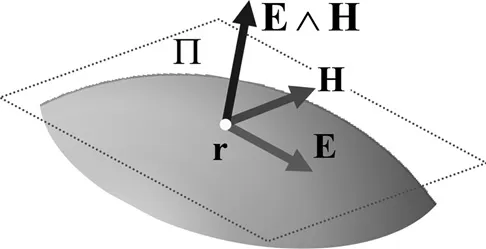
When, in particular, the electromagnetic wave propagates in an isotropic medium, the electric and magnetic strengths are tangent to the wavefront at the considered point r (Figure 1.1). Nevertheless, in the case of an anisotropic medium, it is D, and not E, what is tangent to the wavefront at each given point r. Thus, unlike the case of isotropic media, for anisotropic media the temporal evolution of D is usually taken as the representative of the polarization of the electromagnetic wave (Cloude 2009, p. 13), even though we shall use the symbol E without distinction in the mathematical formulation of polarization.
An illustration of propagation of the electromagnetic wave in an isotropic medium.
FIGURE 1.1When the electromagnetic wave propagates in an isotropic medium, both electric and magnetic strength vectors lie in a plane Π which is tangent to the wavefront at the considered point r.
In spite of the fact that we sometimes use the term light, in general and unles...

Table of contents

  1. Cover
  2. Half-Title Page
  3. Title Page
  4. Copyright Page
  5. Dedication
  6. Contents
  7. Preface
  8. Preface to the second edition
  9. Acknowledgements
  10. Authors
  11. 1 Polarized Electromagnetic Waves
  12. 2 Three-Dimensional States of Polarization
  13. 3 Nondepolarizing Media
  14. 4 Nondepolarizing Media: Retarders, Diattenuators and Serial Decompositions
  15. 5 The Concept of Mueller Matrix
  16. 6 Physical Quantities in a Mueller Matrix
  17. 7 Parallel Decompositions of Mueller Matrices
  18. 8 Serial Decompositions of Depolarizing Mueller Matrices
  19. 9 Differential Jones and Mueller Matrices
  20. 10 Geometric Representation of Mueller Matrices
  21. 11 Filtering of Measured Mueller Matrices
  22. References
  23. Index