This monograph offers the first comprehensive treatment of the multi-faceted scholarly interests of Ole Worm, professor of medicine at the University of Copenhagen. Scholarship about Worm has focused mainly on Worm's collecting and the creation of his cabinet of curiosity, the Museum Wormianum, resulting in Worm's rationale for his research being largely overlooked. Worm shared his many interests with a number of other physicians of the age, but in terms of breadth, few matched the variety of his concerns. For a man who considered himself first and foremost a physician and anatomist, his interests in Paracelsianism and collecting can at times be baffling, while his interests in antiquarianism, runes, and chronology strike the modern reader as at odds with his medical and natural philosophical interests. It is important to comprehend that Worm's multi-faceted interests in the created world were underpinned by his Lutheran, Melanchthonian natural philosophy, and this served to unify all Worm's scholarly undertakings, inquiries, and experiments in the single aim of reaching a better understanding of God's creation, the Book of Nature.
eBook - ePub
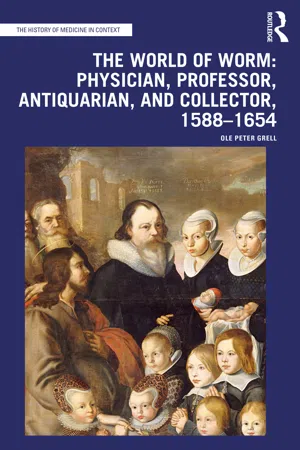
The World of Worm: Physician, Professor, Antiquarian, and Collector, 1588-1654
- 274 pages
- English
- ePUB (mobile friendly)
- Available on iOS & Android
eBook - ePub
The World of Worm: Physician, Professor, Antiquarian, and Collector, 1588-1654
1 The Physician
DOI: 10.4324/9781003290940-2
Worm’s interests and research constantly changed throughout his life. For a period he appeared to have prioritised natural philosophy, later his focus was on antiquarianism and history, and finally he became increasingly absorbed in collecting, creating his cabinet of curiosity and in particular in writing the book about his museum. Only one interest or role remained constant in his career: namely that of the physician. Worm practised medicine throughout most of his life. He never stopped looking after his patients be it through direct physical consultations or via letters, and with only two exceptions he remained in Copenhagen to look after them during major outbreaks of epidemic disease and plague. However, it is important to remember that most of Worm’s activities as a practising physician have left little or no evidence behind, consisting as they did of face to face encounters between physician and patient.
Even before he had obtained his medical degree Worm had started practising medicine. He had begun his medical studies in 1607 and already three years later, at the tender age of twenty-one and yet to obtain his MD, he started practising medicine during his two month stay in Paris, as his obituary put it ‘he regularly and with success practised medicine’. Later in the summer of 1610 Worm returned to Denmark most likely to his home in Aarhus. He visited the influential nobleman Holger Rosenkrantz, the Learned, on the latter’s estate Rosenholm in late June. In the beginning of September Worm arrived in Copenhagen where he matriculated at the university. He would appear to have spent the next eight to ten months in Copenhagen not only studying and building up relationships with ‘the leading professors at the Academy’, but also adding to his reputation by providing medical assistance to a wide clientele who encouraged him to settle in the capital.1
Worm, however, decided to continue his academic travels, undoubtedly realising his need for an MD. First he headed for Marburg and then to Basle where he obtained his MD in December 1611. He then travelled via the Netherlands to England where he arrived in late February or beginning of March 1612. The choice of England, at this time a fairly unusual destination on the peregrinatio academica, was most likely linked to the close royal connections between England and Denmark, with the English King James I married to the Danish King Christian IV’s sister, Anne of Denmark. Six years earlier Christian IV had undertaken a four week state visit to England which had seen contacts being established between English and Danish courtiers. One of them Jonas Charisius, who had married a daughter of the famous Paracelsian physician, Peter Severinus, the Dane, met Worm in London on 6th March 1612 and most likely facilitated the contact to the nobleman Robert Rich, Baron Rich who later in 1618 became Earl of Warwick. By the end of March Worm had become personal physician to Robert Rich whom he also assisted in the latter’s chemical and medical research. As always Worm sought the acquaintance of many of the leading local physicians, especially the two royal physicians Theodore de Mayerne and John Craig. Worm remained as personal physician to Robert Rich for nearly eighteen months eventually returning to Copenhagen in July 1613 to take up a professorship in pedagogy.2
Worm began establishing his medical practice in Copenhagen at the same time he took up his professorship.
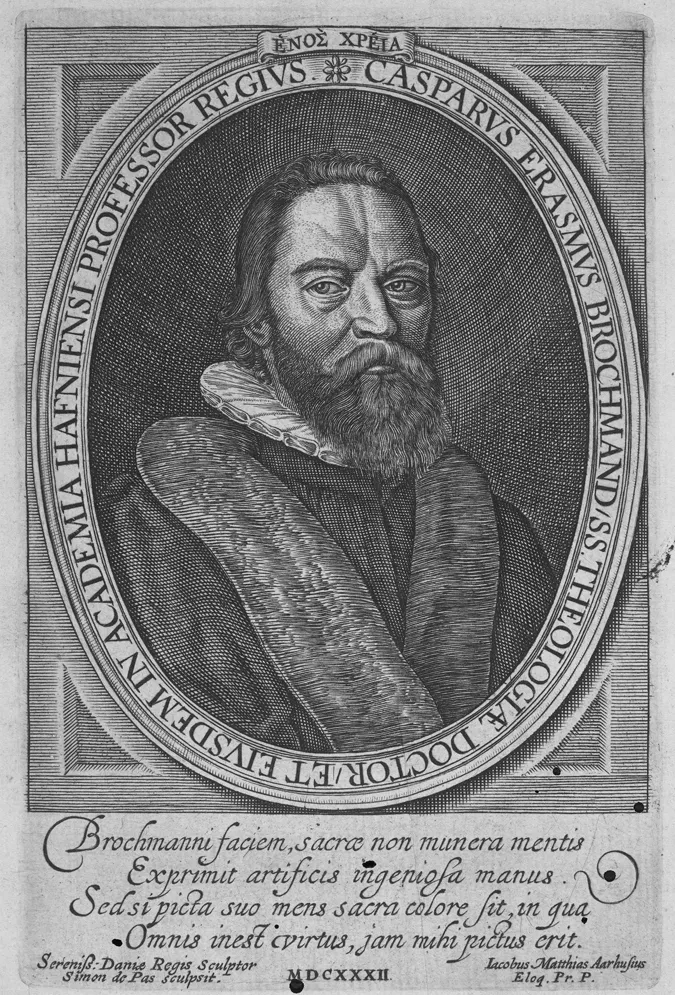
In a letter from August 1616 to his friend Anders Skytte, physician to Queen Sophie, Worm complained that his university teaching and his many patients prevented him from finding enough time for his own research.3 Despite the demands on his time Worm was satisfied with the success of his medical practice as he informed his old teacher Caspar Bauhin in Basle a few months later.4 Not surprisingly a number of his patients came from within the academic community, such as the professor of theology, Jesper Rasmussen Brochmand, who in 1617 had taken on the role of tutor to Christian, the elected-prince.
In this new role Brochmand had to spend much of his time away from his home in Copenhagen attending the prince at royal castles, such as at Kronborg and Frederiksborg. Over the three years Brochmand served as tutor to the prince Worm regularly supplied him with prescriptions and medical remedies.5 Jesper Brochmand’s absence from home, however, caused his wife considerable anxiety which Worm had to deal with as the family physician. Brochmand’s own health also concerned Worm and writing to Brochmand in May 1617 he offered detailed advice:

Your wife is seriously troubled about your health; thus I would appreciate if you wrote to her that you were feeling better after the blood-letting (which I hear you have agreed to) and at the same time informed her that you feel that your body is stronger than before. This would in particular cause her to feel relieved. And please make sure that you do not work too hard and keep late hours thereby neglecting your health. Much is achieved with moderation. Make sure that your stools keep step with your intake; do not let worries and misplaced late hours tax your mental capacity thereby leaving you with a disabled body. That way I think everything will turn out well.6
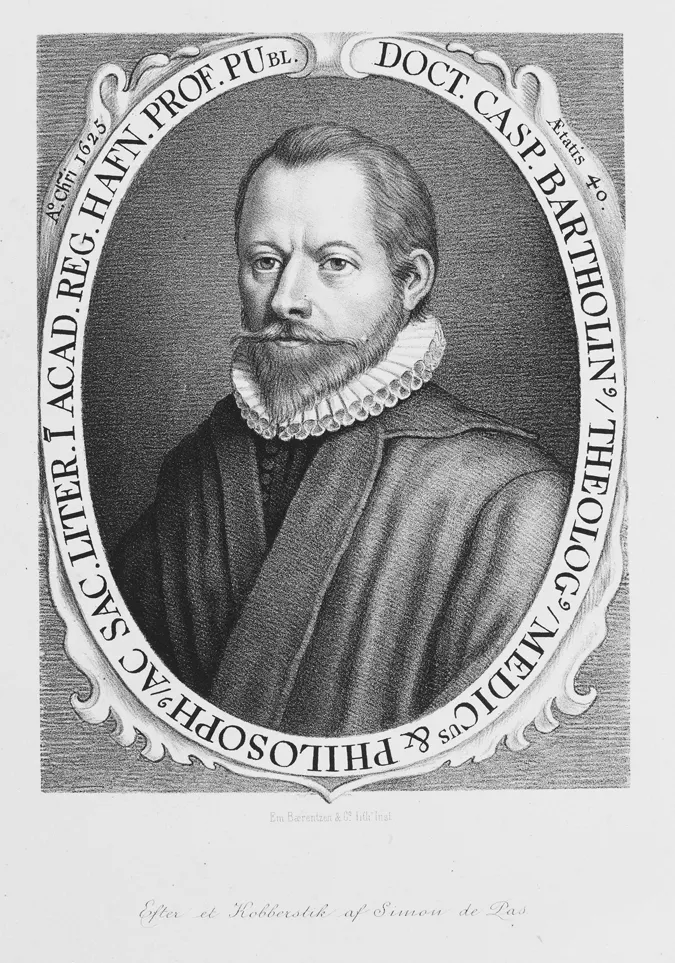
Ole Worm counted many members of the academic community among his patients, including family, such as his father-in-law professor Thomas Fincke, and his brother-in-law Caspar Bartholin. Worm had married Dorothea Fincke in November 1615 and thereby allied himself with the influential Fincke dynasty. In December 1617 Worm informed his brother-in-law Jacob Fincke, who was studying in Giessen, that his father Thomas had suffered from an ‘endemic fever’ over the last couple of months, but was now recovering well.7 In November 1623 Worm wrote to his student in Wittenberg, Hans Andersen Skovgaard informing him that Caspar Bartholin had recently been confined to bed with shooting pains in his limbs causing Worm considerable concern.
In another letter written later that month Worm indicated that Caspar Bartholin was slowly recovering while his rheumatism was abating and his ‘hectic heat’ had become less intense. Worm pointed out that even if Bartholin’s appetite had improved his stomach did not yet function properly, nor for that matter, did his limbs, adding, that he hoped God would help his brother-in-law to a full recovery. Caspar Bartholin sought relief at the spa in Carlsbad, but to little or no avail. Worm reported in February 1625 that he had returned from the spa having failed to recover properly, being repeatedly affected by ‘kidney pains’ which taxed his health. However, a couple of years later Worm was able to report that Caspar Bartholin had finally recovered and did no longer suffer from pains caused by kidney stones. The fact that it was plague which eventually killed Caspar Bartholin two years later would seem to confirm Worm’s diagnosis in 1627.8
Worm remained close to his nephews from the Fuiren family, both of whom became medical students, and he served the family as their physician. Worm appears to have been particularly concerned for Thomas, who was never in good health. He supplied him with a remedy against constipation without which Thomas claimed that his stomach would not function. Worm, however, remained concerned about Thomas’s digestion and warned him against using too many pills in a letter where he informed him that his mother and older sister had both recently suffered from a nasty fever, but were recovering.9
Later when studying in Padua the Fuiren brethren regularly sought medical advice from their uncle in Copenhagen. Henrik asked Worm’s advice about his brother in June 1641. He was concerned that his coughs regularly produced foaming blood which he thought might result in consumption. Despite having taken the medical remedies on the advice of the Paduan professor of medicine, Benedictus Sylvaticus during the spring which were not only intended for his chest, but which should also have served to ease his constipation and improve his urination, none of it had helped. Consequently, Worm advised his mother to ask him to return home as soon as possible, thinking that the thicker, cooler air and the Rostock beer might help him.10
Worm showed similar concern for his nephew Thomas Bartholin for whom he stood in loco parentis. He paid close attention to Thomas’s health, which he considered delicate, while the latter studied in Leiden. Writing to Thomas in June 1638 Worm advised Thomas not to take too many medical remedies which might break down his natural heat and possibly his strength too. Thomas Bartholin was suffering from constipation and Worm advised him to eat a handful of large beans together with soup first thing in the morning; if that did not work he told his nephew to buy some pills he was familiar with which would serve to assist Nature in producing faeces. Worm recommended Thomas to try to develop a daily routine, making sure that he went to the toilet morning and evening. Such a regime would in Worm’s opinion help Nature to cure him.11 In May 1640 Worm expressed serious concern for Thomas’s frailty. He warned Thomas not to weaken his already feeble body further through misplaced wakeful nights and research thereby wasting his health and ‘depriving his fatherland of his glorious talents’. He impressed on Thomas to recollect the example of his late father, who in his youth exhausted himself with such strenuous studies, that when the time came, when he might best have been of use to his fatherland, he was overwhelmed with a host of emerging illnesses, achieving only the lesser part of all that he wanted to do.12
Worm also appears to have had the former Tycho Brahe pupil and professor of theology Cort Aslaksen among his patients. He certainly attended Aslaksen in the latter’s last illness. Reporting to his friend, the physician Niels Christensen Foss in Lund, Worm described how, as he put it,
the convulsion which had caused a paralysis in his [ Aslaksen] right leg developed into gangrene and caries towards the end which the surgeons were unable to prevent or neutralise despite all their efforts. His waning strength and other things, which I shall tell you on another occasion, did not make an amputation advisable.13
Another university professor who relied on Worm for medical advice was the professor of metaphysics Jens Dinesen Jersin. In 1624, while Dinesen served as tutor to King Christian IV’s illegitimate sons Christian Ulrik and Hans Ulrik Gyldenløve at the Academy in Sorø, Worm prescribed Dinesen pills which were particularly beneficial for the head and pills for his wife’s complaints about her uterus which Worm had personally manufactured chemically.14
Thomas Wegner, who was made Bishop of Stavanger in Norway in 1627, might well have been a patient of Ole Worm from 1618 when he became vicar at St. Nicolai Church in Copenhagen. It is evident from Worm’s letter of May 1628 that they had been friends for some time and that Worm had previously supplied Wegner with drugs. Offering Wegner some advice on how to deal with pills which had become stuck together Worm promised to deal with any concern Wegner might have about his health or drugs he needed. Worm also took the opportunity to inform Wegner that Copenhagen had recently been struck by a storm or tornado which had damaged many of the buildings in the capital and shattered St. Nicolai Church where Wegner had been the vicar for nearly a decade. This was according to Worm all grim proofs of the anger of the Almighty.15
Worm regularly supplied Wegner with medical remedies and Wegner reciprocated by sending fish and oysters to Worm after his promotion to the bishopric in Norway. In 1635 Worm had been told by his nephew, Henrik Fuiren, that Wegner suffered from colic. Worm forwarded some purging electuarium aperiens and recommended an enema, but warned that this required materials which might not be available locally to Wegner; so he suggested oil and a hot compress with laurel leaves as an alternative.16 When Wegner’s son Cort returned to Copenhagen in June 1638 to resume his studies after the plague epidemic of 1637 Worm took the opportunity to forward medical remedies and medical advice to his father. It is interesting that Wegner continued to rely on Worm as his physician after his promotion to the see of Stavanger. Obviously physicians were thin on the ground in Norway while Thomas Wegner retained great confidence in the advice and treatment by Worm even if it had to be done from a distance and via correspondence.
In February 1648 Worm filled a box he was returning to his friend the royal historiographer and professor of history at the Academy in Sorø, Steffen Hansen Stephanius, with cough lozenges against the cough Stephanius normally suffered from that time of the year. Worm was evidently both his considerate friend and physician.17
Worm was appreciated by many of his patients who often thanked him for his assistance. In some cases, as in that of the young Margrethe Hansdatter, he received thank you letters and presents. Worm was happy to hear about Margrethe’s improved health and showed himself a firm believer ...
Table of contents
- Cover
- Half Title
- Title Page
- Copyright Page
- Table of Contents
- List of figures
- Acknowledgements
- Introduction
- 1 The Physician
- 2 The Professor
- 3 The Antiquarian
- 4 The Collector
- Index
Trusted by 375,005 students
Access to over 1.5 million titles for a fair monthly price.
Study more efficiently using our study tools.
Frequently asked questions
Yes, you can cancel anytime from the Subscription tab in your account settings on the Perlego website. Your subscription will stay active until the end of your current billing period. Learn how to cancel your subscription
No, books cannot be downloaded as external files, such as PDFs, for use outside of Perlego. However, you can download books within the Perlego app for offline reading on mobile or tablet. Learn how to download books offline
Perlego offers two plans: Essential and Complete
- Essential is ideal for learners and professionals who enjoy exploring a wide range of subjects. Access the Essential Library with 800,000+ trusted titles and best-sellers across business, personal growth, and the humanities. Includes unlimited reading time and Standard Read Aloud voice.
- Complete: Perfect for advanced learners and researchers needing full, unrestricted access. Unlock 1.5M+ books across hundreds of subjects, including academic and specialized titles. The Complete Plan also includes advanced features like Premium Read Aloud and Research Assistant.
We are an online textbook subscription service, where you can get access to an entire online library for less than the price of a single book per month. With over 1.5 million books across 990+ topics, we’ve got you covered! Learn about our mission
Look out for the read-aloud symbol on your next book to see if you can listen to it. The read-aloud tool reads text aloud for you, highlighting the text as it is being read. You can pause it, speed it up and slow it down. Learn more about Read Aloud
Yes! You can use the Perlego app on both iOS and Android devices to read anytime, anywhere — even offline. Perfect for commutes or when you’re on the go.
Please note we cannot support devices running on iOS 13 and Android 7 or earlier. Learn more about using the app
Please note we cannot support devices running on iOS 13 and Android 7 or earlier. Learn more about using the app
Yes, you can access The World of Worm: Physician, Professor, Antiquarian, and Collector, 1588-1654 by Ole Peter Grell in PDF and/or ePUB format, as well as other popular books in History & World History. We have over 1.5 million books available in our catalogue for you to explore.