Smart Electrical Grid System
eBook - ePub

Smart Electrical Grid System

Design Principle, Modernization, and Techniques

  1. 278 pages
  2. English
  3. ePUB (mobile friendly)
  4. Available on iOS & Android
eBook - ePub

Smart Electrical Grid System

Design Principle, Modernization, and Techniques

About this book

Smart technologies, such as artificial intelligence and machine learning, play a vital role in modeling, analysis, performance prediction, effective control, and utilization of smart energy systems. This book presents novel concepts in the development of smart cities and smart grids as well as discusses the technologies involved in producing efficient and economically feasible energy technologies around the world.

It comprehensively covers important topics, including optimization methods for smart grids, power converters, smart meters, load frequency control, automatic generation control, and power electronics for smart grids.

This book focuses mainly on three areas of electrical engineering: control systems, power electronics, and renewable resources, including artificial intelligence for the development of smart electrical grids.

Key Features

• Clarifies how the smart grid plays an important role in modern smart technologies

• Introduces the basic concepts of modernization of smart grid with the assumption of basic knowledge of mathematics and power systems

• Describes the structure of technologies based on Internet of Things (IoT), which acts like a bridge to cover the gap between the physical and virtual worlds required for the realization of the smart grid

• Includes practical examples of the smart grid and energy saving

• Illustrates the integration of renewable energy sources with worked examples

• Enables readers to engage with the immediate development of power systems by using smart approaches for future smart grids
Frequently asked questions

Yes, you can cancel anytime from the Subscription tab in your account settings on the Perlego website. Your subscription will stay active until the end of your current billing period. Learn how to cancel your subscription.
No, books cannot be downloaded as external files, such as PDFs, for use outside of Perlego. However, you can download books within the Perlego app for offline reading on mobile or tablet. Learn more here.
Perlego offers two plans: Essential and Complete
  • Essential is ideal for learners and professionals who enjoy exploring a wide range of subjects. Access the Essential Library with 800,000+ trusted titles and best-sellers across business, personal growth, and the humanities. Includes unlimited reading time and Standard Read Aloud voice.
  • Complete: Perfect for advanced learners and researchers needing full, unrestricted access. Unlock 1.4M+ books across hundreds of subjects, including academic and specialized titles. The Complete Plan also includes advanced features like Premium Read Aloud and Research Assistant.
Both plans are available with monthly, semester, or annual billing cycles.
We are an online textbook subscription service, where you can get access to an entire online library for less than the price of a single book per month. With over 1 million books across 1000+ topics, we’ve got you covered! Learn more here.
Look out for the read-aloud symbol on your next book to see if you can listen to it. The read-aloud tool reads text aloud for you, highlighting the text as it is being read. You can pause it, speed it up and slow it down. Learn more here.
Yes! You can use the Perlego app on both iOS or Android devices to read anytime, anywhere — even offline. Perfect for commutes or when you’re on the go.
Please note we cannot support devices running on iOS 13 and Android 7 or earlier. Learn more about using the app.
Yes, you can access Smart Electrical Grid System by Krishan Arora, Suman Lata Tripathi, Sanjeevikumar Padmanaban, Krishan Arora,Suman Lata Tripathi,Sanjeevikumar Padmanaban in PDF and/or ePUB format, as well as other popular books in Technology & Engineering & Electrical Engineering & Telecommunications. We have over one million books available in our catalogue for you to explore.

1 Internet of Things-Based Modernization of Smart Electrical Grid

Krishan Arora
Lovely Professional University
DOI: 10.1201/9781003242277-1

CONTENTS

  1. 1.1 Introduction
  2. 1.2 Pros of Smart Electrical Grid (SEG)
  3. 1.3 Existing System
  4. 1.4 Research Gaps
  5. 1.5 Proposed System
  6. 1.6 Methodology
    1. 1.6.1 Framework
    2. 1.6.2 Component Requirement Analysis
  7. 1.7 Implementation
  8. 1.8 Functional Requirements
  9. 1.9 Results and Discussion
  10. 1.10 Conclusions
  11. References

1.1 Introduction

Automation is evolving in every field around us. As a person living in the fastest growing age of technology development, we have moved from room-sized computers to light and portable laptops and from insecure databases to highly secure web browsers. The same is the case for electrical grids. There are several technological developments in this field of automation, and one of them is automation of grid or “smart electrical grid” (SEG). By connecting individual devices and various appliances to a centralized hub and controlling each and every thing through that network is quite fascinating. An SEG allows you to experience high-tech functionality and convenience that wasn’t possible in the past.
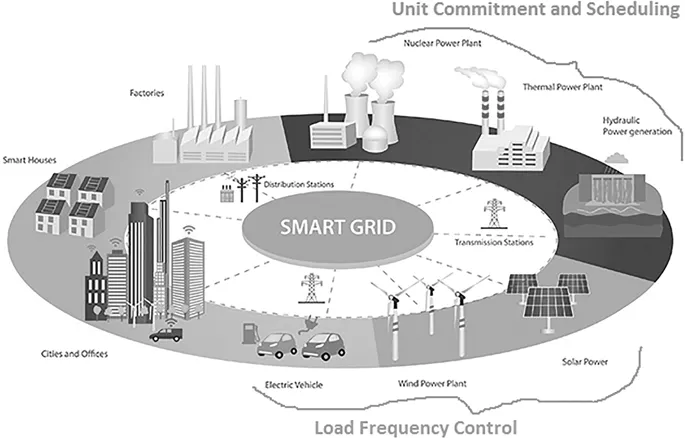
IoT has numerous applications in different fields, such as e-health, smart home, smart cities, smart education system, smart transportation, smart agriculture, and smart factories. Above all, SEG has major attraction in academia and industry due to its direct relation with the real-time events [1,2 and 3]. Figure 1.1 depicts the various applications of the smart grid [4,5].
FIGURE 1.1 Modern smart grid system.
SEGs can be classified into two broad categories based on controlling methodology: (i) native controlled and (ii) remotely controlled [6]. The former system depicts that users can control grid appliances by using controllers via wireless technologies (e.g., Zigbee, GSM, and Bluetooth) or stationary communication methods, whereas in the case of latter, users can control the electrical grid with Internet connections through mobile phones. Numerous flaws occur while setting up the controlling methodology; thus, the SEG should provide an interface for observing and controlling the appliances [6].

1.2 Pros of Smart Electrical Grid (SEG)

Nowadays, for a fast and reliable connection, wireless communication systems such as Wi-Fi are more promising candidates with ample advantages over wired connections:
  1. Cost-Effective: The installation cost decreases due to the non-requirement of cables in contrast to the wired system where the cable, its material, and laying technology along with the need for experienced professionals add up to the cost.
  2. Easy Deployment, Installation, and Coverage: Remote devices or appliances can be easily accessed wirelessly along with easy deployment and installation.
  3. System Extension and Scalability: Transportation of a native structure is predominantly priceless when, due to novel or distorted prerequisites, augmentation of the scheme is essential. More than wired establishments, in which cabling extension is expensive and time-consuming [7], this makes remote systems an original essence.
  4. Amalgamation of Mobile Devices: With the advancement of the communication technology, wireless platform gives the automation an easier and possible solution, where devices or appliances can be remotely controlled or observed without any physical connections.
  5. Aesthetic Benefits: This not only covers a large area, but also beautifully manages the architecture and gives immense benefits to historical buildings and tourist spots.

1.3 Existing System

Currently, modern electrical grids use a lot of techniques. Different modes of wireless communications are used to transfer data and signals between their various components, such as Bluetooth, Zigbee, Wi-Fi, and Global System for Mobile Communications (GSM) [8]. Bluetooth (HC-05) acts as a slave device and is used for communication between Arduino (Mega) IDE and a smartphone. The operating voltage is 3.6–6V. The Bluetooth Board HC-06 has 6 pins such as State, RXD, TXD, GND, VCC, and EN. Internally, the input/output port of an Arduino board (microcontroller) is programmed using C language/Python and the connection is made to home appliances through Bluetooth BT cell [9].
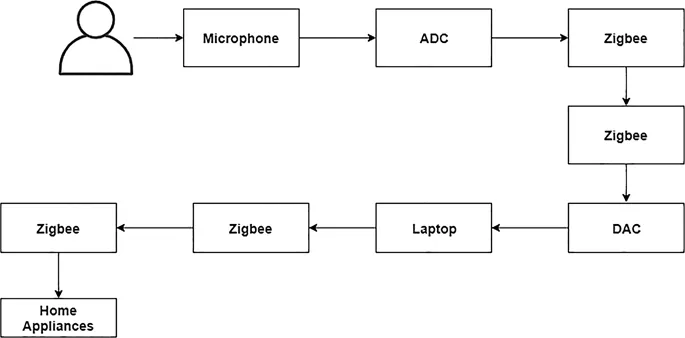
Zigbee is under radio frequency (RF) communication and uses IEEE 802.15.4 standard. The reflection of the Zigbee standard illustrates the packet routing in a network where a large number of nodes exist and the transmission of data occurs in a zigzag pattern as shown in Figure 1.2. Zigbee supports application in all fields. The main component in Zigbee is its coordinator (ZC), which maintains the network and routing table. This standard has three frequency bands, and the prominent band of use is 2.5 GHz with data rates of 250 and 40 kbps. This method has numerous advantages as per the literature, such as low cost, interoperability, low signal-to-noise ratio, low power consumption, implementation by using any microcontroller, easy deployment of innovations, high data security, and requirement of low bandwidth for minor projects [10] (Table 1.1).
FIGURE 1.2 Zigbee-based automation system.
TABLE 1.1Comparison between Different Methodologies
Methodologies Communication Interface Controller User Interface No. of Devices Cost Speed Range Energy Savings
Bluetooth Bluetooth and AT instructions Arduino Uno Android Unlimited Moderate Low 10 m No
GSM SMS messages Arduino ADK Mobile phone Limited Low Very low No
Zigbee Zigbee with instructions Zigbee controller (ZC) Smartphone Unlimited High Low 10 m Yes
The proposed wireless design Wi-Fi (NODEMCU) Arduino SDK Smartphone Unlimited Low High Unlimited Yes
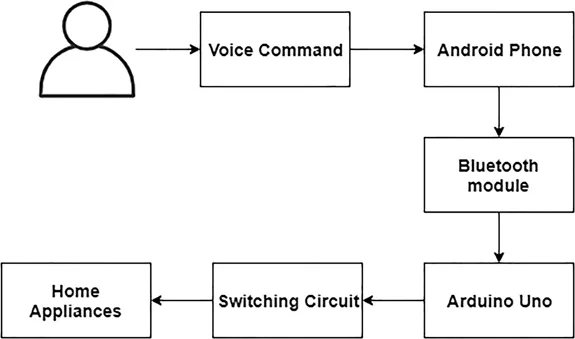
As per the literature, voice control method is used for SEG as shown in Figure 1.3 with the help of Arduino and various wireless technologies such as GSM, Bluetooth, Wi-Fi and NFC. In the reported literature [11,12 and 13], the experiment is conducted on five groups with different voice commands to access fan, light, and utility, and the safety check was performed at a baud rate of 115,200 bps to make an SEG [14]. In addition to smart grid automation, the advantage of the feature along with voice is that the motion of the objects or appliances can be recognized [15]. The grid automation is controlled through voice by using Arduino as a controller, Bluetooth HC-05 module as a wireless communicator, and HC-SR04 as an ultrasonic sensor to detect the motion as shown in Figure 1.3.
FIGURE 1.3 Voice recognition.

1.4 Research Gaps

Technology is advancing in every field, and that’s how the concept of grid automation emerged. Technology is all about making each and every task easier. There are different technologies that are used to automate electrical grids which are discussed. The development and implementation has many problems as follows:
  1. Dependency on Range: The SEG connects all the devices of the grid to the mobile app through...

Table of contents

  1. Cover
  2. Half Title
  3. Series Page
  4. Title Page
  5. Copyright Page
  6. Table of Contents
  7. Preface
  8. Editors
  9. Contributors
  10. Chapter 1 Internet of Things Based Modernization of Smart Electrical Grid
  11. Chapter 2 Role of Non-Conventional Energy Resources in Today’s Environment
  12. Chapter 3 Flexible Load and Renewable Energy Integration with Impact on Voltage Profile of a Large Size Grid
  13. Chapter 4 Energy Storing Devices for Sustainable Environment
  14. Chapter 5 Clean and Green Energy Fundamentals
  15. Chapter 6 Evaluation of Sustainable Window for Energy Mitigation in an Electrical Grid Building
  16. Chapter 7 Filter Bank Multicarrier for Smart Grid Systems
  17. Chapter 8 Recent Trends in Economic Scheduling and Emission Dispatch of Distributed Generators in Microgrids
  18. Chapter 9 Forecasting of Tensile–Shear Strength of JSC 590RN Low-Carbon Steel Spot Welds Using Taguchi Technique Used in Electrical Grids
  19. Chapter 10 Experimental Analysis of Surface Integrity of Machined Stainless Steel (SS-304) by Taguchi Method Coupled with GRA Used in Electrical Grids
  20. Chapter 11 Energy Storage Devices Based on 2D Phosphorene as an Electrode Material
  21. Chapter 12 Application and Performance Analysis of Various Nature-Inspired Algorithm in AGC Synthesis
  22. Chapter 13 Unified Smith Predictor for MIMO Systems with Multiple Time Delays
  23. Chapter 14 Renewable Energy Sources and Small Hydro Power Scenario in Mountainous Regions of Himalayas
  24. Chapter 15 A Comprehensive Review on Energy Storage Systems
  25. Chapter 16 Cyber and Theft Attacks on Smart Electric Metering Systems: An Overview of Defenses
  26. Index