Assuming an international perspective, Chinese Tourist Outbound Behaviour presents an insightful exploration of the evolution of China's tourism market, explores Chinese tourists' behaviour, and considers how the country's tourism landscape will expand in the future.
Featuring 16 chapters compiled and written by industry experts representing 11 countries, this collection offers a vivid profile of Chinese tourists and the characteristics distinguishing them from other market segments. This book coincides with the growing interest in Chinese tourism and tourist behaviour as the top market in the world in terms of tourism spending and arrival numbers, presenting an overview of Chinese tourist segments and travel-related concerns to paint a clear picture of the market's status. Chapters address the future of Chinese tourism, providing industry stakeholders an up-to-date view on this valuable market along with suggestions to best harness the market's power.
Providing an up-to-date exploration of numerous contemporary issues, this book will be valuable to a wide audience, including advanced students in tourism, hospitality and leisure and recreation studies and stakeholders, authorities, establishments and employees within the tourism industry. This book offers readers greater knowledge about the past, present and future of the Chinese outbound tourism market.
1 Chinese outbound tourist behaviour An introduction
Jun Wen and Metin Kozak
DOI: 10.4324/9781003121329-1
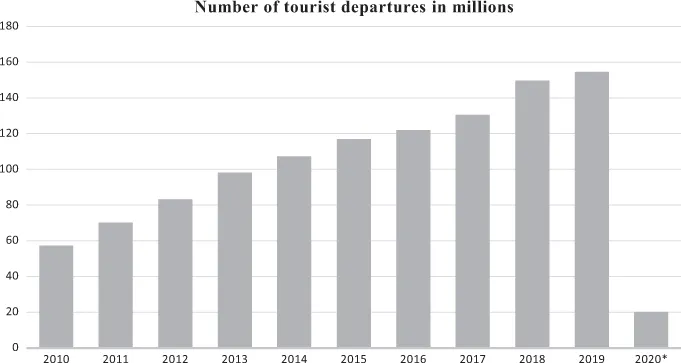
Tourism’s popularity as a research area is growing (Zhu et al., 2021a, 2021b). As an example, China has begun to attract increasing attention due to being one of the world’s rapidly expanding source markets. Chinese outbound tourism is hence a topic of interest among industry stakeholders. These tourists accounted for nearly 155 million visitors in 2019—almost triple the number in 2010 (Textor, 2021; see Figure 1.1). Unfortunately, but not unexpectedly, COVID-19 caused this figure to decline to roughly 20.2 million in 2020. However, once the pandemic came under a degree of control, China’s Labour Day holiday (1 May to 5 May 2020) implied some tourism recovery. Domestic visitors reached 115 million during the celebration, twice that of the Qingming Festival (otherwise known as Ancestors’ Day or Chinese Memorial Day, an early April celebration). Tourism revenue was also five times higher—totalling 47.56 billion yuan—than during the Qingming Festival (Ministry of Culture and Tourism of China, 2020). About 90% of hotel enterprises in China had resumed operations by that time (China Hospitality Association, 2020). In fact, occupancy rates during the Labour Day holiday jumped more than twofold over the Qingming Festival (Tang, 2020). The Chinese thus appear to be willing to travel even though outbound tourism has yet to return to pre-pandemic levels; for instance, Australia has not begun to welcome international tourists as of this writing.
Figure1.1 Number of outbound tourists from China between 2010 and 2019 with an estimate for 2020 (Textor, 2021)
In past decades, China’s outbound tourism market has risen faster than expected. The World Tourism Organization projected in 2004 that outbound Chinese tourists would total 100 million by 2020 (World Tourism Organization [WTO], 2004). That forecast was surpassed six years earlier than assumed—107.28 million Chinese outbound tourists travelled in 2014. According to China’s Ministry of Culture and Tourism, Chinese citizens made 169.21 million outbound trips in 2019 alone (National Bureau of Statistics of China, 2020). Despite these promising statistics, pandemic-related travel restrictions have temporarily crippled outbound tourist flows as mentioned: only 20.23 million Chinese tourists were anticipated to travel overseas in 2020 (Figure 1.1). Yet, outbound travel among the Chinese is likely to pick up in the future—Ctrip and China Tourism Academy (2018) indicated that only 10% of China’s population owns a passport and less than 10% are currently travelling abroad. These relatively small proportions reinforce the potential for ongoing growth in China’s outbound tourism market post-COVID-19. Factors such as high travel demand and other trip purposes like overseas education should continue to propel this market.
Historical overview of the development of China’s outbound tourism market
In order to have an overview of Chinese outbound tourist behaviour changes overtime since studies on Chinese outbound tourism began in the mid-1990s (Johnson et al., 2020), conducting a historical overview of the development of China’s outbound tourism market is essential to lay the foundation (i.e., Arlt, 2016; Arlt & Burns, 2013; Bi et al., 2016; Lim, et al., 2020).
China’s outbound tourism industry has undergone three developmental phases since 1983 (Lim et al., 2020). Prior to that year, outbound travel from China was strictly limited to business, education, or other official purposes (Lim et al., 2020). Leisure travel was typically considered wasteful (Arlt, 2016), causing international tourism to be exceedingly rare (Mak, 2013). The initial phase of modern outbound tourism in China occurred between 1983 and 1997. Travel during this period predominantly involved tourists who were visiting friends and relatives (VFR). These trips, which tourists first took to Hong Kong and Macao prior to being allowed to visit Southeast Asia, were mostly funded by relatives. VFR travel particularly enlarged China’s tourism market to Hong Kong. This expansion was mostly due to the availability of package tours (e.g., for sightseeing) and two-way travel permits (Qu & Lam, 1997). Outbound tourism in mainland China then grew in 1991 following bilateral tourism agreements that enabled leisure tourists to travel on group tours coordinated by the Chinese Travel Service (Lim & Wang, 2008). Eligible countries included Malaysia, Singapore, and Thailand. Chinese residents thus had more opportunities to encounter life outside their own borders. Yet, of the 1.186 billion citizens in China in 1993, only 0.31% had travelled abroad (Arlt, 2016), underscoring this market’s early growth potential.
The second phase of Chinese outbound tourism development spanned from 1997 to 2005. Throughout this period, the country’s Approved Destination Status (ADS) scheme oversaw Chinese outbound tourism via bilateral travel agreements. China’s Public Security Bureau and the China National Tourism Administration published “The temporary rules on Mainland Chinese outbound travel in self-financed mode” in 1997, confirming the establishment of outbound travel (Travel and Tourism Intelligence, 2003). ADS agreements were first signed with Australia and New Zealand in 1999 (Arlt, 2016; Lim & Wang, 2008). Additional agreements followed, including one with the European Union in 2004. Policies regarding travel to Hong Kong, Macau, and Taiwan were relaxed to foster tourism amid stronger cross-strait relations (Arlt, 2010). Outbound tourism in China ballooned from 3.7 million visitors in 1993 to 29 million in 2004 (Arlt, 2016). Other regions were inspired to try to capture these tourists as a result.
The third phase of Chinese outbound tourism began in 2005 and still applies today (Lim et al., 2020). The Chinese state has gradually reasserted regulatory control over outbound tourism through policies that accommodate the many Chinese tourists travelling overseas. These regulations simultaneously guarantee the government’s power in protecting key policy objectives (Lim et al., 2020). The Chinese government at first promoted the development of its inbound travel market over domestic and outbound tourism (Wei & Wei, 2005). Yet, outbound tourism soon developed quickly under the guidance of President Xi Jinping, the first Chinese leader to offer such support since China’s establishment in 1949. The Chinese government named tourism a “strategic pillar industry” in 2009 upon introducing detailed policies on the sustainability of outbound tourism.
Since then, outbound tourism has been one way that the country highlights its global standing (Tse, 2013). Mega events such as the 2008 Beijing Olympic Games and the Expo 2010 promoted China as a major tourist source market. The year 2012 represented another milestone in this market’s development: China overtook the United States to become the largest outbound tourism source market in the world as measured by total departures and travel expenditure (Arlt, 2016). Chinese citizens spent $130 billion USD across roughly 150 million trips in 2018 (Tourism Research Institute, 2020). The market’s prospects remain bright given that no more than 10% of the Chinese population currently hold passports. At present, Chinese outbound tourism can be segmented into various groups. These classifications naturally influence destination-related marketing and promotion as discussed below.
An overview of Chinese outbound tourism segmentation
Market segmentation can reveal travellers’ features and help stakeholders devise tailored marketing approaches (Bloom, 2004). Segmentation has uncovered new and emerging markets in multiple destinations (Li et al., 2013). Several literature reviews to date have analysed the large body of research on Chinese outbound tourism (e.g., Law et al., 2016; Lojo et al., 2019); however, many studies have framed Chinese outbound tourists as a homogenous group. As a notable exception, Li et al. (2017) argued that China’s long-haul outbound tourism market varies in terms of individuals’ ages, motivations, preferences, travel experiences, travel arrangements, and so on. Quer and Peng (2021) delved into this assertion through a systematic review of studies on Chinese outbound tourism segmentation. They referred to 171 articles published between 1995 and 2020, focusing on specific segments of Mainland Chinese outbound tourists as outlined here.
The first identified Chinese outbound tourism segment consists of shoppers (Quer & Peng, 2021). Shopping is a major travel motivation among Chinese outbound tourists (e.g., Jin et al., 2020, 2021; Meng et al., 2019; Xu & McGehee, 2012), especially given Chinese citizens’ growing consumption power. Scholars have started to pay particular attention to Chinese outbound tourists’ luxury consumption, such as Chinese cigar tourists who travel to Cuba and other cigar-themed destinations (e.g., the Dominican Republic), to purchase authentic hand-rolled Cuban cigars and attend cigar-themed events such as cigar festivals (e.g., Ying et al., 2018). Quer and Peng (2021) also discussed the relationship between Chinese outbound tourists’ shopping behaviour and cultural values; travellers’ personal needs and shopping satisfaction were found to be influenced by product attitudes and service quality. Favourable shopping destinations for the Chinese include Hong Kong (Hung et al., 2020), Macao (Chang et al., 2017), Taiwan (Guo & Jiang, 2021), and North Korea (Li, Li et al., 2021). Quer and Peng (2021) further pointed out that Chinese outbound tourists’ shopping satisfaction positively affects their travel-related attitudes as evidenced by destination loyalty and behavioural intentions.
Another Chinese outbound tourism segment consists of students, including in Australia (e.g., Li, Liu et al., 2021), the United States (e.g., Li, Lin, et al., 2021), New Zealand (e.g., Yang et al., 2021), and the United Kingdom (e.g., Song, 2021). With the emphasis on academic achievement in Chinese society, it comes as no surprise that some individuals opt to study abroad. Many choose to do so in pursuit of self-development (relational and individual), cross-cultural learning, high-quality education, language acquisition, and better job opportunities (Quer & Peng, 2021). At the same time, Chinese students also engage in leisure activities to balance their studies during daily life abroad. These students play an especially important role in overseas educational ...
Table of contents
Cover
Half Title
Title Page
Copyright Page
Table of Contents
List of figures
List of tables
List of contributors
Foreword
1 Chinese outbound tourist behaviour: an introduction
Part I Historical development of Chinese outbound tourism
Part II Travel experiences of Chinese outbound tourists
Part III Chinese outbound tourists’ shopping and health
Part IV Revisiting Chinese outbound tourism
Index
Trusted by 375,005 students
Access to over 1.5 million titles for a fair monthly price.
Study more efficiently using our study tools.
Frequently asked questions
Yes, you can cancel anytime from the Subscription tab in your account settings on the Perlego website. Your subscription will stay active until the end of your current billing period. Learn how to cancel your subscription
No, books cannot be downloaded as external files, such as PDFs, for use outside of Perlego. However, you can download books within the Perlego app for offline reading on mobile or tablet. Learn how to download books offline
Perlego offers two plans: Essential and Complete
Essential is ideal for learners and professionals who enjoy exploring a wide range of subjects. Access the Essential Library with 800,000+ trusted titles and best-sellers across business, personal growth, and the humanities. Includes unlimited reading time and Standard Read Aloud voice.
Complete: Perfect for advanced learners and researchers needing full, unrestricted access. Unlock 1.5M+ books across hundreds of subjects, including academic and specialized titles. The Complete Plan also includes advanced features like Premium Read Aloud and Research Assistant.
Both plans are available with monthly, semester, or annual billing cycles.
We are an online textbook subscription service, where you can get access to an entire online library for less than the price of a single book per month. With over 1.5 million books across 990+ topics, we’ve got you covered! Learn about our mission
Look out for the read-aloud symbol on your next book to see if you can listen to it. The read-aloud tool reads text aloud for you, highlighting the text as it is being read. You can pause it, speed it up and slow it down. Learn more about Read Aloud
Yes! You can use the Perlego app on both iOS and Android devices to read anytime, anywhere — even offline. Perfect for commutes or when you’re on the go. Please note we cannot support devices running on iOS 13 and Android 7 or earlier. Learn more about using the app
Yes, you can access Chinese Outbound Tourist Behaviour by Jun Wen, Metin Kozak, Jun Wen,Metin Kozak in PDF and/or ePUB format, as well as other popular books in Business & Hospitality, Travel & Tourism Industry. We have over 1.5 million books available in our catalogue for you to explore.