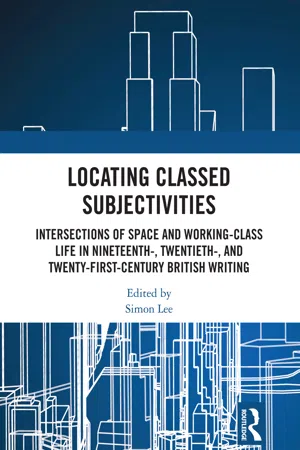
Locating Classed Subjectivities explores representations of social class in British fiction through the lens of spatial theory and analysis. By analyzing a range of class-conscious texts from the nineteenth-, twentieth-, and twenty-first centuries, the collection provides an overview of the way British writers mobilized spatial aesthetics as a means to comment on the intricacies of social class. In doing so, the collection delineates aesthetic strategies of representation in British writing, tracing the development of literary forms while considering how authors mobilized innovative spatial metaphors to better express contingent social and economic realities. Ranging in coverage from early-nineteenth-century narratives of disease to contemporary writing on the working-class millennial, Locating Classed Subjectivities offers new perspectives on literary techniques and political intentions, exploring the way class is parsed and critiqued through British writing across three centuries. As such, the project responds to Nigel Thrift and Peter Williams's claim that literary and cultural production serves as a particularly rich yet unexamined access point by which to comprehend the way space and social class intersect.
eBook - ePub
Locating Classed Subjectivities
Intersections of Space and Working-Class Life in Nineteenth-, Twentieth-, and Twenty-First-Century British Writing
- 240 pages
- English
- ePUB (mobile friendly)
- Available on iOS & Android
eBook - ePub
Locating Classed Subjectivities
Intersections of Space and Working-Class Life in Nineteenth-, Twentieth-, and Twenty-First-Century British Writing
About this book
Information
1 Fevered Anxieties Public Health, Urban Infrastructure, and Infectious Classes in Austen, Edgeworth, and Scott
DOI: 10.4324/9781003119425-2
In Discipline and Punish, Michel Foucault lays out two distinctly spatial “ways of exercising power” in the wake of illness: the leper “gave rise to rituals of exclusion, which to a certain extent provided the model for and general form of the great Confinement,” while the seventeenth-century plague produced “the utopia of the perfectly governed city,” a city “traversed throughout with hierarchy, surveillance, observation, writing” (1995, 198). Over the course of the eighteenth century and into the early years of the nineteenth century, Foucault traces the way in which these two projects merge. This occurs primarily through “an intensification and a ramification of power” felt and seen in the development of modern urban infrastructure ( 198). The primary spaces Foucault notes are “the psychiatric asylum, the penitentiary, the reformatory, the approved school and … the hospital” ( 199). Each of these spaces functioned in order to extend the logic of exclusion to “beggars, vagabonds, madmen and the disorderly,” while also instituting “the technique of power proper to disciplinary partitioning” more broadly throughout the city ( 199). According to Mary Poovey, this process of cultural formation depended upon an ambiguity that allowed society in the long eighteenth century to “treat one segment of the population as a special problem at the same time that they could gesture toward the mutual interests that (theoretically) united all parts of the social whole” (8). This ambiguity enables and enacts the Foucauldian premise of exclusion and segregation so that the offending segment of society can be identified as a special problem “needing both discipline and care” in order to be reintegrated into the broader social whole.
Foucault’s turn to prisons, asylums, and hospitals, as well as Poovey’s focus on workhouses and factories, reveals the degree to which this system of integration and surveillance spread throughout the nineteenth-century city. To borrow from Pamela Gilbert, the surveillance and control of “the city’s and citydwellers’ bodies” are essential to the experience of modernity (2004, 110). Urban infrastructure, then, became key not only to the surveillance that allowed the “perfectly governed city” to identify those segments that are not perfectly governed but also to provide the spaces of exclusion necessary to reinstating the perfect governmentality.1 The development of urban infrastructure in the eighteenth and nineteenth centuries reveals a class-based anxiety that reflects and draws upon a health-based anxiety amplified by geographic demarcation. By attending to the representation of urban infrastructure and its intersection with public health in novels of the early nineteenth century, this chapter argues that the metaphors of contagion and sight reveal a biopolitics that reflect an anxiety that seeks to exclude and segregate those impoverished and contagious parts of society that might infect the wider public. Novels of the early nineteenth century reveal the metropolitan developments that seek to contain the threat of class and health contamination. Jane Austen’s Sense and Sensibility (1811), Maria Edgeworth’s The Absentee (1812), and Walter Scott’s The Heart of Midlothian (1818), all employ urban infrastructure as a way of both revealing and excluding the threat posed by specific populations of the poor, the ill, or the criminal. Indeed, these literary representations of urban development emphasize the way that space and infrastructure within the metropolis can be used to achieve a class-based social segregation under the rubric of public health.
Fundamental to the type of exclusion and segregation that Foucault and Poovey lay out is an eighteenth-century obsession with the development of an urban and spatial technology of sight—a sight that enables us to see society as a whole and a sight that enables us to see completely and thoroughly the individuals who make up that whole. Governing society through the literal and metaphorical vehicle of sight was key throughout this period of urban development. Central among these theories is Adam Smith’s works of moral philosophy, in which he famously argues that the individual functions as a microcosm for the larger self-governing society through an internal mechanism of observation and sight. Famously, Smith claimed that “[w]e endeavour to examine our own conduct as we imagine any other fair and impartial spectator would examine it” (2009, 133). This construction identifies the moral gaze and spectatorship of society at large as the “mirror” and “looking glass” that enables the individual to view “the propriety and impropriety of his own passions, the beauty and deformity of his own mind” ( 134–35). As Poovey makes clear in her interpretation of Smith, the image of society as a mirror that reflects back the individual’s propriety or impropriety is key to his understanding of “the larger self-governing society,” precisely because the metaphor of sight and observation functions as a type of the internal discipline that Foucault describes (1995, 33). However, even as Smith’s conception of society “depended upon (literally or imaginatively) being seen” (Poovey 1995, 33), he acknowledges that
as soon as he comes into a great city, he is sunk in obscurity and darkness. His conduct is observed and attended to by nobody, and he is therefore very likely to neglect it himself, and to abandon himself to every sort of low profligacy and vice.(Smith 2008, 440)
In order to counteract this effect of modern society, Poovey notes that Smith believed these urban citizens had “to be governed from above” since “their literal bodies could no longer be seen, the former had to be conceptualized as an aggregate; because they could not govern themselves” (1995, 34). If society depends upon the gaze of others to instill a moral critic in each individual, but modern cities particularly disrupt the ability of the gaze to penetrate into each individual, then society must govern through a more totalizing vision of the social body. It must develop a more complex and authoritative capacity to see and, thus, to enforce its disciplinary gaze—a process that, in the late eighteenth and early nineteenth centuries, occurs through urban renovations, literally reshaping the space of the city so that it is easier to govern.
The city, for Smith, both provides the ideal form of self-government through the constant gaze of others and undermines the ability to govern by its impenetrability. This contradiction helps to explain the intervention of urban infrastructure and public health in order to better govern and better see the bodies that, unobserved, could fall into profligacy and vice. Public health infrastructure was “increasingly related to intervention by a state that came to be seen as the proper guardian of public health,” marking the “body and its health” as a social issue (Gilbert 2004, XVII). The extension of this observation occurred through the development not only of asylums, prisons, and hospitals but also new thoroughfares, housing developments, and the management of impoverished neighborhoods. These urban infrastructural developments reflect an “insistence on order, efficiency, and social discipline, and a concern with the conditions of men” (Rosen 2015, 71). Demonstrating an anxiety over the disorder, inefficiency, lack of discipline, and impoverished conditions of, especially, the poor, these urban renovations provide an essential framework for understanding the representation of social and political attitudes toward the poor and the sick. Thus, the imbrication of metaphors of sight, illness, poverty, and urban development in the early-nineteenth-century novels of Jane Austen, Maria Edgeworth, and Walter Scott demonstrate the fear that their moral and physical ills posed a “threat to the larger social body” (Gilbert 2004, 111).
“No Family of Ton Can Breathe Eastward of Berkeley Square”: Urban Planning and Health in Sense and Sensibility
E. J. Clery has recently argued that Jane Austen’s Pride and Prejudice (1813) is “a product of London,” despite the novel’s overwhelmingly rural mise-en-scène (2018, 156). The novel’s “metropolitan orientation,” Clery notes, “goes beyond its status as a literary commodity” produced in London; London’s brief appearances in Pride and Prejudice impress upon both the content and form of Austen’s novel in a way that “exposes changes and tensions characterizing the topography of the metropolis” (159). I argue that the topography of the metropolis plays a similar role in Austen’s first published novel, Sense and Sensibility. This is not simply because “more of the action of Sense and Sensibility takes place in London than in any of [Austen’s] other works”; rather, it is because of the way London’s geography in the novel reveals a narrative of concern over illness and social contamination (159). Focusing explicitly on the overlap of the Dashwood sisters’ trip to Mrs. Jennings’s house in “one of the streets near Portman-square,” with Marianne’s contracting a “putrid fever,” and the historical topography of John Nash’s development of Regent Street as a way of “screening the fashionable West End from déclassé quarters” (Porter 1995, 127), I argue that the illness narrative central to Austen’s novel provides a lens through which we can better understand the redevelopment of the physical urban landscape as a manifestation of Regency anxieties of the threat posed to public and individual health by social mixing.
In Pride and Prejudice, Austen reveals the overlay of geography and class in London through Caroline Bingley’s attitude toward the Gardiners, the Bennett sisters’ aunt and uncle, because they reside “somewhere near Cheapside” (2008, 26). Far from Grosvenor Street in the fashionable West End, the Gardiners’ address in Gracechurch Street in the City of London lies “in so different a part of town, all our connections are so different … that it is very improbable [Jane Bennett and Mr. Bingley] should meet at all, unless he really comes to see her” ( 109). To emphasize the degree of social separation, Elizabeth Bennett acknowledges that this is “quite impossible” since Mr. Bingley is
now in the custody of his friend, and Mr. Darcy would no more suffer him to call on Jane in such a part of London… . Mr. Darcy may have heard of such a place as Gracechurch Street, but he would hardly think a month’s ablution enough to cleanse him from its impurities, were he once to enter it.(109–10)
The language of “impurities” and “cleanse” reinforce not only the class-based and spatial division of the capital but also alert us to the threat that such cross-class relations pose. Indeed, the threat of contamination from appearing in Gracechurch Street is enough that a month’s “ablution” would rid Bingley of the threat posed by such low-class environs. Ablution, in particular, invokes both a physical and a spiritual form of contamination; its religious connotations of ritualistic cleansing, especially in the Judeo-Christian tradition, signify a deep-seated infection of the body as well as the soul. To borrow from William A. Cohen, society characterizes people “as filthy when they are felt to be unassimilably other, whether because perceived attributes of their identities repulse the onlooker or because physical aspects of their bodies do” (2005, IX—X). In Elizabeth’s understanding of Darcy’s and Caroline Bingley’s disgust at her Cheapside relatives, the mark of filth is simply their relationship to trade, which is to say that the threat is one of Cohen’s “perceived attributes,” rather than something inherently physical about the Gardiners.
However, as Clery has noted, the assumption of “abjection invoked here, the horror of contamination Elizabeth attributes to Mr. Darcy, is her recognition of the taboo of intermarriage between alien tribes” (2018, 163). The fact that this taboo is expressed in terms of “contamination,” to use Celery’s phrase, obviously marks the residents of the City, those who engage in trade, as capable of spreading their filth to anyone with whom they come into contact. They are, to put it another way, infectious. And this language of infection reveals an important element of the Bingleys’ and Darcy’s ...
Table of contents
- Cover
- Half Title
- Title
- Copyright
- Contents
- List of Contributors
- Introduction
- 1 Fevered Anxieties: Public Health, Urban Infrastructure, and Infectious Classes in Austen, Edgeworth, and Scott
- 2 Spaces of Little Dorrit, or the Global Marshalsea
- 3 “For God’s Sake, Women, Go Out and Play”: Nomadic Space in the Work of Ethel Carnie Holdsworth
- 4 “Class Lives”: Spatial Awareness and Political Consciousness in British Mining Novels of the 1930s
- 5 Remembering the Future: A Modernized London in Proud City and The End of the Affair
- 6 “Low Tastes”: John Braine, Drinking, and Class
- 7 Addressing Stigma: Demonized Locales in Pat Barker’s Union Street
- 8 Ghost Towns: The Haunting, Deindustrialized Spaces of Ross Raisin’s Waterline and Martin Amis’s Lionel Asbo
- 9 “Paths That Lead Me Back”: Zadie Smith’s Northwest London
- 10 “Be Gone”: Escaping Racialized Working-Class Space in Bernardine Evaristo’s Mr. Loverman and Girl, Woman, Other
- 11 “All I Need Is Myself”: Spatializing Neoliberal Class Consciousness in the Northern Millennial Novel
- Index
Trusted by 375,005 students
Access to over 1.5 million titles for a fair monthly price.
Study more efficiently using our study tools.
Frequently asked questions
Yes, you can cancel anytime from the Subscription tab in your account settings on the Perlego website. Your subscription will stay active until the end of your current billing period. Learn how to cancel your subscription
No, books cannot be downloaded as external files, such as PDFs, for use outside of Perlego. However, you can download books within the Perlego app for offline reading on mobile or tablet. Learn how to download books offline
We are an online textbook subscription service, where you can get access to an entire online library for less than the price of a single book per month. With over 1.5 million books across 990+ topics, we’ve got you covered! Learn about our mission
Look out for the read-aloud symbol on your next book to see if you can listen to it. The read-aloud tool reads text aloud for you, highlighting the text as it is being read. You can pause it, speed it up and slow it down. Learn more about Read Aloud
Yes! You can use the Perlego app on both iOS and Android devices to read anytime, anywhere — even offline. Perfect for commutes or when you’re on the go.
Please note we cannot support devices running on iOS 13 and Android 7 or earlier. Learn more about using the app
Please note we cannot support devices running on iOS 13 and Android 7 or earlier. Learn more about using the app
Yes, you can access Locating Classed Subjectivities by Simon Lee in PDF and/or ePUB format, as well as other popular books in Literature & Literary Criticism. We have over 1.5 million books available in our catalogue for you to explore.