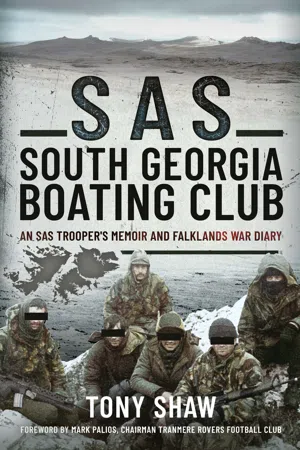
A veteran of the British Army's elite special forces regiment recounts his long career from Selection to the Falklands war, Northern Ireland, and beyond.
Many aspire to serve with the Special Air Service, arguably the world's most prestigious regiment, but few achieve their aim. In this inspiring memoir, Tony Shaw describes how he left school to embark on a thirty-year military career, including four years in 'The Regiment'. Against the odds, he rose through the ranks, eventually retiring as a Major.
Initially attached to 22 SAS as a signaler, Shaw volunteered for the grueling test known as 'Selection'. He was posted to D Squadron Boat Troop with whom he saw active service in the Falklands War, Northern Ireland, and the UK counter-terrorist team.
Shaw's Falklands War diary offers a gripping account of the action he and his colleagues experienced, including recces, diversionary attacks, raids, and ambushes both on South Georgia and the Falklands Islands. Later he commanded the Royal Signals troop supporting D Squadron, 22 SAS, before commissioning and later on pursuing a second career as a security consultant in various Middle Eastern hotspots.
- 256 pages
- English
- ePUB (mobile friendly)
- Available on iOS & Android
eBook - ePub
About this book
Information
Subtopic
Military BiographiesIndex
HistoryChapter 1
My Journey Begins
Falklands War Diary – SAS Diversionary Raid – Diary Entry Monday 14 June 1982
Deciding we could still get away with it, Ted our Troop Boss, told me to radio the three rigid raider boats to come and pick us up. The boats arrived within ten minutes as they had been loitering waiting for our call. Leaving three men from Boat Troop on this ‘safe beach’ we now had three patrols, one of these from the SBS, making a total of eighteen men. Each rigid raider also had its Royal Marine coxswain who all proved to be great guys who you could rely upon in a difficult situation as we were soon to find out. Our mission was to create a diversion at the eastern end of Wireless Ridge in an area known as Cortley Hill. This was at the far end of Wireless Ridge and looked directly on to Stanley Harbour. There were two large, diesel fuel storage tanks there at a distance of about 600m from where we intended to land. If we didn’t encounter enemy forces, we were to blow these tanks to create the diversion. This meant some members of Boat Troop were carrying demolition charges. As always, I was part of callsign 17 Alpha and we were on the Squadron VHF radio net. We started our journey via a circuitous route to avoid the hospital ship. When we were half-way across the bay, Ted gave the signal for our 81mm and 60mm mortars to begin firing. They fell short at first and then exploded harmlessly in the peat above our selected landing point. With 300m to go our MILAN team from 23 Troop, G Squadron, fired a missile to our right at a target that they had identified with their night sights. It was actually an Argie gun position and they scored a direct hit. As we were making our final run in to the beach the remainder of D Squadron opened up with several GPMG machine guns in the sustained fire role. Immediately, several enemy machine guns and anti-aircraft guns firing on a horizontal trajectory returned fire and the sky lit up with tracer, some of it passing directly over our heads. Incredibly we still hadn’t been spotted in the boats and were able to land unopposed a short distance away from the nest of enemy machine guns that were firing away.
We formed up in three patrols with a slight gap between each patrol. I was lead scout and took up point position with Tommy immediately behind me and then Ted, the Boat Troop Boss. I started advancing cautiously up the hill with most of the firing 200m to our right meaning we still hadn’t been seen. I came across a wire, stretched taut at knee-height and beckoned Tommy to come and check it out with me. We agreed it marked the edge of a minefield, probably immediately in front of the Argie defensive positions. We turned right and followed the wire for about 50m, before it made a sharp turn uphill. Again, we followed the wire hoping to make our way around the edge. The wire turned right again and was going directly in front of the enemy machine guns which were still firing sporadically across the bay at the remainder of D Squadron. Ted came up to me and Tommy and suggested we might like to cross over the wire and the rest of Boat Troop would follow in our footsteps through the mined area. Now this was not what I wanted to hear, but if that’s what the Boss wanted, who was I to argue?
I was born in Birkenhead, a large town on the Wirral Peninsula. It lies on the south bank of the River Mersey, opposite Liverpool. Shipbuilding was the main industry in the town. The largest ship ever built at Cammell Laird was the aircraft carrier HMS Ark Royal, launched in 1950. Cammell Laird remained the largest employer in Birkenhead until their closure in 1993. Subsequently, the shipyard reopened as a ship-repairer, until in 2012 the company won an order to build two car ferries.
I was born in a small, terraced house, the youngest of four siblings. My father had contracted TB before my birth. Due to his ongoing poor health, he only worked the occasional day in the summer as a coach driver and our family survived on sickness benefits. Dad was a Roman Catholic while my mum was Church of England. That was quite unusual in those days as sectarianism thrived on Merseyside. My paternal grandfather, Thomas, married Mary, an Irish Romany gypsy, and they moved to Birkenhead in 1910.
I don’t remember having many toys during childhood. I do however recall a photo being taken on my third birthday. The photo shows me with a bus conductor’s hat, a doll and a kitten. The hat was almost certainly left behind by a child on a coach excursion to Blackpool. My father would have been the coach driver and brought the hat home for me. The doll belonged to a girl called Judy who lived next door and was the same age as me.
My father took the decision to send us all to Catholic primary schools, but I was the only one in the family to regularly attend church. From when I was 7, my mother would walk me to the Catholic church every Sunday to attend Mass. She always waited outside the church, never setting foot inside.
I had a Protestant friend, Alan, who lived on our street. When I was 11, Alan suggested we join the local company of the Boys Brigade, which boasted a fine marching band. The Boys Brigade had strong connections with the Orange Lodge, a Protestant fraternity. The company commander welcomed both of us and quickly agreed that we could learn how to play the bugle and wear their uniform. He then gave us joining forms to complete. Alan handed over his form first and the company commander smiled when he saw that Alan attended ‘The Woodlands C of E Primary School’. Then he saw that I had written ‘St Werburgh’s RC Primary School’. He went ballistic, telling Alan to get the fuck out of his sight and take his ‘Fenian’ friend with him!
I did well at primary school and passed my ‘eleven-plus’. I was awarded a scholarship at St Anselm’s College, a Catholic grammar school for boys. This was, and still is, a prestigious school with an outstanding reputation for excellence. Each year, six boys from Birkenhead were awarded one of these scholarships while the remainder of the boys were fee-paying. I looked smart in my new uniform, which my mother had obtained using a council clothing voucher. I found the transition to grammar school very difficult, as most of the boys had attended preparatory school together since the age of 7.
As I was growing up, I thought about supporting Everton or Liverpool. Eventually, having listened to the roar of the fans on a Friday evening, which was when Tranmere played most of their home games in those days, I decided to support the Super White Army. It wasn’t until 1966 that I managed to visit Prenton Park. Tranmere will always be close to my heart and I am proud to be a long-suffering fan.
When I was 12, Alan and I started part-time jobs at the local chippy. The owner, Ralph, was paranoid that the local authority would discover he was employing underage boys. He made a cubby hole for us behind sacks of potatoes and instructed us to hide there if anyone entered the yard. Ralph had been brought up on a plantation in Uruguay. Ralph’s wife was a Jewish refugee who had managed to evade the Nazis and emigrate to Uruguay just before the Second World War. The two met in Montevideo and married, before moving to England. Twenty years later, they bought the fish and chip shop. The work at the chippy was tiring as we peeled and then ‘eyed’ the potatoes, before putting the processed potatoes into a tank of diluted bleaching agent. Our hands were always sore, with cracked skin. We worked in the shed until 10 pm each evening and it was often cold.
Ralph always brought us mugs of tea at 8 pm and stayed to talk about his past life. I looked forward to Ralph’s stories and found them a gateway to another world. Ralph had moved to Montevideo in his mid-20s and found work in the port. He remembered seeing the badly damaged German battleship Admiral Graf Spee tied up alongside at this neutral port in December 1939, the day after a battle with HMS Exeter, Ajax and Achilles. The German captain was informed by the Uruguayan authorities that his stay could not be extended beyond seventy-two hours and the ship was scuttled rather than face the Royal Navy waiting on the high seas.
I joined the Boy Scouts at the age of 12. There wasn’t any money to buy a uniform, but I scrounged second-hand items. I normally walked the three miles home as I seldom had the bus fare. I was walking home one evening when three youths grabbed me. They held me down and demanded money which I didn’t have. I managed to throw a few punches and escaped their clutches, but I still had a black eye to explain to my mum. As always, my dad didn’t show much interest, looking up from his newspaper to suggest that I should find a different route to walk home in the dark!
I started going to ‘The Vikings Youth Club’ in Rock Ferry where I played five-a-side football every Thursday. George Yardley, Tranmere Rover’s centre-forward, gave up his spare time to train us. I was in complete awe of George and when he told me I had played well one evening I couldn’t stop smiling! After playing football, we always went to the clubroom upstairs. I was shy, but eventually started to speak to the teenage girls there. I still had to keep it a secret that I went to a ‘posh’ school, as Rock Ferry was a rundown part of town and it wasn’t wise to be different. As part of my double life, I spent ages perfecting my scouse accent for use at the youth club, but would get the leather strap at school from the Christian Brothers for dropping my aitches! Quite a few of the Brothers had a perversion for corporal punishment and we would hide when one of the ‘mad monks’ was on the warpath!
I was an enthusiastic Tranmere Rovers fan by this time, although could rarely afford the entrance fee. The Rock Ferry boys would climb over the wall at Prenton Park, but we were often caught and ejected from the ground. I did however pay to watch Tranmere beat Coventry City 2–0 in a replay with an attendance of almost 24,000 at Prenton Park during an excellent FA Cup run in the 1967/68 season, finally losing 2–0 to Everton in March 1968 (61,982 was the official attendance figure at Goodison Park). It took until January 2001 before Tranmere beat Everton in the FA Cup. The final score was Everton 0–3 Tranmere, in front of a crowd of 39,207 with Steve Yates scoring two goals and Jason Koumas the other. Victory was sweeter after waiting all those years.
My exam results at St Anselm’s were always poor. I was still going to the youth club and getting to know the girls there. All this left no time for homework. When I was 13, I came bottom of the class. From that day, I resolved to work harder and gradually improved. I had left it too late with my French studies though and the French tutor wrote in my school report that I would never be able to speak a foreign language. How wrong he was! By the end of my time in the SAS I had learnt five languages (German, Greek, Italian, Arabic and Spanish) at colloquial level. I also learnt quite a few phrases in Swahili and Malay, adding to my versatility as an SAS linguist.
I joined the Army Cadet Force (ACF) aged 14 and attended two drill nights a week. The detachment was affiliated to the Cheshire Regiment. We went shooting on the indoor range and I discovered that I was a good shot. I soon confided in the detachment commander that I wanted to make a career in the army and he advised me to improve my school grades. I took his advice, and by the time I left school I had good grades for all subjects, except maths, where I still struggled.
One drill night, a recruiting sergeant visited us. When he discovered I wanted to join the army and attended a grammar school, he tried to persuade me to wait until I was 18 years old with two GCE A-levels before joining as an officer. I wasn’t interested in this proposal and the sergeant eventually conceded that I could join under the junior entrant scheme.
Soon after, I visited the local Army careers office to enlist. After filling in some forms, I was sent to Liverpool for an army medical. Within a few weeks I attended the Army Youth Selection Centre. The test centre was co-located with Army Apprentice College (AAC) Harrogate, a military academy for the Royal Corps of Signals. At the end of the selection test an officer informed me my scores were excellent, with the exception of maths which was borderline for a technical trade. When I told the officer that my preference was either the Cheshire Regiment or the Parachute Regiment, he explained that my scores were too good. We eventually agreed that I would join as a Royal Signals radio technician, but he cautioned that my maths must improve. Choosing to become a radio technician meant I would return to Harrogate in September to begin my apprenticeship.
Before leaving the army cadets, I went to the Cheshire County ACF summer camp at Dering Lines in the town of Brecon in Wales. Nowadays, Dering Lines is home to the Infantry Battle School, but in those days it was a battle school run exclusively by the Parachute Regiment for their own NCO cadres. We had a demonstration one day of all the kit that a paratrooper would carry into battle, including a main and reserve parachute. The para corporal showed us how the main chute would deploy by means of a static line. It was a windy day and immediately the canopy filled with air, before he demonstrated the correct technique for collapsing the chute on the ground. I was transfixed and vowed that one day I would learn how to parachute.
While at summer camp, we had an orienteering exercise. I was wearing canvas shoes, shorts and a T-shirt. I knew nothing about orienteering and set off alone up the nearest mountain on a compass bearing. As I crested the summit, I heard gunfire and spotted a red warning flag. I had inadvertently stumbled into the wrong end of the firing ranges above Cwm Gwdi Camp. I was soon spotted and firing ceased. A Land Rover set off up the track to apprehend me. The range officer, an ACF lieutenant, jumped out of the vehicle screaming at me, ‘You stupid cunt! What the fuck are you doing up here?’ When I explained I was orienteering and my strategy was to go in a straight line he laughed in disbelief and said I would have to stay with them and get a lift back at the end of the day. The firers were all ACF sergeants on a cadre course using Lee-Enfield rifles. They also had some Bren machine guns. After a mug of tea, the lieutenant asked me if I wanted to fire a rifle. I was given a couple of magazines and fired off twenty rounds. I was also allowed to fire sixty rounds in short bursts with the Bren. When we arrived back at Dering Lines, I discovered that I hadn’t even been missed!
On returning from summer camp, I reported to the Army careers office in Birkenhead to formally enlist into the army. I had a pleasant surprise as I was paid a day’s wages together with a travel warrant with instructions to report to Harrogate the following week. Seven days later, I boarded the train to start my new life. At the age of 15, I was now a junior soldier.
At Harrogate railway station, two sergeants in their best uniforms with peaked hats, white belts, red sashes and pace sticks directed us to an army truck. The journey took about twenty minutes and I quickly realized that Harrogate was a lovely place in contrast to my hometown. On arrival we were issued bedding and other essential items. Once we had made our beds, it was time to grab a meal. But we weren’t finished yet as, without exception, we had to have a haircut.
The next day, we were issued uniforms, including two pairs of ammo boots with leather soles and heels. While ammo boots were excellent for foot drill, they were useless for any other purpose. The following day, we were taken on a four-mile run to break in our boots before starting to bull them all over as best boots.
Each day began at 5.30 am and was crammed full of activities. Trade-training started the following Monday. I discovered that a group of six potential radio technicians, including me, were to receive additional maths classes every evening on account of our comparatively poor scores during the selection test.
AAC Harrogate ran a common core trade-training syllabus. This meant in addition to the technical subjects, I was expected to learn touch-typing and Morse code. The radio technicians’ course also included metalwork which was a new skill for me.
Not only was I now following a military training programme and a trade training apprenticeship, we also had to cram education, sport and hobbies into the week. Every Saturday morning started with RSM’s parade, when all 1,500 junior soldiers marched onto the parade ground behind the College Band. We marched to church every Sunday morning in our best uniforms. The first few Sundays I went to the Roman Catholic Mass which took just over an hour, before switching to the Anglican service as this only lasted fifty-five minutes. By doing this, I moved up the NAAFI queue for tea and cake by more than a hundred places. Within months, I no longer considered myself a Roman Catholic and felt equally comfortable in both churches. This was a useful experience when I started to work undercover with the SAS in Northern Ireland.
We were encouraged to take part in various pursuits and I chose gliding. Every Sunday after church we were driven to a nearby RAF airfield. Once there, we had to sweep the entire hangar with yard brooms before our flight in an open-cockpit glider. The take-off began with a gut-wrenching pull from the towing cable and then we were in the...
Table of contents
- Cover
- Title
- Copyright
- Contents
- Foreword
- Acknowledgements
- Prologue: That Special Spark
- Chapter 1 My Journey Begins
- Chapter 2 Hereford – A Culture Shock
- Chapter 3 SAS Selection
- Chapter 4 SAS Trooper
- Chapter 5 South Atlantic Bound
- Chapter 6 South Georgia
- Chapter 7 Falkland Islands before D-Day
- Chapter 8 Falkland Islands from D-Day Onwards
- Chapter 9 SAS Service Continues
- Chapter 10 Commissioned from the Ranks
- Chapter 11 Civilian Life – Bracknell to Baghdad
- Epilogue: A History Lesson
- Glossary
- Plate section
Trusted by 375,005 students
Access to over 1.5 million titles for a fair monthly price.
Study more efficiently using our study tools.
Frequently asked questions
Yes, you can cancel anytime from the Subscription tab in your account settings on the Perlego website. Your subscription will stay active until the end of your current billing period. Learn how to cancel your subscription
No, books cannot be downloaded as external files, such as PDFs, for use outside of Perlego. However, you can download books within the Perlego app for offline reading on mobile or tablet. Learn how to download books offline
Perlego offers two plans: Essential and Complete
- Essential is ideal for learners and professionals who enjoy exploring a wide range of subjects. Access the Essential Library with 800,000+ trusted titles and best-sellers across business, personal growth, and the humanities. Includes unlimited reading time and Standard Read Aloud voice.
- Complete: Perfect for advanced learners and researchers needing full, unrestricted access. Unlock 1.5M+ books across hundreds of subjects, including academic and specialized titles. The Complete Plan also includes advanced features like Premium Read Aloud and Research Assistant.
We are an online textbook subscription service, where you can get access to an entire online library for less than the price of a single book per month. With over 1.5 million books across 990+ topics, we’ve got you covered! Learn about our mission
Look out for the read-aloud symbol on your next book to see if you can listen to it. The read-aloud tool reads text aloud for you, highlighting the text as it is being read. You can pause it, speed it up and slow it down. Learn more about Read Aloud
Yes! You can use the Perlego app on both iOS and Android devices to read anytime, anywhere — even offline. Perfect for commutes or when you’re on the go.
Please note we cannot support devices running on iOS 13 and Android 7 or earlier. Learn more about using the app
Please note we cannot support devices running on iOS 13 and Android 7 or earlier. Learn more about using the app
Yes, you can access SAS South Georgia Boating Club by Tony Shaw in PDF and/or ePUB format, as well as other popular books in History & Military Biographies. We have over 1.5 million books available in our catalogue for you to explore.