An in-depth study of the rivalry between two of Rome's greatest military commanders—and the battle where they met in combat.
In 49 BC the Roman Republic collapsed once more into civil war, with opposing sides led by Pompey the Great and Julius Caesar. These former allies had built their own factions within the Roman oligarchy and now refused to compromise. Yet their violent struggle for control of the Republic lasted eighteen months before these two men met in combat at The Battle of Dyrrhachium.
Gareth Sampson outlines the strategic background of the battle, describing the early campaigns of the civil war. The battle itself is analyzed in depth, shedding light on the strengths and weakness of both armies and their commanders. Sampson also looks at the tactics used at various phases of the battle, which culminated in victory for Pompey. He then examines the battle's aftermath, with Caesar defeated and Pompey in the ascendancy.
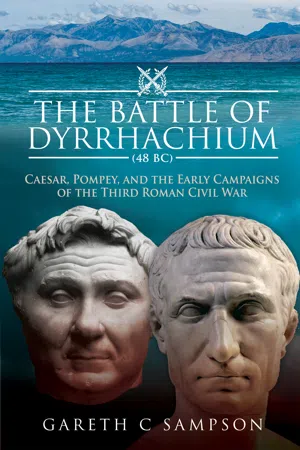
eBook - ePub
The Battle of Dyrrhachium, 48 BC
Caesar, Pompey, and the Early Campaigns of the Third Roman Civil War
- 224 pages
- English
- ePUB (mobile friendly)
- Available on iOS & Android
eBook - ePub
The Battle of Dyrrhachium, 48 BC
Caesar, Pompey, and the Early Campaigns of the Third Roman Civil War
About this book
Information
Subtopic
Military & Maritime HistoryIndex
HistorySection II
The Battle for the Western Republic: The Early Campaigns of Third Civil War (49 BC)
Chapter Two
The Italian Campaign – The Phoney War (49 BC)
Caesar’s invasion of Italy proper, with the crossing of the Rubicon has become one of the most famous acts of the ancient world, along with his supposed utterance of alea jacta est (let the die be cast).1 This, along with the fact that his subsequent career is so well known, makes it problematic to examine this act dispassionately. Yet this is just what we must attempt if we are to understand this crucial first year of the war.
Aims and Tactics – Caesar
Ultimately, we must ask ourselves what were Caesar’s aims in this invasion of Italy?2 Here we can see the problem of having a primary source written by the main protagonist. Caesar wrote his account after his victory and to subsequently justify his actions. It does not give us an insight into his thinking. Having been declared an ‘enemy of the state’, Caesar clearly had little option but to turn to the military or face complete ruin, and possibly death at the hands of his political enemies. He would have been struck by the parallels of recent history, with his (at the time) more famous uncle both being declared an enemy of the state and being undone by the swift use of military force (by his former protege L. Cornelius Sulla).
Nevertheless, having taken the military option, there is still the question of how he was going to use his forces, and again recent history had provided two clear possibilities. On the one hand there were the examples of Sulla and Marius in 88 and 87 BC respectively, both of whom used their armies to storm Rome, accompanied by increasing bloodshed. On the other hand there were the examples of Caesar’s two former colleagues, Pompeius and Crassus, who in 71 BC, camped their armies under the walls of Rome and intimidated the Senate into granting their political demands.
It must be noted that in each of the previous occasions however, the general had access to far greater forces than Caesar had at his disposal. Nevertheless, Caesar was faced with two options; all out civil war or negotiated settlement. In truth Caesar had probably intended to keep his options open, with a negotiated settlement, which removed his ‘enemy’ status and restored his political position as his preferred option, backed up by a willingness to go to an all-out civil war if it proved necessary.3
Key to this strategy was the need to reach Rome before Pompeius could mobilise his forces and thus secure the levers of power, in particular the Assemblies and have the SCU overturned, and his commands restored by popular legislation. To those ends he soon met up with the two exiled Tribunes (Antonius and Cassius) who would be crucial in passing such legislation. Thus the key to Caesar’s strategy was speed, hence the use of a small number of troops (‘three hundred horsemen and five thousand legionaries’4). If he reached Rome quickly then it would hardly likely to be defended and would fall without a fight.
The second key factor in Caesar’s strategy was to ensure that he could remove any obstacles in his pathway, most notably the scattering of forces that lay between him and Rome, primarily those of his replacement in the Gallic command, L. Domitius Ahenobarbus. The obvious unknown factor in this whole plan however was his opponent, Cn. Pompeius ‘Magnus’; would he fight or negotiate? Though Caesar had worked both for (in 60–59 BC) and with Pompeius (56–55 BC), the two men had never been close. Having been politically outmanoeuvred by Pompeius, Caesar must have hoped that his invasion of Italy and threat to Rome itself would bring Pompeius to the negotiating table. Nevertheless, if the worse was to happen and Pompeius would not negotiate, then Caesar’s clear final objective would have been to seize Pompeius himself. Caesar would have been all too aware of the example set in 88 BC (during the First Civil War) when Sulla seized military control of Rome but allowed his opponent, Marius (Caesar’s uncle) to escape and rally support, thus transforming a coup into a long civil war. Thus, as well as seizing Rome, Caesar needed to seize Pompeius himself, if he were to stop this attempted coup turning into another full-scale civil war.
Aims and Tactics – Pompeius
We find ourselves in an even worse position when it comes to using the sources to ascertain Pompeius’ tactics in this situation. Not only do we not have an equivalent account written by the man himself, but all the histories we do have, have been written in hindsight, with the ultimate result of this conflict known and therefore seemingly predestined. Nevertheless, we need to put aside all thoughts of a predetermined outcome and try to view the situation as it was at the time and using what we know about Pompeius’ history and tactical acumen.
Having totally outmanoeuvred Caesar politically, he would have known that there were only two outcomes; Caesar capitulating or Caesar following the now well-trodden path of using his military to restore his position. Having employed Caesar as his agent (in 60–59 BC) and then acknowledging him as an ally (56 BC), Pompeius would have been well aware of which route Caesar would likely have taken. Yet Pompeius now found himself a victim of his own success. Having successfully forced Caesar into adopting the role of ‘enemy of the state’, a man who would attack his own city, and thus underline his own role, as the ‘saviour of the Republic’, he now actually had to stop Caesar.
In theory, Pompeius had more forces in Italy than Caesar’s invasion force but there were two key problems, both of which Pompeius understood all too well. We know Pompeius was given command of the two legions in Italy, which were destined for reinforcing the eastern provinces against Parthian attack.5 Yet these were in southern Italy and not between Rome and Caesar. Furthermore, these legions had been transferred from Caesar’s command and so it could be argued that there may have been a suspicion as to their loyalty at the time, though they later proved their worth to Pompeius in Greece. Additional forces were being raised (as detailed below) which soon again outnumbered the Caesarian forces but even if veterans were being recruited these were freshly levied legions and no match for battle-hardened veterans, even if they wanted to get involved in a civil war campaign (which as events showed many did not).
Furthermore, although it fits the adventurous image of Caesar invading Italy with just one legion, he had in fact already ordered two others from Transalpine Gaul to cross the Alps and rendezvous with him in northern Italy. Another three legions were left in Narbonensis (Southern) Gaul, to protect Caesar’s flanks from any advance from Spain of Pompeius’ legions.
Thus, whilst the key to Caesar’s strategy was speed, the opposite was true for Pompeius; he needed to slow Caesar down and buy himself time to mobilise his forces, to defend the Republic. As Dio points out, Pompeius had access to quality intelligence on Caesar’s military aims in this campaign, from one of his own senior legates, T. Labienus, who defected from Caesar when the latter invaded Italy.6
Pompeius, perceiving this, became afraid, especially when he learned all his rival’s intentions from Labienus; for this officer had abandoned Caesar and deserted to the other side, and he announced all Caesar’s secrets to Pompeius.7
Thus, Pompeius could be left in no doubt as to Caesar’s aims and his tactics. Armed with this knowledge, in theory Pompeius had two options, to fight or negotiate. Throughout his political career he had always opted for the latter, whether dealing with Sulla, the Senate or Crassus. Yet those tactics belonged to the earlier phase of his career. In the meantime he had consolidated his position as the most powerful man in the Republic, exemplified by his sole Consulship in 52 BC. In his own mind, Pompeius now had no equals, with both his old mentor (Sulla) and old partner (Crassus) dead. Caesar’s invasion of Italy had given him the crowning crisis of his career: saving Rome from another Sulla, the irony of which could not have been lost on him.
To cement his position as ‘Princeps’ of the Republic he needed this crisis and he needed to ensure that it did not end in a shabby negotiation, but in a career-defining victory. Pompeius would have clearly realised that there would have been many in the Senate hoping to settle this matter by negotiation, to avoid the horrors of the First Civil War, yet for him to succeed there could be no successful negotiation, though he certainly needed to be seen to be ‘making an effort’.
Therefore, rather than defuse the situation, he needed it to escalate and become a full-blown civil war. Thus, we have the paradox that the aggressor was probably hoping for a negotiated settlement, but the defender aiming for a full-scale civil war. In military terms Pompeius would have readily realised that Caesar had the short-term military advantage, with his forces closer to Rome and that Rome had never successfully been defended, especially in a civil war (his own father being involved in the siege of 87 BC). That left only two strategies: delay Caesar long enough to mobilise his forces in Spain, or draw Caesar further on, by surrendering Rome. Furthermore if the Senate could be persuaded to flee Rome, rather than stay and negotiate, it would only enhance Caesar’s disgrace and his own elevation.
Thus, Pompeius seems to have entered into a cynical calculation. Certainly losing control of Rome, and the Electoral and Legislative Assemblies was a clear risk and would allow Caesar to overturn his official ‘enemy’ status and become the ‘official’ voice of Rome. Yet as Pompeius himself had seen first-hand, Rome changed hands frequently in the 80s BC during the First Civil War; what mattered was victory in the war, not the battle. Sulla had turned from Consul to enemy and back again several times before he was ultimately elected as Dictator and ‘saviour’ of Rome. With Caesar dead in battle, Pompeius could then re-enter Rome as the hero and Princeps of the Republic. This would no doubt be followed by a programme of propaganda, including the writing of histories, blackening Caesar as the renegade who betrayed his country, much as happened with Catilina, no doubt eagerly supported (in public at least) by Cicero.
Thus Pompeius prepared a two-stage strategy, slow Caesar down, but ultimately evacuate Rome and Italy if necessary, to ensure a wider victory in the war which must now inevitably follow. Most interestingly, we have corroboration of this theory from Cicero. Whereas his early letters had Pompeius abandoning Rome and then Italy for fear of Caesar’s’ armies, he later confessed that it was part of a wider, and preconceived, Pompeian ‘masterplan’:
Nor, indeed, did he [Pompeius] abandon the city because he was unable to protect it, nor Italy because he was driven from it; but his idea from the first was to stir up every land and sea, to rouse foreign princes, to bring barbarous tribes in arms into Italy, to collect the most formidable armies possible. For some time past a kind of royalty like Sulla’s has been the object in view, and this is the eager desire of many who are with him. Do you suppose that some understanding between the two, some bargain has been impossible? Today it is still possible. But the object of neither is our happiness: both want to be kings.8
This ‘disgraceful’ measure our friend Cnaeus [Pompeius] had contemplated two years ago.9
This is a point that Syme himself found convincing:
Furthermore, the whole strategy of Pompeius, distasteful if not inexplicable to many of his allies and associates, was simple and masterly. Caesar would be entrapped in Italy or entangled in a guerrilla war in Spain, while Pompeius returned to victory with all the armies and fleets of the eastern lands. Pompeius should have won.10
The Campaign in Italy (49 BC) – Caesar’s Advance and the Failure of Negotiations
Having briefly covered both protagonist’s objectives, we can now turn to the conflict itself. Caesar himself provides a commentary on the progression of his campaign (see Map 2). Having crossed the Rubicon, with one legion (the Thirteenth), Caesar made for the Roman colony of Ariminum (modern Rimini) on the Adriatic coast. The city fell without a fight and Caesar made it his temporary headquarters, which is where the two Tribunes (M. Antonius and Q. Cassius Longinus) met him. From there he issued orders to the rest of his army in Gaul, to cross the border and join him.
It was here that two emissaries of the Senate reached him, one a Praetor named L. Roscius Fabatus, the other a kinsman named L. Iulius Caesar, and a man whose father was one of Caesar’s legates.11 Though sent on the Senate’s orders, ...
Table of contents
- Cover
- Title
- Copyright
- Contents
- Acknowledgements
- List of Illustrations
- Maps & Diagrams
- Introduction: The Defeat that Never Was
- Timeline: Pre-Third Civil War (70–49 BC)
- Timeline: The Early Years of the Third Roman Civil War (49 BC)
- Timeline: The Early Years of the Third Roman Civil War (48 BC)
- Section I: Rome, Blood & Politics: The Background to the Third Civil War
- Section II: The Battle for the Western Republic: The Early Campaigns of Third Civil War (49 BC)
- Section III: The Dyrrhachium Campaign (48 BC)
- Appendix I: Who’s Who in the Third Roman Civil War (49–48 BC)
- Appendix II: How Many Civil Wars?
- Notes
- Bibliography
- Plates
Trusted by 375,005 students
Access to over 1.5 million titles for a fair monthly price.
Study more efficiently using our study tools.
Frequently asked questions
Yes, you can cancel anytime from the Subscription tab in your account settings on the Perlego website. Your subscription will stay active until the end of your current billing period. Learn how to cancel your subscription
No, books cannot be downloaded as external files, such as PDFs, for use outside of Perlego. However, you can download books within the Perlego app for offline reading on mobile or tablet. Learn how to download books offline
Perlego offers two plans: Essential and Complete
- Essential is ideal for learners and professionals who enjoy exploring a wide range of subjects. Access the Essential Library with 800,000+ trusted titles and best-sellers across business, personal growth, and the humanities. Includes unlimited reading time and Standard Read Aloud voice.
- Complete: Perfect for advanced learners and researchers needing full, unrestricted access. Unlock 1.5M+ books across hundreds of subjects, including academic and specialized titles. The Complete Plan also includes advanced features like Premium Read Aloud and Research Assistant.
We are an online textbook subscription service, where you can get access to an entire online library for less than the price of a single book per month. With over 1.5 million books across 990+ topics, we’ve got you covered! Learn about our mission
Look out for the read-aloud symbol on your next book to see if you can listen to it. The read-aloud tool reads text aloud for you, highlighting the text as it is being read. You can pause it, speed it up and slow it down. Learn more about Read Aloud
Yes! You can use the Perlego app on both iOS and Android devices to read anytime, anywhere — even offline. Perfect for commutes or when you’re on the go.
Please note we cannot support devices running on iOS 13 and Android 7 or earlier. Learn more about using the app
Please note we cannot support devices running on iOS 13 and Android 7 or earlier. Learn more about using the app
Yes, you can access The Battle of Dyrrhachium, 48 BC by Gareth C Sampson,Gareth C. Sampson in PDF and/or ePUB format, as well as other popular books in History & Military & Maritime History. We have over 1.5 million books available in our catalogue for you to explore.