Structured with a practical approach, Engineering Capstone Design guides engineering students to successfully manage capstone design projects. The book addresses the challenge of open-ended design projects, often in a team-based format, discussing team member roles, communication, and cooperation. It incorporates accreditation requirements and provides a modern framework for working with industry, reinforced by the inclusion of case studies.
Offers a structured process for capstone design, responsive to ABET accreditation requirements
Explains how to manage design projects under critical timelines and budgets
Covers essential topics and steps in a capstone design sequence, including defining, conceiving, presenting, prototyping, building, testing, and redesigning
Considers industry perspectives, as well as design competitions
Includes case studies for a look into industry experience
In addition to guiding engineering students conducting capstone design projects, this book will also interest industry professionals who are engaged in product development or design problem-solving.
This book is for students, mentors, sponsors, and professors engaged in engineering capstone design. It is not meant for a specific discipline of engineering but rather a comprehensive approach to capstone design.
Many different disciplines use the word design to describe some methods of problem- solving in that particular area. If you look at the dictionary definition of design, as a verb, we see definitions such as to devise, contrive, to have as a purpose, to devise for a specific function or end, to make a drawing, pattern, or sketch of, and to draw the plans for. Design as a noun has dictionary listings such as a mental project or scheme in which means to an end are laid down, a preliminary sketch or outline showing the main features of something to be executed, the arrangement of elements or details in a product or work of art, and the creative art of executing aesthetic or functional designs. None of these definitions fully captures the practice and the meaning of design in engineering.
Engineering design, sometimes known as the engineering method, is a formal, rigorous, and systematic process to optimize a problem. Problems are often expressed as a desire to solve a situation that has not been solved before or improvements on something that already exists, whether it’s a process, a device, or a concept. Consequently, by the very nature of this statement of problems, they are incomplete and ill-defined. The engineering design process starts with defining and understanding the problem and what is to be achieved.
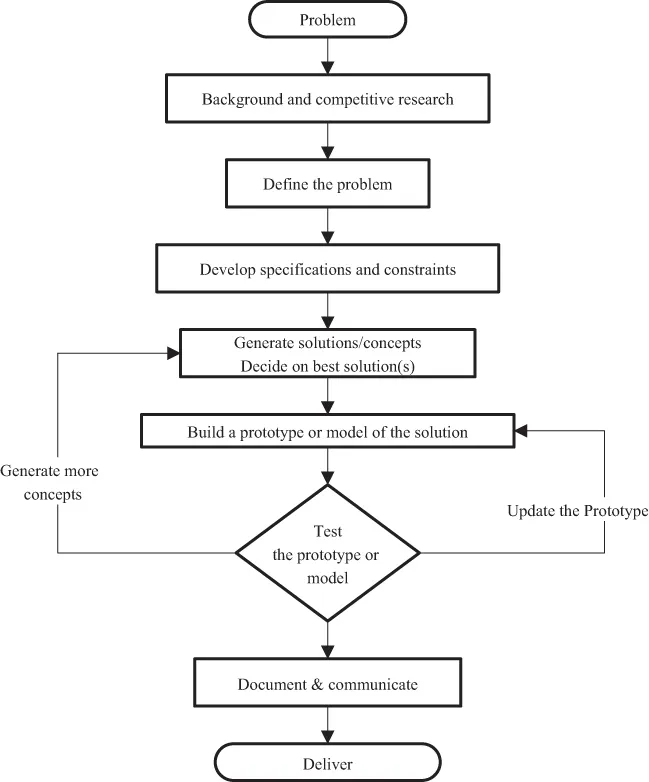
Figure 1.1 shows the process diagram for the engineering method (also known as engineering design).
FIGURE1.1 The engineering method.
Once a problem has been presented, then it is necessary to do better understand the problem. Additional information about the problem area and related topics can be gathered through an online search of the literature, related patents, and competitor information. The problem-solving engineer is responsible for developing the design specifications and any constraints that might be appropriate. Solutions are then generated in the form of concepts that satisfy the design specifications and the constraints. The concept may be a device or a process. If the solution is a device, then it may be possible to prototype it. If the concept is a process, it can be modeled perhaps in a software model. The prototype or the model can be tested against the design specifications, constraints, and any additional considerations such as ethical and environmental. The test results are then used to assess the fitness of the solution concept to the problem. Iterations on the concept, prototype, and model are used to improve, optimize, or streamline the solution. Once a satisfactory solution is achieved, it is documented, communicated, and delivered to the sponsor of the problem or project. The engineering design method is unique to engineering, and it distinguishes the work of engineers from all other forms of professionals, including scientists and mathematicians. We demonstrate this difference by comparing the engineering method to the scientific method.
Science is an essential constituent of engineering. Sometimes engineering is confused with applied science. Sciences rely on the scientific method as their fundamental tool for discovery and advancement. Scientists develop hypotheses based on observations of natural phenomena. A hypothesis is posed to describe or encapsulate the observation based on fundamental questions (formulated by the scientist) about their observations. Figure 1.2 shows the flowchart for the scientific method.
FIGURE1.2 The scientific method.
Scientists formulate experiments to test their hypotheses. The experiments may answer their questions directly and confirm their hypothesis, or it may reveal additional considerations or issues that may emerge from the results. They also attempt to apply their theory or hypothesis to other situations and observations similar to their original observations. Often, experiments result in a need to modify the hypothesis or constrain it to be more directly applicable. If the iteration results on hypothesis, prediction, and testing converge after a sufficient number of iterations, the theory or hypothesis may be proven to be true, false, or somewhat true.
Scientific discovery relies on peer review. Suppose peers can repeat the same experiments and design their experiments to validate the hypothesis further. In that case, the proven hypothesis becomes more widely accepted, and eventually, engineers use it to design systems and devices based on those scientific discoveries and proven principles.
1.2 Engineering Design Process
The engineering method described in the previous section is the foundation of an engineering design process. Additional considerations come into play for an engineering design activity, such as cost and schedules as explicit components that must be included in an industry or professional setting. Often cost and delivery times become the major decision-making factors for the industry design projects.
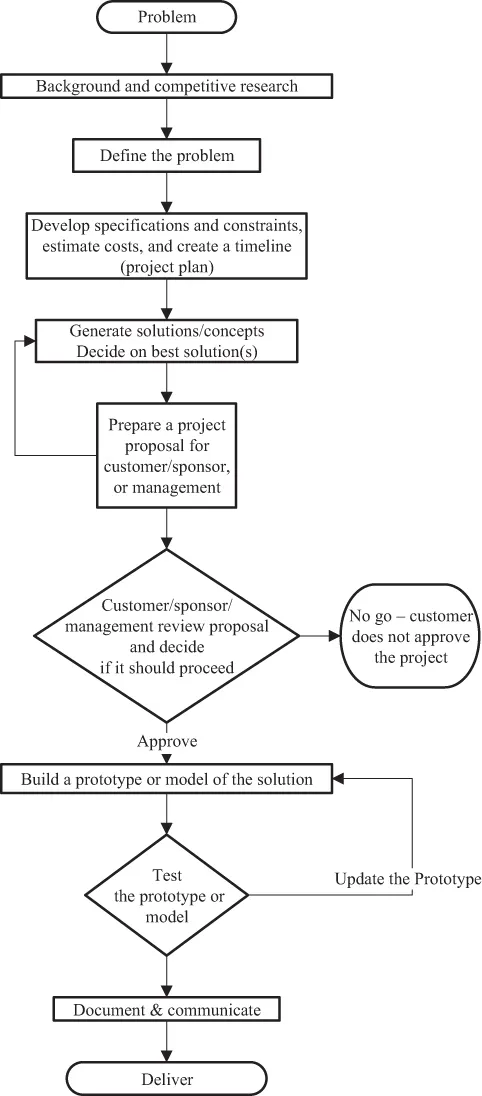
Some concepts will take longer, or they may cost more, resulting in shelving or eliminating those ideas. It is imperative in the engineering design process to estimate costs and timelines as accurately as possible. The process often includes a proposal, resulting in a legal contract between the design engineers and the customers or sponsors. The contractual requirements, pricing, and schedules may constrain the design engineers to take more conservative approaches to be sure to deliver on time and within budget. The design problem and approach to solving it become heavily influenced by the cost and schedule factors.
We can update our flowchart to include this important element of the real-world engineering design into our problem-solving process.
Figure 1.3 shows the engineering design process flowchart. In this process, all efforts and costs associated with developing the design project proposal are burdened by the engineering design group. Those costs are then recovered in the form of an overhead or indirect cost on the project for each proposal that does receive funding support.
FIGURE1.3 The engineering design process.
The cost and schedule considerations are part of the responsibility of every engineer on the team, their methodology for engineering problem-solving based on their experience, knowledge, and skills. Engineers who are successful in preparing winning project proposals and successfully completing the work they proposed will thrive. Those who fail in this process will work under the direction of others. The project proposal preparation, accurate costing, and meeting project timeline are prerequisites to having the opportunity to do excellent technical work on the design. These same elements apply to engineering capstone design, which we will cover later in this chapter.
Because of the central importance of design in engineering practice, it has been required by Accreditation Board for Engineering and Technology (ABET) as part of the curricula in engineering.
1.3 Design and Engineering Accreditation
Engineering accreditation in the United States started with the Engineer’s Council for Professional Development (EPCD) as a professional organization “dedicated to the education, accreditation, regulation, and professional development of engineering professionals and students.” EPCD was renamed the Accreditation Board for Engineering and Technology in 1980. Starting in 2005, ABET was incorporated as Accreditation Board for Engineering and Technology, Inc. and used only the acronym ABET. This change to just ABET was in part in response to the significant increase in international interest, outside of the United States, to adopt ABET philosophy and accreditation requirements in engineering programs [https://www.abet.org/about-abet/history/].
After many years of work, deliberations, and engineering community input, ABET adopted a revolutionary set of changes to its accreditation requirements and process in 1997, named Criteria 2000 (EC2000). The big change was in the focus of accreditation on what the engineering students learned rather than the previous focus on what was taught in the program. EC2000 required that engineering programs establish published education objectives, student learning outcomes, and assessment processes to ensure that the engineering program curriculum provides the technical and professional skills that employers need and demand. Also, the engineering program must demonstrate that the faculty are measuring and assessing student learning outcomes. EC2000 empowered engineering programs to take responsibility for their curriculum and engineering education of their students an...
Table of contents
Cover
Half Title
Title Page
Copyright Page
Table of Contents
Preface
Author
Part I Define, Conceive, Prove, Document
Part II Build, Test, Redesign, Repeat, Document
Bibliography
Index
Trusted by 375,005 students
Access to over 1.5 million titles for a fair monthly price.
Study more efficiently using our study tools.
Frequently asked questions
Yes, you can cancel anytime from the Subscription tab in your account settings on the Perlego website. Your subscription will stay active until the end of your current billing period. Learn how to cancel your subscription
No, books cannot be downloaded as external files, such as PDFs, for use outside of Perlego. However, you can download books within the Perlego app for offline reading on mobile or tablet. Learn how to download books offline
Perlego offers two plans: Essential and Complete
Essential is ideal for learners and professionals who enjoy exploring a wide range of subjects. Access the Essential Library with 800,000+ trusted titles and best-sellers across business, personal growth, and the humanities. Includes unlimited reading time and Standard Read Aloud voice.
Complete: Perfect for advanced learners and researchers needing full, unrestricted access. Unlock 1.5M+ books across hundreds of subjects, including academic and specialized titles. The Complete Plan also includes advanced features like Premium Read Aloud and Research Assistant.
Both plans are available with monthly, semester, or annual billing cycles.
We are an online textbook subscription service, where you can get access to an entire online library for less than the price of a single book per month. With over 1.5 million books across 990+ topics, we’ve got you covered! Learn about our mission
Look out for the read-aloud symbol on your next book to see if you can listen to it. The read-aloud tool reads text aloud for you, highlighting the text as it is being read. You can pause it, speed it up and slow it down. Learn more about Read Aloud
Yes! You can use the Perlego app on both iOS and Android devices to read anytime, anywhere — even offline. Perfect for commutes or when you’re on the go. Please note we cannot support devices running on iOS 13 and Android 7 or earlier. Learn more about using the app
Yes, you can access Engineering Capstone Design by Bahram Nassersharif in PDF and/or ePUB format, as well as other popular books in Technology & Engineering & Product Design. We have over 1.5 million books available in our catalogue for you to explore.